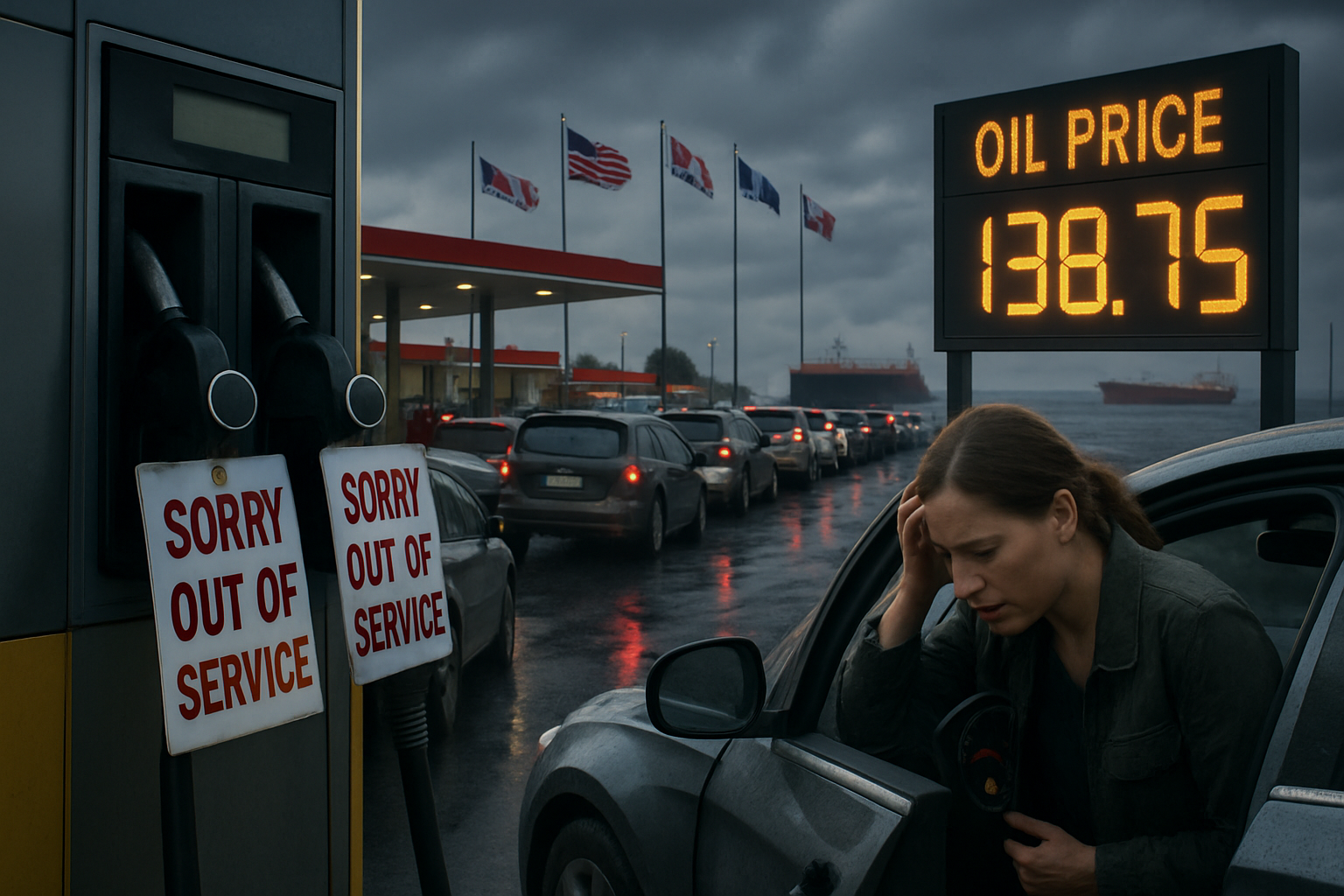
The world is experiencing its most severe energy crisis since the 1970s oil shocks, with fuel prices reaching historic peaks and governments implementing emergency measures from Australia to Europe as a temporary ceasefire offers the first glimpse of potential relief.
Following six weeks of unprecedented global fuel shortages and soaring energy costs, a breakthrough two-week ceasefire mediated by Pakistan has created cautious optimism for market stabilization. However, the crisis has exposed fundamental vulnerabilities in global energy architecture that experts warn will require years to address.
The Scale of the Global Crisis
The crisis, triggered by Iran's Revolutionary Guard declaring the Strait of Hormuz "unsafe for shipping," effectively blocked 40% of global seaborne oil transit through the critical 21-mile chokepoint. Oil prices breached $100 per barrel for the first time since 2022, with Brent crude peaking at $119.50 and WTI reaching a record single-day jump of 18.98% to $108.15.
The International Energy Agency (IEA) deployed its largest strategic petroleum reserve release in 50-year history, releasing 400 million barrels from 32 countries—more than double the 182.7 million barrels released during the 2022 Ukraine crisis. Japan led with 80 million barrels, marking its first strategic release since the 2011 Fukushima disaster.
"This represents the most severe energy security crisis in decades, exposing our dangerous over-dependence on single-point chokepoints,"
— Samuel Ciszuk, Energy Analyst
Government Emergency Responses Worldwide
Governments across the globe have implemented unprecedented emergency measures, abandoning free-market principles to protect consumers from crushing fuel costs.
European Interventions
Ireland implemented a €235 million relief package, cutting diesel excise by 20 cents and petrol by 15 cents. Hungary imposed immediate price caps against "war-driven explosions" in fuel costs. France deployed 500 fuel inspectors to prevent price manipulation, while Romania outlined five emergency scenarios to prevent diesel exceeding 10 lei per liter. Germany strengthened antitrust laws targeting gas station price manipulation—representing significant market intervention in modern German energy policy.
Asia-Pacific Responses
The Philippines' President Marcos declared a year-long "national energy emergency," activating the UPLIFT program as diesel approached 100 pesos per liter and nationwide jeepney strikes erupted. New Zealand's Prime Minister Luxon considered "Muldoon-era" emergency measures including car-free days and petrol limits—interventions not seen since the 1970s crisis. Singapore implemented 30% logistics cost increases while coordinating regional Southeast Asian responses.
Critical Shortages in the Pacific
Papua New Guinea witnessed devastating impacts on public transport, with PMV (Public Motor Vehicle) operators in Madang reporting fuel costs doubling overnight. One operator's receipt showed K600 spent in a single day, demonstrating the sharp rise in operational costs. Similar patterns emerged in Markham, where PMV owners struggled with unprecedented fuel price increases affecting bus and taxi fares across the region.
In Australia, hundreds of service stations ran empty across New South Wales, Queensland, Victoria, and South Australia. Queensland stations in remote townships like Texas and Robinvale completely depleted their supplies, with petrol prices surging past $2.50 per liter and approaching the $3 threshold in some regions.
Transport and Aviation Crisis
The crisis paralyzed global transportation networks. Over 18,000 flights were cancelled worldwide—the most extensive disruption since COVID-19. Eight countries simultaneously closed their airspace, creating an "aviation black hole" severing critical Europe-Asia corridors. Dubai International Airport, the world's busiest with 86 million passengers annually, shut down due to missile damage.
Jet fuel costs soared 122%, from $85-90 to $150-200 per barrel, forcing airlines to implement emergency surcharges. Air New Zealand cut over 1,000 flights affecting 44,000 passengers, while European carriers including Emirates, Air France-KLM, and Wizz Air suspended operations indefinitely.
Wellington's Metlink faced major diesel spikes, with the Greater Wellington Regional Council calling on the government for fare discounts to encourage public transport use as alternative to private vehicle travel.
Consumer Impact: Rationing and Record Prices
The human cost of the crisis became evident through widespread fuel rationing and record-breaking prices. Bangladesh implemented comprehensive fuel rationing for 170 million people, representing 95% oil import dependence. Pakistan introduced wartime austerity measures with four-day government work weeks, fuel prices reaching Rs321.17 per liter—the highest in South Asia.
In the Caribbean, Jamaica saw fuel prices increase 15-20% since December, with E10-87 gasoline jumping from $148.87 to $172.38, while kerosene prices increased 19.6%. The government faced mounting pressure to review special consumption tax policies.
European consumers faced heating oil approaching €2 per liter in Ireland, prompting government criticism of "brazen rip-offs." Sweden experienced electricity increases of 10-20 öre with gasoline up 1-2 kronor per liter, with the Malmö region most exposed due to continental integration. Bosnia-Herzegovina was reduced to two-day gas reserves.
Supply Chain Collapse and Infrastructure Damage
The crisis exposed the fragility of global supply chains dependent on the Persian Gulf. Maersk and MSC suspended operations, stranding over 150 oil and LNG tankers worth billions in cargo value. Qatar's LNG production at Ras Laffan and Mesaid facilities—representing approximately 20% of global exports—suffered extensive damage from Iranian missile attacks.
Qatar's Energy Minister Saad Al Kaabi warned that Gulf states might declare force majeure "within weeks," with oil potentially reaching $150 per barrel, threatening to "bring down economies of the world."
Manufacturing sectors dependent on Gulf networks experienced severe disruptions across automotive, electronics, and textiles industries. China suspended refined fuel exports, while Singapore reported 30% increases in logistics costs.
Financial Market Devastation
Financial markets experienced unprecedented crashes. Pakistan's KSE-100 index fell 8.97%—the largest single-day decline in its history. South Korea's KOSPI dropped 12%, triggering circuit breakers as the Korean won fell to a 17-year low. PayPal postponed its $1.1 billion IPO indefinitely due to market volatility.
Central banks, including the ECB and Bank of Japan, coordinated emergency liquidity measures, though traditional monetary policy proved limited in effectiveness against structural geopolitical disruptions.
The Ceasefire and Market Response
The April 8 ceasefire announcement brought immediate market relief. France's Defense Minister Sébastien Lecornu expected fuel price decreases "by end of weekend or early next week" following oil prices retreating below $100 per barrel and European gas declining 20% post-ceasefire.
However, consumer skepticism remained high. In Sweden, residents questioned whether price drops were genuine, with one Eskilstuna resident noting, "There's still old diesel in the tanks, it's just a damn game." Malaysia's diesel remained at RM6.72 per liter, reflecting five weeks of pre-ceasefire high costs, with the Finance Ministry confirming pricing lags.
Africa's Vulnerability Exposed
African nations faced particularly acute challenges. Ethiopia's Ethio-Djibouti Railway deployed special gondola wagons to address capacity gaps exacerbated by fuel shortages. Most African countries maintain only 15-25 days of fuel reserves compared to the IEA standard of 90 days, highlighting dangerous vulnerabilities.
The crisis demonstrated how quickly regional conflicts could devastate import-dependent economies, with experts warning of the need for enhanced strategic reserve policies and supply diversification.
Nuclear Diplomacy and Geopolitical Context
The crisis stemmed from the complete breakdown of US-Iran nuclear talks despite earlier Geneva breakthrough agreements—the most progress since the 2018 JCPOA collapse. The subsequent military escalation, dubbed "Operation Epic Fury," represented the largest coordinated operation since 2003, triggering Iranian retaliation through "True Promise 4" operations.
With the New START treaty having expired on February 5—marking the first time in 50+ years without US-Russia nuclear constraints—and Iran's uranium enrichment reaching 60% purity with over 400kg of weapons-grade material, nuclear governance experts warned of the "highest nuclear risks in decades."
"This represents the greatest test of multilateral cooperation and crisis management in the modern era,"
— UN Secretary-General António Guterres
Energy Architecture Transformation Required
The crisis exposed fundamental vulnerabilities in global energy architecture. The 21-mile Strait of Hormuz proved to be a dangerous single-point failure in modern logistics, with no realistic alternatives capable of handling diverted volume. Alternative Arabian Peninsula routes offer inadequate capacity with significant time and cost penalties.
Energy experts emphasize that strategic petroleum reserves provide only temporary relief for sustained disruptions. Qatar Energy Minister Al Kaabi's force majeure warnings underscore the need for fundamental restructuring to reduce dependence on volatile geopolitical regions.
Looking Forward: Template-Setting Implications
March and April 2026 represent a watershed moment for international energy security. The crisis tests whether diplomatic solutions can prevail over military confrontation in addressing 21st-century conflicts. Success in containing the escalation could provide a framework for future nuclear crisis resolution, while failure might accelerate military solutions, encourage nuclear proliferation globally, and undermine diplomatic credibility worldwide.
Energy architecture transformation requiring supply diversification and renewable transitions typically takes years or decades to implement, but the urgency has been dramatically accelerated. The crisis demonstrates that over-dependence on strategic chokepoints in volatile regions requires immediate attention from policymakers worldwide.
As the temporary ceasefire offers breathing space, governments face the challenge of addressing both immediate consumer relief and long-term energy security planning. The template-setting nature of this crisis will influence international approaches to territorial disputes, nuclear governance, and energy market resilience for decades to come.
While oil prices have retreated and markets show signs of stabilization, experts warn that the underlying vulnerabilities exposed during this crisis demand fundamental transformation of global energy systems. The two-week diplomatic window provides critical time to address not only temporary relief measures but also the structural changes necessary to prevent future energy security catastrophes of this magnitude.