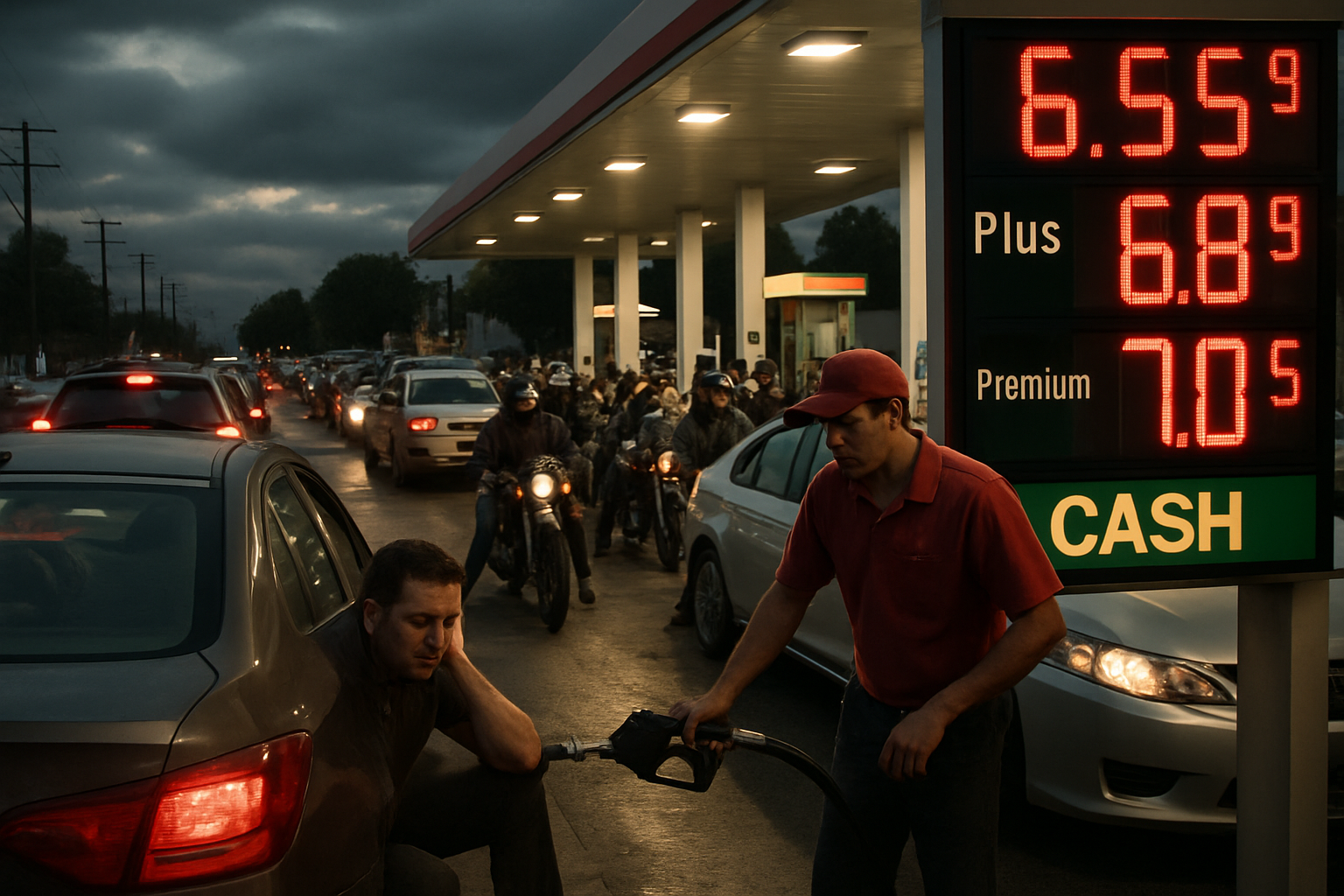
A devastating global fuel crisis is intensifying as Middle East conflicts trigger unprecedented price increases worldwide, with Jamaica experiencing $4.50 gasoline hikes, New Zealand preparing for prolonged Iran conflict impacts, and Panama implementing significant fuel price adjustments that will affect millions of consumers across the Caribbean and Central America.
Jamaica Faces Immediate Price Shock
Jamaican motorists are confronting immediate financial pressure as fuel prices jumped by $4.50 across all grades, according to the latest ex-refinery costs from Petrojam. The increases, effective March 19, push 90-octane gasoline to $170.83 per liter and 87-octane to $163.38 per liter, representing some of the steepest single-day increases in recent memory.
The price surge extends beyond gasoline, with automotive diesel rising to $175.75 per liter and ultra-low sulfur diesel reaching $182.59 per liter—both up $4.50. Kerosene prices have climbed to $165.15 per liter, while propane and butane liquid petroleum have increased by $3.06 each, reaching $77.05 and $86.27 per liter respectively.
Marketing companies and retailers will add their respective mark-ups to these ex-refinery prices, meaning consumers will face even higher costs at gas stations across the island. The increases come at a particularly challenging time for Jamaica's economy, where transportation costs directly impact food prices and essential services.
New Zealand Braces for Extended Crisis
In New Zealand, the government is preparing for what Prime Minister Christopher Luxon describes as a "prolonged Iran conflict" that could have lasting impacts on the country's fuel security. Usage of the Gaspy fuel price tracking app has tripled as drivers begin forming queues at service stations, creating scenes reminiscent of the early days of the COVID-19 pandemic.
The escalating strikes in Iran have prompted New Zealand authorities to develop comprehensive contingency plans, with officials warning that the current crisis could persist far longer than initially anticipated. The government is considering emergency measures not seen since the 1970s oil crisis, including potential fuel rationing and modified work schedules to reduce transportation demands.
Speaking at a joint press conference with Finance Minister Nicola Willis, Luxon emphasized that the government is preparing for a "worst-case scenario" as the Iran conflict continues to disrupt global energy markets. The administration is exploring all available options to maintain fuel security, including potential releases from strategic petroleum reserves and enhanced coordination with international partners.
Panama Implements Regional Price Adjustments
Panama has announced significant fuel price increases starting March 20, 2026, with the new rates remaining in effect until April 3. The National Energy Secretariat confirmed that 95-octane gasoline will increase by 20 cents per liter, 91-octane by 18 cents, and diesel by a substantial 30 cents per liter.
The regional price variations reflect Panama's complex distribution network:
- Panama and Colon: 95-octane at $1.144, 91-octane at $1.065, diesel at $1.210
- Arraiján and La Chorrera: 95-octane at $1.147, 91-octane at $1.067, diesel at $1.213
- Penonomé, Aguadulce and Divisa: 95-octane at $1.152, 91-octane at $1.073, diesel at $1.218
- Las Tablas: Higher rates reflecting increased distribution costs in remote areas
These increases will significantly impact Panama's logistics sector, which serves as a crucial hub for Central American commerce and the global shipping industry.
The Iran Crisis: Root Cause of Global Disruption
The current fuel crisis stems from the most severe energy disruption since the 1970s oil shocks, triggered by Iran's Revolutionary Guard declaring the Strait of Hormuz "unsafe for shipping." This critical 21-mile waterway handles 40% of global seaborne oil transit, making its closure a single-point failure for the world's energy infrastructure.
The crisis began with the complete collapse of US-Iran nuclear negotiations despite achieving "broad agreement on guiding principles"—the most progress since the 2018 JCPOA breakdown. The diplomatic failure led to Operation Epic Fury, the largest coordinated US-Israeli military operation since 2003, triggering Iran's massive retaliation known as Operation True Promise 4.
Oil prices have breached $100 per barrel for the first time since 2022, with Brent crude peaking at $119.50 and West Texas Intermediate recording an unprecedented 18.98% single-day jump to $108.15. Natural gas prices have exploded 24% in Europe and 78% in the United States, reaching €47.32/MWh—the highest levels since February 2025.
International Emergency Response
The International Energy Agency has announced the largest strategic petroleum reserve release in its 50-year history—400 million barrels from 32 member countries, more than double the 182.7 million barrels released during the 2022 Ukraine crisis. Japan is releasing 80 million barrels starting March 16, the first such deployment since the 2011 Fukushima disaster, reflecting the country's 95% dependence on Middle Eastern oil, with 70% transiting through the now-blocked Strait of Hormuz.
Germany has confirmed participation in the coordinated response, with the United States expected to contribute the largest share. Energy Secretary Christopher Wright is even considering lifting additional sanctions on Russian oil to help stabilize global supplies, with "hundreds of millions of barrels of sanctioned oil" potentially available for market stabilization.

Aviation Industry Under Severe Strain
The crisis has created unprecedented disruption in global aviation, with over 18,000 flights cancelled worldwide—the most extensive disruption since COVID-19. Eight countries have simultaneously closed their airspace: Iran, Iraq, Israel, UAE, Qatar, Syria, Kuwait, and Bahrain. Dubai International Airport, the world's busiest with 86 million passengers annually, remains completely shut down due to missile damage.
Major carriers including Emirates, Air France-KLM, Wizz Air, and Bulgaria Air have suspended operations indefinitely, affecting hundreds of thousands of passengers globally. Jet fuel costs have soared from $85-90 per barrel to $150-200—an increase of up to 122%—forcing airlines worldwide to implement emergency fare increases and route modifications.
Supply Chain Collapse and Economic Impact
The crisis extends far beyond fuel, creating a cascading effect throughout global supply chains. Major shipping companies Maersk and MSC have suspended operations in the Persian Gulf, leaving more than 150 oil and LNG tankers stranded, representing billions of dollars in cargo value.
Qatar, which supplies approximately 20% of global LNG exports, has halted production at its Ras Laffan and Mesaid facilities following Iranian drone attacks. Qatar Energy Minister Saad Al Kaabi has warned that Gulf states may be forced to declare force majeure "within weeks," with oil prices potentially approaching $150 per barrel, which could "bring down the economies of the world."
Financial markets have crashed globally, with Pakistan's KSE-100 experiencing its largest single-day decline in history at -8.97%, while South Korea's KOSPI fell 12%, triggering circuit breakers and sending the Korean won to a 17-year low. The crisis has forced PayPal to postpone its $1.1 billion IPO indefinitely due to market volatility.
Consumer Impact Spreads Globally
The effects are being felt by consumers worldwide. In Sweden, electricity prices are expected to increase by 10-20 öre, with gasoline rising by 1-2 kronor, particularly affecting the Malmö region due to its continental European market integration. Ireland faces heating oil prices approaching €2 per liter, prompting officials to condemn what they call "brazen rip-offs."
Bangladesh has implemented fuel rationing affecting 170 million people, while Pakistan—facing the highest fuel prices in South Asia at Rs321.17 per liter—has instituted wartime austerity measures including four-day government work weeks. Bosnia-Herzegovina reports having only two days of gas reserves remaining, highlighting the urgency of the crisis.
Government Emergency Measures
Nations worldwide are implementing unprecedented emergency measures. Hungary has imposed immediate price caps on gasoline and diesel to combat what it calls "war-driven price explosions." France has deployed 500 fuel station inspectors to prevent price manipulation, while Romania has developed five comprehensive scenarios to prevent diesel from exceeding 10 lei per liter, including temporary tax and excise reductions.
Slovakia has activated its strategic petroleum reserves for the first time under current protocols, joining a growing list of countries tapping emergency supplies. The coordinated nature of these responses reflects the global recognition that traditional market mechanisms are insufficient to address a crisis of this magnitude.
Nuclear Dimensions and Regional Instability
The current crisis occurs against a backdrop of unprecedented nuclear governance challenges. The New START treaty expired on February 5, marking the first time in over 50 years that the United States and Russia operate without nuclear arms control constraints. Iran continues uranium enrichment at 60% purity, approaching weapons-grade levels, with over 400 kilograms of material sufficient for multiple nuclear weapons.
The regional coalition of Saudi Arabia, UAE, Qatar, and Egypt—unprecedented in its diplomatic consensus supporting negotiations—has been severely strained by Iranian attacks on member territories. The UAE suffered one civilian death in Abu Dhabi, Kuwait's airport was struck injuring 32 people, and Qatar intercepted 65 missiles and 12 drones using Patriot systems, with 8 people wounded despite successful interceptions.
Long-term Energy Architecture Transformation
The crisis has exposed dangerous vulnerabilities in global energy architecture, particularly the over-dependence on strategic chokepoints like the Strait of Hormuz. The 21-mile waterway represents a single-point failure for modern logistics, with no realistic alternatives capable of handling the volume of oil transit.
Energy experts emphasize that while strategic petroleum reserves provide temporary relief, the fundamental issue requires years or decades of supply diversification and renewable energy transitions. However, the urgency of the current crisis is accelerating discussions about energy independence and security planning.
"This is the most severe energy security crisis in decades, and it has exposed our single-chokepoint vulnerabilities in a way that demands immediate attention and long-term planning."
— Samuel Ciszuk, Energy Analyst
Recovery Timeline Remains Uncertain
Unlike weather-related or technical disruptions, the recovery timeline for this crisis depends entirely on military operations resolution and diplomatic normalization. Aviation industries cannot maintain long-term scheduling with closed airspace, while energy markets remain volatile with critical transit routes blocked.
Traditional monetary policy tools are showing limited effectiveness against these structural geopolitical disruptions, forcing central banks like the European Central Bank and Bank of Japan to coordinate emergency liquidity provisions to prevent broader financial contagion.
UN Secretary-General António Guterres has described the situation as representing "the greatest test of multilateral cooperation in crisis management in the modern era," with nuclear risks at their "highest level in decades."
Template-Setting Crisis for the 21st Century
March 2026 represents a watershed moment in global energy security, establishing new paradigms for crisis management in an increasingly multipolar world. The success or failure of international cooperation during this crisis will influence diplomatic approaches to conflict resolution for decades to come.
The crisis affects multiple domains simultaneously: regional war prevention, global energy security, nuclear governance credibility, and international law enforcement under post-World War II order principles. Success in containing the escalation could provide a framework for future nuclear crisis resolution while strengthening diplomatic precedents.
Failure, however, could accelerate military solutions that reshape Middle Eastern geopolitics for decades, encourage nuclear proliferation globally, and undermine diplomatic credibility worldwide, affecting how the international community approaches conflict resolution throughout the 21st century.
As fuel prices continue climbing in Jamaica, New Zealand, Panama, and dozens of other nations, the world confronts a crisis that demands both immediate relief measures and fundamental transformation of energy security planning to reduce dependence on volatile geopolitical regions and strategic chokepoints.
The outcome of this crisis will determine whether the international community can successfully manage complex, interconnected challenges through multilateral cooperation, or whether the world is entering an era where military solutions increasingly replace diplomatic ones in addressing global security threats.