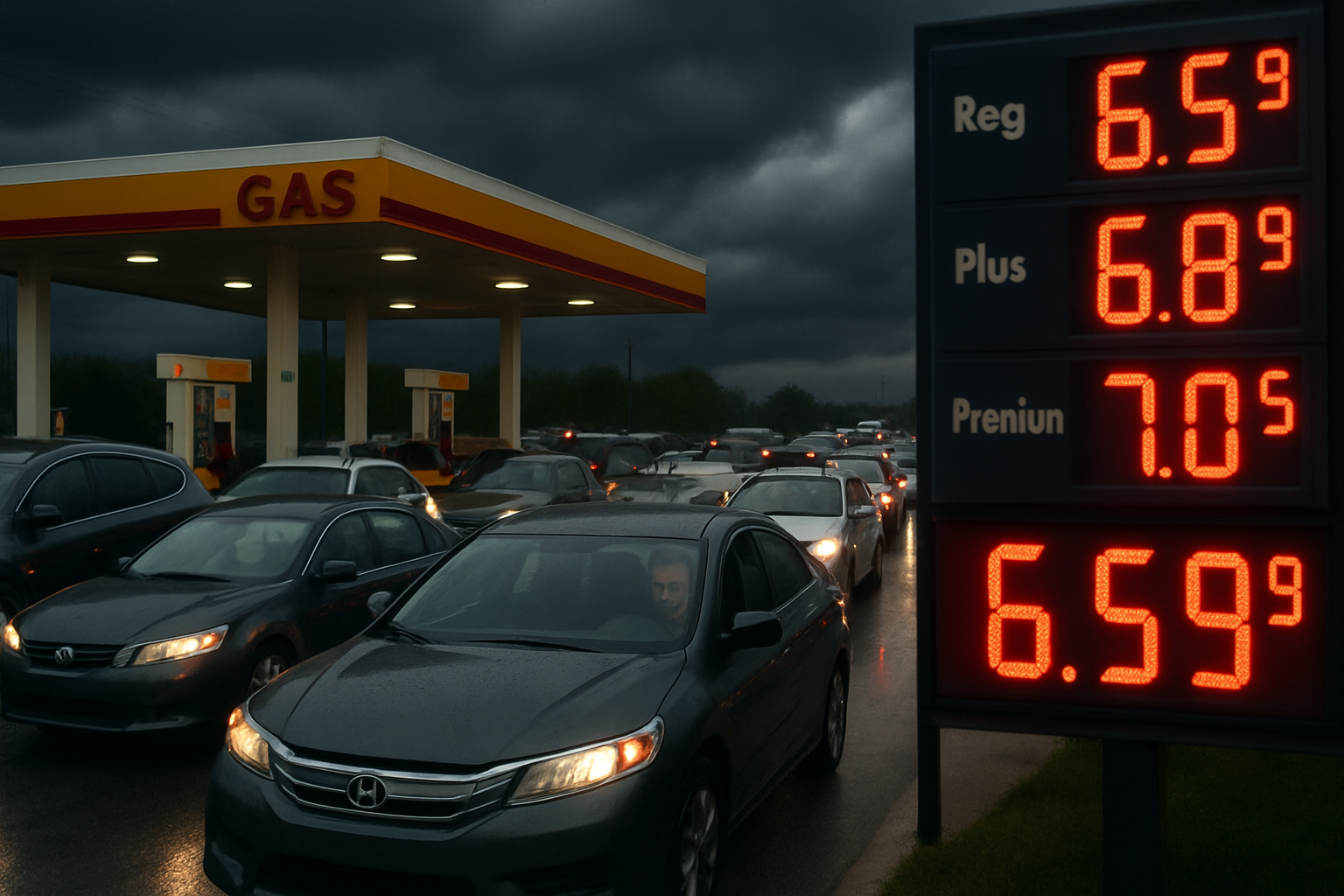
The global energy crisis triggered by the Middle East conflict has entered its second month with devastating consequences spreading across all continents. Oil prices have surged past $100 per barrel for the first time since 2022, while fuel shortages and consumer protests intensify from Ireland to Madagascar as governments scramble to implement emergency relief measures.
The crisis stems from Iran's Revolutionary Guard declaring the strategic Strait of Hormuz "unsafe for shipping," effectively blocking 40% of global seaborne oil transit through the critical 21-mile chokepoint. This unprecedented supply disruption has created the most severe energy crisis since the 1970s oil shocks, forcing the International Energy Agency to deploy the largest strategic petroleum reserve release in its 50-year history.
Europe Bears Brunt of Crisis
European consumers are experiencing the most acute impacts, with Austria's energy economists proposing a targeted intervention that could save businesses and consumers half a billion euros in electricity costs. The strategy involves market intervention at the CO2 certificate level, representing a significant departure from traditional free-market approaches.
In Ireland, fuel protests have paralyzed major cities including Dublin, Cork, Galway, and Limerick as transport operators report catastrophic increases in operating costs. Maelisa McGettigan of McGettigan Travel described the situation as "absolute madness," with bus fuel costs rising from €120-130 to nearly €190 per fill-up, adding €2,000-3,000 weekly to business expenses.
The situation is similarly dire across Europe, with France preparing a comprehensive energy relief package and Germany implementing unprecedented market interventions to prevent fuel price manipulation. Romania has outlined five emergency scenarios to prevent diesel prices from exceeding critical thresholds.
Africa Declares Energy Emergencies
The crisis has prompted extraordinary government responses across Africa, with Madagascar declaring a nationwide 15-day energy emergency—the first such declaration in the nation's modern history. The Malagasy cabinet cited "deep crisis due to disruptions in energy supply across the island, linked to the conflict in the Middle East."
"This decision was taken following the observation that the country is facing a deep crisis due to disruptions in energy supply across the island, linked to the conflict in the Middle East."
— Madagascar Government Cabinet Statement
Several African governments have responded to surging global oil prices by implementing sharp fuel price increases, energy-saving measures, or electricity rationing. Local media reported widespread fuel shortages across Madagascar on Tuesday, illustrating the global reach of a crisis that began in the Persian Gulf.
Asia-Pacific Governments Mobilize Emergency Responses
Canadian Prime Minister Mark Carney's government is actively exploring support measures for consumers as gas prices surge due to the Iran conflict. Officials are looking at ways to "cushion the blow" for Canadian families facing unprecedented fuel costs.
New Zealand faces particular vulnerability given its geographic isolation and heavy reliance on imported fuel. Charities report increasing demand for food assistance, including requests from working families where both parents are employed—a stark indicator of the crisis's impact on middle-class households.
The situation has prompted calls for the government to reconsider fuel subsidy programs that were previously scaled back as economic recovery appeared to be taking hold.
Transportation Industry in Crisis
The transportation sector faces unprecedented challenges as fuel costs reach unsustainable levels. In Romania, aviation fuel prices have doubled since the conflict began on February 28, when the United States and Israel launched military strikes against Iran. Airlines across Europe are warning that higher tariffs, fuel surcharges, and capacity reductions are becoming the "new normal."
Norwegian diesel has become more expensive than gasoline for the first time in recent memory, forcing a complete reversal of traditional fuel market dynamics. This shift reflects the broader disruption to global energy markets that extends far beyond simple supply and demand fundamentals.
Strategic Petroleum Reserves Deployed
In response to the crisis, the International Energy Agency announced the largest strategic petroleum reserve release in its 50-year history—400 million barrels from 32 countries, more than double the response to the 2022 Ukraine crisis. Japan is contributing 80 million barrels, marking the first deployment since the 2011 Fukushima disaster.
Despite these unprecedented measures, energy experts warn that strategic reserves represent only a temporary buffer against sustained supply disruptions. The 21-mile Strait of Hormuz represents a critical single-point failure in modern logistics, with no realistic alternatives for the massive volume of oil and gas that normally transits the waterway.

Financial Markets in Turmoil
Global financial markets have experienced their worst disruptions in years, with Pakistan's KSE-100 index suffering its largest single-day decline in history—a staggering 8.97% drop. South Korea's KOSPI index fell 12%, triggering circuit breakers as the Korean won hit a 17-year low against major currencies.
The aviation industry has been particularly hard hit, with over 18,000 flights cancelled worldwide since the crisis began—the most extensive disruption since COVID-19. Eight countries have simultaneously closed their airspace, creating what analysts describe as an "aviation black hole" across critical Europe-Asia corridors.
Diplomatic Breakdown and Nuclear Concerns
The crisis originated from the complete breakdown of US-Iran nuclear negotiations, despite what had been described as "broad agreement on guiding principles"—the most progress since the 2018 JCPOA collapse. Iran's insistence on excluding ballistic missiles and proxy groups from negotiations clashed with comprehensive U.S. demands covering missiles, armed groups, and human rights issues.
Adding to global concerns, the New START nuclear treaty between the United States and Russia expired in February 2026, marking the first time in over 50 years without US-Russia nuclear constraints. Iran continues uranium enrichment at 60% purity, with over 400kg of weapons-grade material—sufficient for multiple nuclear weapons.
Template-Setting Crisis for the 21st Century
UN Secretary-General António Guterres has characterized the current situation as "the greatest test of multilateral cooperation in the modern era," with nuclear risks at their "highest in decades." Energy security expert Samuel Ciszuk describes it as "the most severe energy security crisis in decades, exposing single-chokepoint vulnerabilities."
"This is the most severe energy security crisis in decades, exposing dangerous single-chokepoint vulnerabilities in our global energy architecture."
— Samuel Ciszuk, Energy Security Analyst
The crisis has forced governments worldwide to abandon traditional free-market principles in favor of direct intervention, including price caps, strategic reserve releases, and emergency subsidy programs. These measures represent the most significant government intervention in energy markets since the 1970s.
Long-Term Implications for Global Energy Security
The current crisis has exposed fundamental vulnerabilities in global energy architecture that require years or decades to address. Over-dependence on strategic chokepoints in volatile geopolitical regions demands urgent restructuring of supply chains and acceleration of renewable energy transitions.
Recovery timeline remains uncertain, as unlike weather-related disruptions, resolution depends on military operations and diplomatic normalization rather than predictable natural patterns. The crisis serves as a template-setting moment for 21st-century international crisis management, with implications extending far beyond current events.
As the situation continues to evolve, governments worldwide face the challenge of protecting their citizens from energy poverty while managing the broader economic consequences of a crisis that demonstrates the dangerous fragility of modern interconnected systems.