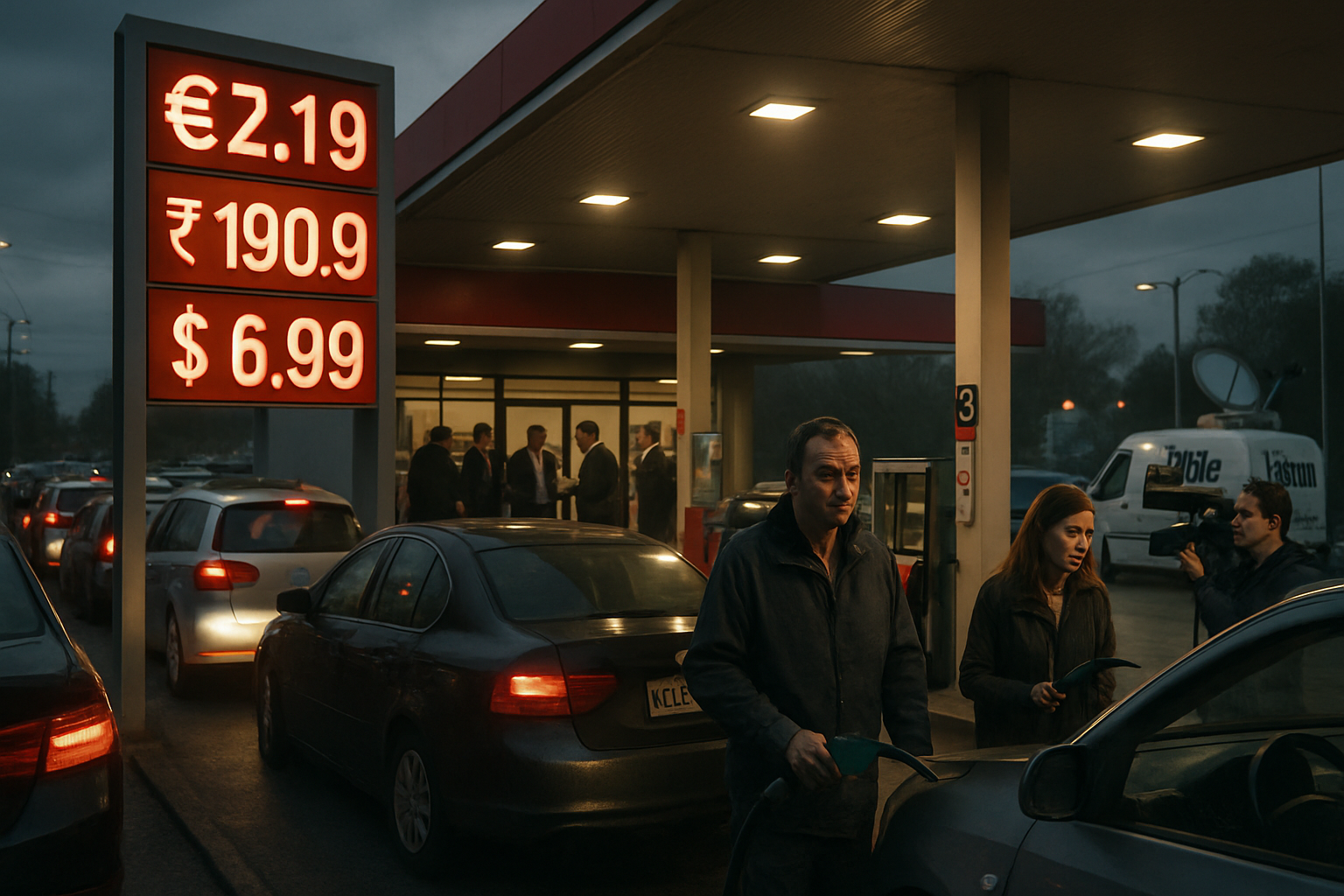
The global energy crisis has intensified into its second month, forcing governments across Europe, Asia, and Africa to implement emergency measures as fuel costs reach historic highs and threaten economic stability worldwide.
The ongoing crisis, triggered by Iran's closure of the Strait of Hormuz—a critical waterway handling 40% of global oil transit—has pushed oil prices beyond $100 per barrel for the first time since 2022, with Brent crude peaking at $119.50 and WTI reaching a record single-day jump of 18.98% to $108.15.
Latvia Introduces "Windfall Profit" Tax on Fuel Retailers
Latvia has emerged as a leader in innovative crisis response with its announcement of a "windfall profit" tax targeting fuel retailers. Economics Minister Viktors Valainis told Latvian Television that this levy will incentivize retailers to reduce prices as quickly as possible, marking one of Europe's most direct interventions in fuel pricing mechanisms.
The measure represents a shift from traditional market-based approaches to more aggressive government intervention, reflecting the severity of the current crisis. Latvia's strategy aims to capture excess profits that retailers may be earning during the emergency while encouraging rapid price reductions for consumers.
Pakistan Implements Digital Fuel Subsidy System
In Karachi, Chief Minister Syed Murad Ali Shah launched an innovative online verification system allowing citizens to register their motorcycles for a targeted fuel subsidy of Rs2,000 per month. The digital platform at taxportal.excise.gos.pk requires users to enter their computerized national identity card details and bank account information for automated confirmation.
This technological approach to fuel rationing represents a new model for crisis management, allowing governments to provide targeted relief while monitoring consumption patterns. The system aims to prevent subsidy leakage while ensuring support reaches those most in need.
"We are implementing a fair and transparent system to help our citizens cope with these unprecedented fuel costs while maintaining fiscal responsibility."
— Syed Murad Ali Shah, Chief Minister of Sindh
Romania Implements Immediate Diesel Excise Tax Cuts
Romania has implemented one of Europe's most immediate responses with a reduction in diesel excise taxes that took effect overnight, resulting in price drops of 36 cents per liter at most filling stations. The decision came following high-level discussions convened by President Nicușor Dan, including the Prime Minister and Energy and Transport Ministers, along with leadership from Romania's two major petroleum companies.
The overnight price adjustment demonstrates the speed with which governments are now responding to fuel cost pressures, abandoning longer deliberation processes in favor of rapid relief measures.
Global Supply Chain Crisis Continues
The underlying cause of the crisis remains Iran's Revolutionary Guard declaration that the Strait of Hormuz is "unsafe for shipping," effectively blocking the 21-mile chokepoint through which 40% of the world's seaborne oil transits. This has stranded over 150 oil and LNG tankers worth billions in cargo value, with major shipping companies Maersk and MSC suspending all Persian Gulf operations.
The International Energy Agency has responded with its largest strategic petroleum reserve release in 50-year history—400 million barrels from 32 countries, more than double the 182.7 million barrels released during the 2022 Ukraine crisis. Japan is contributing 80 million barrels, marking its first reserve deployment since the 2011 Fukushima disaster.
Consumer Impact Reaches Critical Levels
The crisis has created severe hardship for consumers worldwide. In Bangladesh, fuel rationing affects 170 million people, while Pakistan has implemented wartime austerity measures including four-day government work weeks as fuel reaches Rs321.17 per liter—the highest in South Asia.
European consumers face equally challenging conditions. Swedish drivers are paying an additional 10-20 öre for electricity and 1-2 kronor more for gasoline, with the Malmö region most exposed due to continental market integration. Ireland has seen heating oil approach €2 per liter, prompting government officials to denounce what they call "brazen rip-offs."
Aviation Industry Faces Unprecedented Challenges
The transportation sector has been particularly hard hit, with over 18,000 flights cancelled globally—the most extensive disruption since the COVID-19 pandemic. Jet fuel costs have surged from $85-90 to $150-200 per barrel, representing a 122% increase that has forced airlines to implement emergency fare surcharges.
Dubai International Airport, the world's busiest with 86 million passengers annually, remains completely shut down due to missile damage, while eight countries maintain simultaneous airspace closures across the Middle East region.
Financial Markets Show Severe Strain
Global financial markets continue to experience significant volatility. Pakistan's KSE-100 index suffered its largest single-day decline in history at -8.97%, while South Korea's KOSPI fell 12% with circuit breakers triggered as the Korean won hit a 17-year low.
Central banks including the European Central Bank and Bank of Japan are coordinating emergency liquidity measures to prevent broader financial contagion, though traditional monetary policy tools show limited effectiveness against such structural geopolitical disruptions.
Government Responses Vary by Region
The crisis has prompted unprecedented government intervention across multiple continents:
- Hungary has implemented immediate price caps on gasoline and diesel to combat "war-driven price explosions"
- France deployed 500 fuel station inspectors to prevent price manipulation
- Slovakia activated strategic petroleum reserves for the first time under current protocols
- Australia is investigating fuel price gouging as prices approach the critical $3 per liter threshold
- New Zealand is considering "Muldoon-era" emergency measures including car-free days and petrol purchase limits
Energy Security Architecture Under Review
The crisis has exposed fundamental vulnerabilities in global energy architecture, with experts calling for urgent transformation of energy security planning. The 21-mile Strait of Hormuz represents a dangerous single-point failure in modern logistics with no realistic alternatives to handle the diverted volume.
Energy analyst Samuel Ciszuk describes this as "the most severe energy security crisis in decades, exposing single-chokepoint vulnerabilities that had been assumed away." Qatar's Energy Minister Saad Al Kaabi has warned that Gulf states may declare force majeure "within weeks" if oil approaches $150 per barrel, which could "bring down the economies of the world."
"This crisis represents the greatest test of multilateral cooperation in crisis management in the modern era."
— UN Secretary-General António Guterres
Long-term Transformation Required
While strategic petroleum reserves provide temporary relief, experts emphasize that fundamental restructuring of energy supply chains is needed to reduce dependence on volatile geopolitical regions. The transition to renewable energy and supply diversification requires years or decades of implementation, but the urgency has been dramatically accelerated by current events.
The crisis stems from the complete breakdown of US-Iran nuclear negotiations despite what had been the most significant progress since the 2018 JCPOA collapse. The resulting military confrontation has created a template-setting moment for 21st-century crisis management with implications extending far beyond energy markets.
Recovery Timeline Remains Uncertain
Unlike weather-related disruptions that follow predictable patterns, recovery from this crisis depends entirely on military and diplomatic resolution of the underlying Middle East conflict. Aviation cannot schedule flights through closed airspace, and energy markets remain volatile while critical transit routes are blocked.
This represents what experts consider the most dangerous international crisis since the end of the Cold War, affecting regional war prevention, global energy security, nuclear governance credibility, and international law enforcement simultaneously.
The events of April 2026 are establishing new paradigms for energy security planning and international crisis management that will influence global stability mechanisms for decades beyond the current emergency. As governments continue deploying unprecedented intervention measures, the world watches to see whether diplomatic or military solutions will ultimately determine the framework for future international cooperation in an increasingly volatile world.