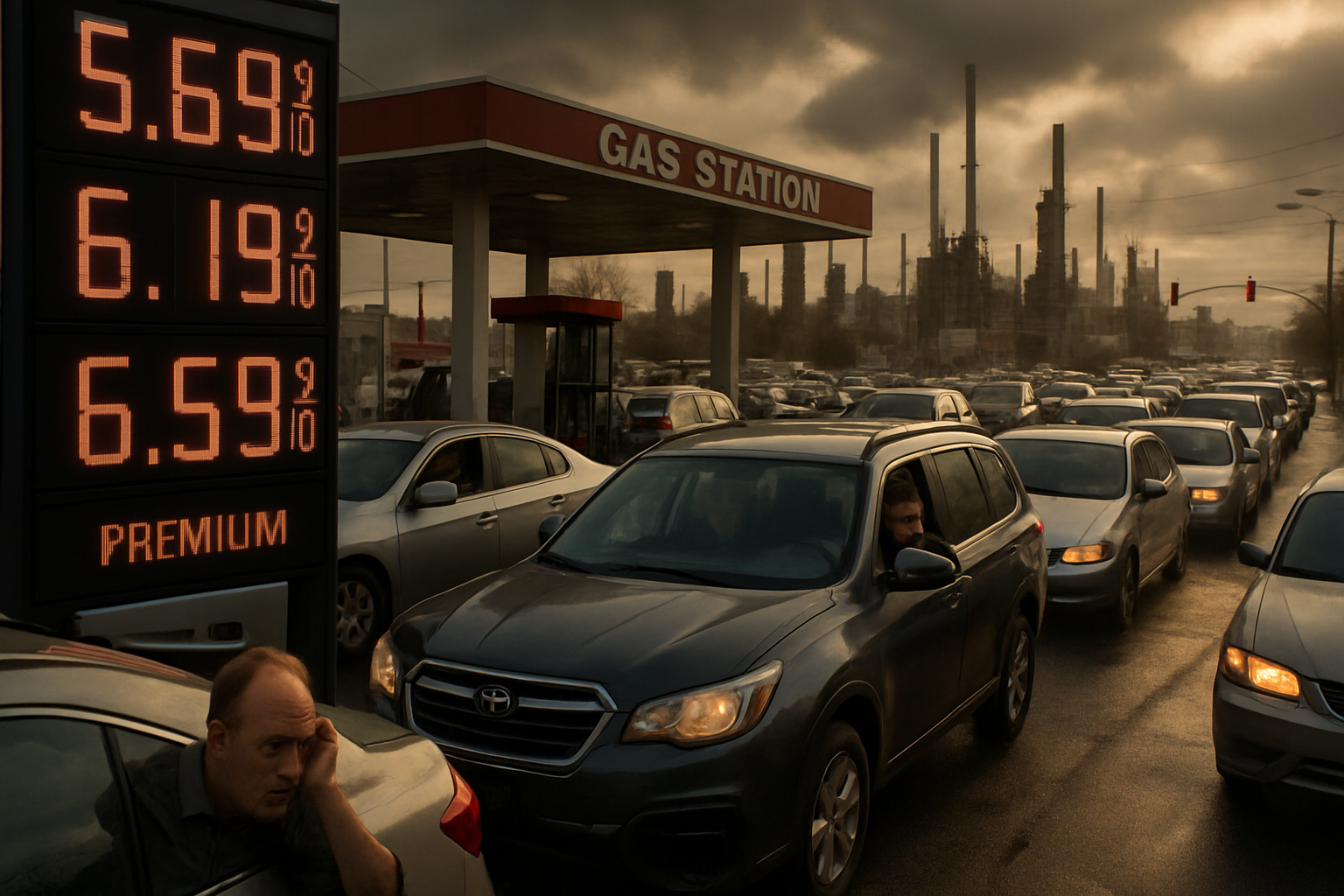
Countries across six continents are implementing emergency fuel relief measures as the global energy crisis, triggered by Iran's closure of the Strait of Hormuz in March, continues to drive fuel prices to unprecedented levels worldwide.
The ongoing crisis, which began with the collapse of US-Iran nuclear negotiations and subsequent military operations, has created the most severe global fuel shortage since the 1970s oil shocks. With oil prices having breached $100 per barrel for the first time since 2022 and reaching peaks of $119.50 for Brent crude, governments are scrambling to protect consumers from devastating cost increases.
Government Emergency Interventions Accelerate
In one of the most significant moves to date, Cyprus has announced plans to reduce fuel excise tax by 8.33 cents per liter on petrol and 6 cents per liter on diesel, effective April 4. The measure, passed as urgent legislation, represents the latest in a wave of government interventions designed to cushion consumers from soaring fuel costs driven by Middle East tensions.
"The cut reduces excise duty significantly and is designed to counter rising fuel prices driven by the war in the Middle East," said Nayia Symeonidou, head of the Tax Policy Unit at the Ministry of Finance, highlighting how the crisis has forced rapid policy responses across multiple nations.
Australia has witnessed some of the most dramatic scenes of the crisis, with fuel expert Alison Reeve from the Grattan Institute warning that Australians may face fuel rationing as a "last resort." Prime Minister Anthony Albanese has encouraged citizens to avoid driving where possible as regional stations run completely dry and prices approach the $3 per liter threshold in some areas.
The Root Cause: Iran's Strategic Chokepoint Closure
The current crisis stems from Iran's Revolutionary Guard declaration that the Strait of Hormuz is "unsafe for shipping," effectively blocking 40% of global seaborne oil transit through the critical 21-mile waterway. This action followed the complete breakdown of US-Iran nuclear negotiations despite what had been described as a "broad agreement on guiding principles" - the most progress since the 2018 JCPOA collapse.
The dramatic escalation led to Operation Epic Fury, the largest US-Israeli coordinated military operation since 2003, followed by Iran's retaliation through Operation True Promise 4. The resulting conflict has created a template-setting crisis for 21st-century international relations, affecting not only energy security but also nuclear governance credibility and post-World War II international order principles.
Consumer Impact Reaches Crisis Levels
New Zealand banking data reveals that residents are facing a 30% increase in fuel bills, with major banks reporting significant changes in consumer spending patterns. The country's largest bank has documented how fuel price rises are reshaping household budgets across the nation.
Singapore's ride-sharing giant Grab has announced it will provide delivery partners with fuel vouchers amid rising expenses, reflecting how the crisis is forcing companies to adapt their business models to protect workers from unsustainable cost increases.
Lithuania, despite its distance from the Middle East conflict zone, is experiencing the ripple effects as energy experts describe the situation as requiring both short-term relief and long-term strategic planning. The country's response mirrors that of nations worldwide - implementing immediate price relief while recognizing the need for fundamental energy architecture transformation.
International Emergency Response Unprecedented
The International Energy Agency (IEA) has deployed the largest strategic petroleum reserve release in its 50-year history, coordinating the release of 400 million barrels from 32 member countries - more than double the 182.7 million barrels released during the 2022 Ukraine crisis.
Japan leads the response with 80 million barrels, marking the first strategic reserve deployment since the 2011 Fukushima disaster. Given that Japan depends on the Middle East for 95% of its oil supply, with 70% transiting through the now-closed Strait of Hormuz, the nation faces an existential energy security threat.
"This is the most severe energy security crisis in decades, exposing single-chokepoint vulnerabilities that require fundamental restructuring of global energy systems."
— Samuel Ciszuk, Energy Security Expert
Economic Ripple Effects Intensify
The crisis has triggered massive financial market volatility, with Pakistan's KSE-100 suffering its largest single-day decline in history at -8.97%, while South Korea's KOSPI fell 12%, triggering circuit breakers and pushing the Korean won to a 17-year low.
Natural gas prices have exploded by 24% in Europe and 78% in the United States, reaching €47.32/MWh - the highest levels since February 2025. Qatar's halt of LNG production at its Ras Laffan and Mesaid facilities, representing approximately 20% of global LNG exports, has intensified the energy squeeze.
Aviation has been particularly hard hit, with over 18,000 flights cancelled worldwide - the most extensive disruption since COVID-19. Eight countries have simultaneously closed their airspace, creating what experts describe as an "aviation black hole" across critical Europe-Asia corridors.
Supply Chain Vulnerabilities Exposed
Major shipping companies Maersk and MSC have suspended all Persian Gulf operations, leaving more than 150 oil and LNG tankers stranded with billions of dollars in cargo. The 21-mile Strait of Hormuz has proven to be a devastating single point of failure for modern logistics, with no realistic alternative routes available.
China's suspension of refined fuel export contracts has compounded global supply shortages, while Singapore retailers report logistics cost increases of up to 30%. The manufacturing sector, particularly automotive, electronics, and textile industries with Gulf-dependent supply networks, faces severe disruptions.
Long-term Implications for Energy Security
Energy experts warn that the current crisis represents a watershed moment requiring fundamental transformation of global energy architecture. The dangerous over-dependence on strategic chokepoints has been brutally exposed, necessitating years or decades of supply diversification and renewable energy transitions.
Qatar's Energy Minister Saad Al Kaabi has warned that Gulf states may be forced to declare force majeure "within weeks," with oil potentially approaching $150 per barrel - levels that could "bring down the economies of the world."
UN Secretary-General António Guterres has described the situation as "the greatest test of multilateral cooperation in crisis management in the modern era," emphasizing the template-setting nature of current events for 21st-century international relations.
Nuclear Governance Crisis Compounds Concerns
The fuel crisis unfolds against the backdrop of the most serious nuclear governance crisis in decades. The New START treaty between the US and Russia expired in February 2026, marking the first time in over 50 years without nuclear constraints between the superpowers. Meanwhile, Iran continues uranium enrichment at 60% purity, approaching weapons-grade levels with over 400kg of enriched material - sufficient for multiple nuclear weapons.
This nuclear dimension adds critical urgency to diplomatic resolution efforts, as experts warn that failure to contain the current crisis could accelerate military solutions and encourage nuclear proliferation globally, fundamentally undermining diplomatic credibility worldwide.
Path Forward Uncertain
Unlike weather-related disruptions, recovery from this crisis depends entirely on military and diplomatic resolution of the underlying conflict. Aviation industries cannot make long-term scheduling decisions with closed airspace, while energy markets remain volatile with critical transit routes blocked.
Traditional monetary policy tools have proven limited against these structural geopolitical disruptions, forcing central banks like the European Central Bank and Bank of Japan to coordinate emergency liquidity measures to prevent broader financial contagion.
The coming weeks will determine whether this crisis can be contained as a regional confrontation or whether it escalates into a broader Middle Eastern war with decades-long global implications for energy security, international law enforcement, and nuclear proliferation prevention mechanisms.
As of April 2026, the world faces its most consequential energy crisis in the modern era, with implications extending far beyond current fuel prices to reshape the fundamental frameworks of international cooperation and crisis management for decades to come.