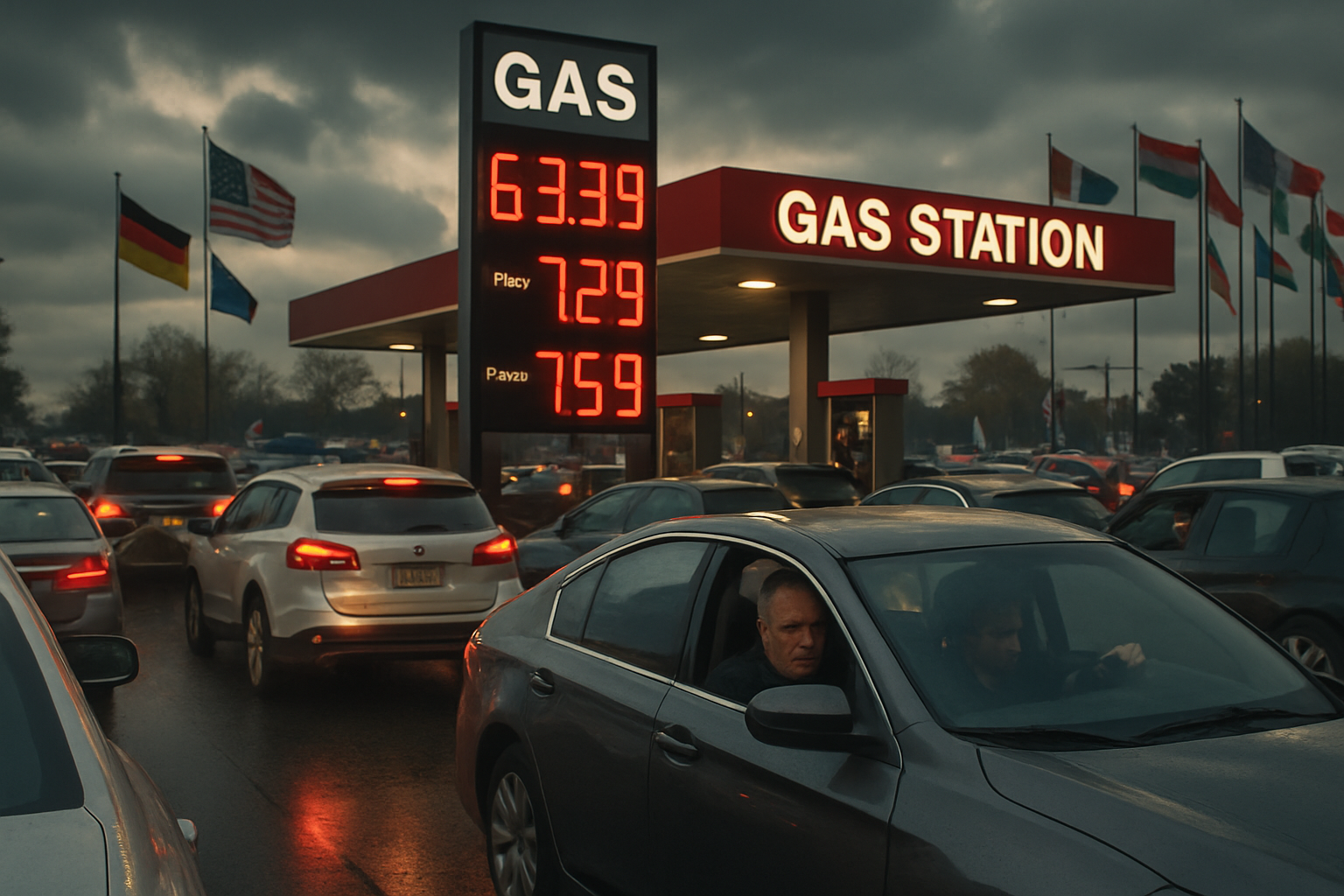
A deepening global fuel price crisis is forcing governments across multiple continents to implement emergency measures as energy costs surge to levels not seen since the 1970s oil shocks, with nations from Australia to Mauritania scrambling to protect consumers from unprecedented price increases.
The crisis has intensified following Iran's Revolutionary Guard closure of the Strait of Hormuz, which blocks 40% of global seaborne oil transit through the critical 21-mile chokepoint. Oil prices breached $100 per barrel for the first time since 2022, with Brent crude peaking at $119.50 and West Texas Intermediate surging a record 18.98% to $108.15.
Australia Implements Emergency Fuel Measures
In Australia, petrol prices have begun falling in major cities after retailers moved early to pass on the government's 26-cent excise cut. Prime Minister Anthony Albanese announced emergency powers to underwrite fuel imports and investigate price-gouging as petrol prices approach the $3 per liter threshold in some regions.
NSW Energy Minister Penny Sharpe is chairing crisis talks in Sydney as Queensland stations run completely dry. The situation has prompted calls for a 25% tax on gas exports, with The Australia Institute suggesting this could generate almost $350 million weekly for national coffers.
"The longer we delay implementing a gas export tax, and the longer the government defends the failed PRRT (Petroleum Resource Rent Tax), the more it is costing the Australian people,"
— Dr Richard Denniss, The Australia Institute
European Nations Abandon Free-Market Principles
European countries have implemented some of the most comprehensive emergency energy measures since the 1970s. Germany's Federal Ministry of Economics is strengthening antitrust laws to prevent gas station price manipulation, representing significant market intervention in modern German energy policy.
France has deployed 500 fuel station inspectors to prevent price manipulation, while Hungary implemented immediate gasoline and diesel price caps against what officials termed "war-driven price explosions." Romania has outlined five scenarios to prevent diesel exceeding 10 lei per liter, including temporary tax and excise reductions.
Ireland announced a €235 million package cutting diesel prices by 20 cents and petrol by 15 cents, while Austria's Finance Minister Magnus Brunner implemented a comprehensive fuel price brake system, redistributing excess fuel tax revenues back to consumers.
Asia-Pacific Region Under Severe Strain
New Zealand is considering "Muldoon-era" emergency measures not seen since the 1970s, including car-free days and petrol purchase limits, as fuel prices approach NZ$4 per liter. Prime Minister Christopher Luxon warned the country is preparing for a "prolonged Iran conflict."
The Philippines has declared a year-long national energy emergency, with President Ferdinand Marcos Jr. activating the UPLIFT program as diesel approaches 100 pesos per liter. Nationwide jeepney strikes have erupted, with drivers demanding fare increases of 13-18 pesos.
Kenya faces a crisis as a deal with a Saudi Arabian firm collapsed, potentially forcing citizens to use dirty fuels like charcoal and firewood due to higher cooking gas taxes.
Middle East and Africa Navigate Complex Challenges
Mauritania has implemented a comprehensive response package, including raising the minimum wage by 5,000 old ouguiyas to offset rising energy costs. The government announced a ban on vehicle movement within cities at midnight and raised fuel prices by 10-15% while reducing household gas subsidies.
"The new measures take into account vulnerable groups and will not affect the prices of basic commodities,"
— Government spokesperson Hussein Madou
Barbados provided relief to motorists with gasoline prices dropping six cents to $3.73 per liter and diesel falling 12 cents to $3.15 per liter, while kerosene prices remained unchanged at $1.53 per liter.
IEA Deploys Historic Strategic Reserves
The International Energy Agency announced its largest strategic petroleum reserve release in 50 years—400 million barrels from 32 countries, double the amount released during the 2022 Ukraine crisis. Japan leads with 80 million barrels, its first deployment since the 2011 Fukushima disaster, despite 95% dependence on Middle East oil.
Energy Secretary Christopher Wright is considering lifting Russian oil sanctions for supply stabilization, potentially making "hundreds of millions of barrels of sanctioned oil" available to global markets.
Aviation Industry in Crisis
The aviation sector faces its worst crisis since COVID-19, with over 18,000 flights cancelled worldwide. Eight countries have simultaneously closed their airspace, creating an "aviation black hole" severing Europe-Asia corridors. Dubai International Airport, the world's busiest with 86 million passengers annually, remains shut due to missile damage.
Jet fuel costs have surged 122% from $85-90 to $150-200 per barrel, forcing airlines to implement emergency surcharges. Air France-KLM added 50 euros to economy and 200 euros to business class long-haul tickets.
Financial Markets in Turmoil
Global financial markets have crashed, with Pakistan's KSE-100 suffering its largest single-day decline in history at -8.97%. South Korea's KOSPI fell 12%, triggering circuit breakers as the Korean won hit a 17-year low. PayPal postponed its $1.1 billion IPO indefinitely due to market volatility.
Natural gas prices exploded 24% in Europe and 78% in the US, reaching €47.32 per MWh—the highest since February 2025. Qatar's LNG production at Ras Laffan and Mesaid facilities, representing 20% of global exports, remains halted following Iranian attacks.
Root Causes and Nuclear Concerns
The crisis stems from the complete collapse of US-Iran nuclear talks despite what negotiators called the "broad agreement on guiding principles"—the most progress since the 2018 JCPOA breakdown. Operation Epic Fury, the largest US-Israeli coordinated operation since 2003, triggered Iranian retaliation under "Operation True Promise 4."
The nuclear governance crisis has deepened with the New START treaty's expiration on February 5—the first time in 50+ years without US-Russia nuclear constraints. Iran continues 60% uranium enrichment with over 400kg of weapons-grade material, approaching multiple weapons capability.
"This is the greatest test of multilateral cooperation in crisis management in the modern era,"
— UN Secretary-General António Guterres
Expert Analysis: Single-Point Failure Exposed
Energy analysts warn that the crisis exposes dangerous vulnerabilities in global energy architecture. The 21-mile Strait of Hormuz represents a single-point failure in modern logistics with no realistic alternatives.
Samuel Ciszuk, energy geopolitics expert, describes this as "the most severe energy security crisis in decades, with single-chokepoint vulnerabilities exposed." Qatar Energy Minister Saad Al Kaabi has warned Gulf states may declare force majeure "within weeks" if oil approaches $150 per barrel, threatening to "bring down economies of the world."
Supply chain disruption extends beyond energy, affecting consumer goods and industrial materials worldwide. Maersk and MSC have suspended all Persian Gulf operations, leaving over 150 oil and LNG tankers stranded with billions in cargo value. China has suspended refined fuel exports, while Singapore reports 30% increases in logistics costs.
Long-Term Implications for Energy Security
This crisis represents a watershed moment in 21st-century energy security planning, requiring fundamental transformation to reduce dependence on strategic chokepoints in volatile geopolitical regions. Strategic petroleum reserves provide only temporary relief for sustained disruptions.
The template-setting nature of this crisis will influence international approaches to energy markets evolution, supply chain resilience, and nuclear proliferation prevention for decades. Success in containing the crisis could provide a framework for future nuclear crisis resolution, while failure may accelerate military solutions, reshape Middle Eastern geopolitics, and encourage nuclear proliferation globally.
Recovery timelines remain uncertain, dependent on military and diplomatic resolution rather than predictable market forces. Unlike weather-related disruptions, this geopolitical crisis cannot be scheduled around, leaving energy markets volatile and aviation unable to operate in closed airspace.
As governments worldwide implement emergency measures not seen since the 1970s oil crisis, the international community faces critical decisions balancing immediate supply needs against long-term energy security architecture that could reshape global energy markets and international relations for generations.