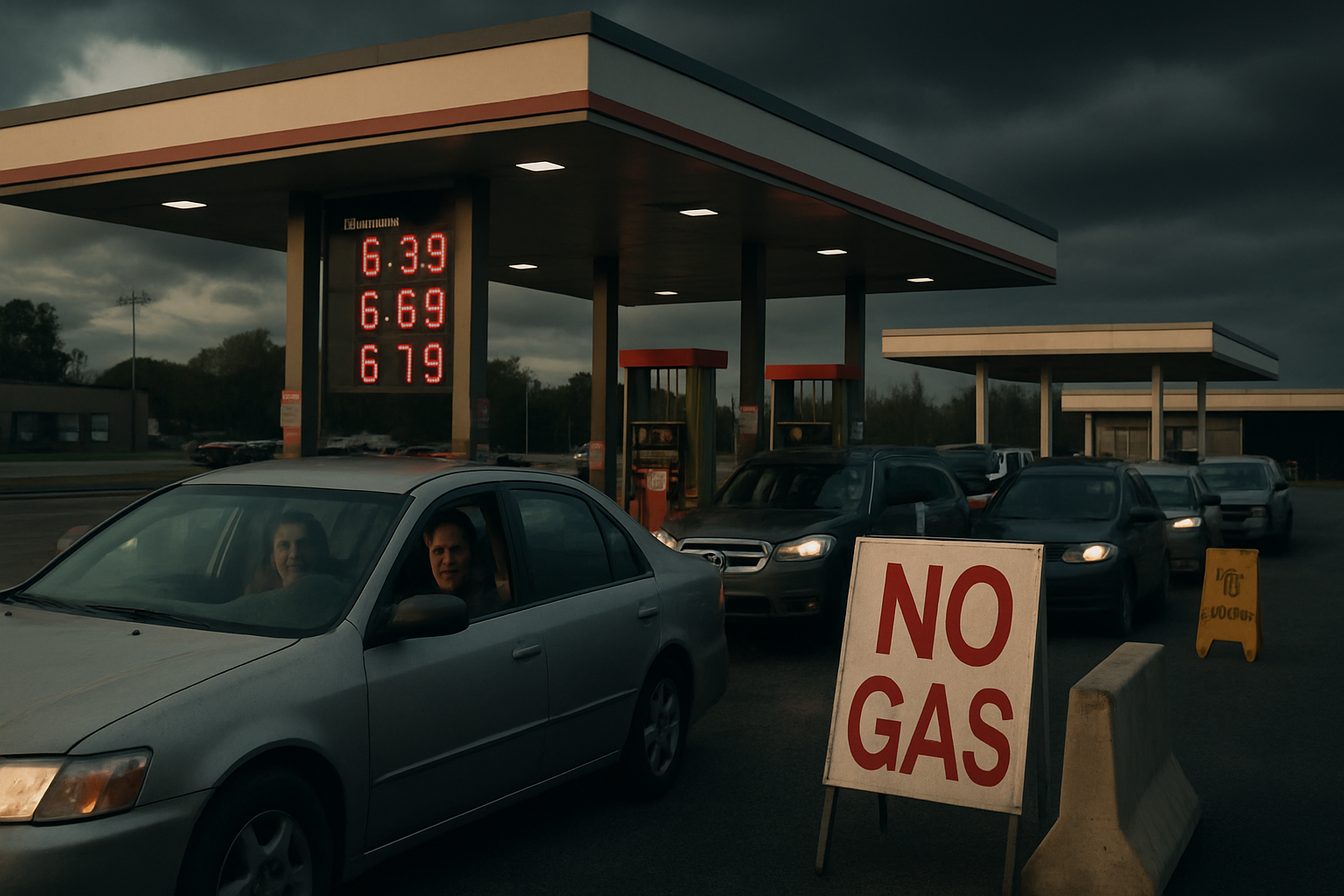
Global fuel prices have surged to historic levels as ongoing Middle East conflicts disrupt critical energy supply chains, forcing governments from Estonia to Japan to implement emergency measures to protect consumers from record-high gasoline and energy costs.
The crisis, centered on Iran's Revolutionary Guard closure of the Strait of Hormuz—a 21-mile chokepoint handling 40% of global seaborne oil transit—has triggered the most severe energy emergency since the 1970s oil shocks. Oil prices have breached $100 per barrel for the first time since 2022, with Brent crude peaking at $119.50 and West Texas Intermediate jumping a record 18.98% to $108.15 in a single day.
Estonia Takes Decisive Action
In Estonia, Alexela Group owner Heiti Hääl warned that fuel prices at gas stations could rise above €2 per liter on Thursday, with expectations of even higher increases if the conflict continues. The warning comes as the Estonian Stockpiling Agency joined other nations in releasing strategic fuel reserves to market in response to what officials describe as the Iran conflict's unprecedented impact on global energy supplies.
"The Estonian Stockpiling Agency has decided to join other states in releasing the country's strategic fuel reserves to the market in the wake of the Iran conflict," officials announced, marking the first such deployment since the agency's establishment of current crisis protocols.
Japan Faces Record-High Prices
Japan has experienced its worst fuel price crisis in modern history, with average retail gasoline prices hitting a record 190.80 yen per liter, reflecting higher crude oil prices amid the Iran war. The surge has prompted the Japanese government to consider rolling out gasoline subsidies—a measure not seen since the country's economic challenges of previous decades.
The crisis is particularly acute for Japan, which relies on Middle Eastern oil for 95% of its imports, with 70% of that supply transiting through the now-closed Strait of Hormuz. The government is considering deploying national oil stockpiles for the first time since the 2011 Fukushima disaster, highlighting the severity of the current emergency.
"The national average retail prices of gasoline have exceeded ¥190 per liter, forcing us to consider emergency subsidies to protect Japanese consumers from these unprecedented price shocks."
— Japanese Ministry of Economy, Trade and Industry spokesperson
International Energy Agency Responds
The International Energy Agency (IEA) has announced the largest strategic petroleum reserve release in its 50-year history, deploying 400 million barrels from 32 member countries—more than double the 182.7 million barrels released during the 2022 Ukraine crisis. Japan is contributing 80 million barrels starting March 16, with Germany confirming participation and the United States expected to be the largest contributor.
U.S. Energy Secretary Christopher Wright is considering additional measures, including the potential lifting of Russian oil sanctions to help stabilize global supply. "We have hundreds of millions of barrels of sanctioned oil that could potentially be made available for market stabilization," Wright stated during emergency consultations with G7 partners.
Global Supply Chain Crisis
The energy crisis extends far beyond fuel prices, creating a global supply chain emergency. Major shipping companies Maersk and MSC have completely suspended Persian Gulf operations, leaving over 150 oil and LNG tankers stranded with billions of dollars in cargo value. The aviation industry has been equally devastated, with more than 18,000 flights cancelled worldwide—the most extensive disruption since the COVID-19 pandemic.
Natural gas prices have exploded by 24% in Europe and 78% in the United States, reaching €47.32 per MWh—the highest levels since February 2025. Qatar, which supplies approximately 20% of global LNG exports, has halted production at its Ras Laffan and Mesaid facilities following Iranian drone attacks.
Consumer Impact Worldwide
The crisis has created severe consumer hardship across multiple continents. In Sweden, electricity prices have increased by 10-20 öre with gasoline rising 1-2 kronor, with the southern Malmö region most exposed due to its integration with continental European markets. Ireland faces "brazen rip-offs" as heating oil approaches €2 per liter, prompting government calls to reduce fuel taxes that currently represent 65% of the cost per euro.
Bangladesh has implemented fuel rationing for its 170 million citizens, while Pakistan—experiencing its highest fuel prices in South Asia at Rs321.17 per liter—has imposed wartime austerity measures including four-day government work weeks. Bosnia-Herzegovina has been reduced to just two days of gas reserves, highlighting the vulnerability of smaller European nations to energy supply disruptions.
Government Emergency Measures
Governments worldwide have implemented unprecedented emergency measures to protect consumers. Hungary has imposed immediate price caps on gasoline and diesel to counter what Prime Minister Viktor Orbán called "war-driven price explosions." France has deployed 500 fuel station inspectors to prevent price manipulation, with Prime Minister declaring that "war cannot serve as a pretext for abusive price increases."
Romania has developed five comprehensive scenarios to prevent diesel prices from exceeding 10 lei per liter, including temporary tax and excise reductions. Slovakia has activated its strategic petroleum reserves for the first time under current protocols, while multiple countries are exploring emergency subsidy programs for essential sectors.
Financial Market Turmoil
The energy crisis has triggered severe financial market disruptions globally. Pakistan's KSE-100 index crashed 8.97% in its largest single-day decline in history, while South Korea's KOSPI fell 12%, triggering circuit breakers as the Korean won hit a 17-year low. The crisis has forced PayPal to postpone its $1.1 billion IPO indefinitely due to market volatility.
Central banks, including the European Central Bank and Bank of Japan, are coordinating emergency liquidity provisions to prevent financial contagion, though traditional monetary policy tools have limited effectiveness against structural geopolitical disruptions.
Nuclear Diplomacy Breakdown
The crisis stems from the complete collapse of U.S.-Iran nuclear negotiations despite what had been described as a "broad agreement on guiding principles"—the most progress since the 2018 JCPOA collapse. The negotiations broke down over scope disagreements, with Iran maintaining "red lines" on ballistic missiles and proxy forces while the United States demanded comprehensive restrictions.
This diplomatic failure led to Operation Epic Fury, the largest coordinated U.S.-Israeli military operation since 2003, followed by Iran's massive retaliation "Operation True Promise 4." The crisis occurs as the New START treaty expired on February 5, leaving the world without U.S.-Russia nuclear constraints for the first time in over 50 years.
Long-term Energy Security Implications
Energy analysts describe this as the most severe energy security crisis in decades, exposing dangerous over-dependence on strategic chokepoints with no realistic alternatives. Samuel Ciszuk of Rystad Energy noted that the crisis demonstrates "single-chokepoint vulnerabilities that have been exposed in the most dramatic way possible."
Qatar's Energy Minister Saad Al Kaabi has warned that Gulf states may be forced to declare force majeure "within weeks," potentially driving oil prices toward $150 per barrel and threatening to "bring down the economies of the world." The 21-mile Strait of Hormuz has proven to be a single-point failure for modern global logistics, highlighting the urgent need for fundamental energy architecture restructuring.
Recovery Timeline Uncertain
Unlike weather-related disruptions, recovery from this crisis depends entirely on military operations resolution and diplomatic normalization. The aviation industry cannot maintain long-term scheduling with critical airspace closed, while energy markets remain volatile with blocked transit routes. Traditional economic policy tools have proven ineffective against structural geopolitical disruptions of this magnitude.
The crisis represents what UN Secretary-General António Guterres called "the greatest test of multilateral cooperation and crisis management in the modern era," with nuclear risks at their "highest level in decades." The international community faces critical decisions between immediate supply needs and long-term energy security architecture that could reshape global energy markets and international relations for generations.
As governments worldwide scramble to protect their citizens from unprecedented fuel costs, March 2026 is emerging as a watershed moment that will establish new paradigms for energy security planning and international crisis management in an increasingly volatile, interconnected world.