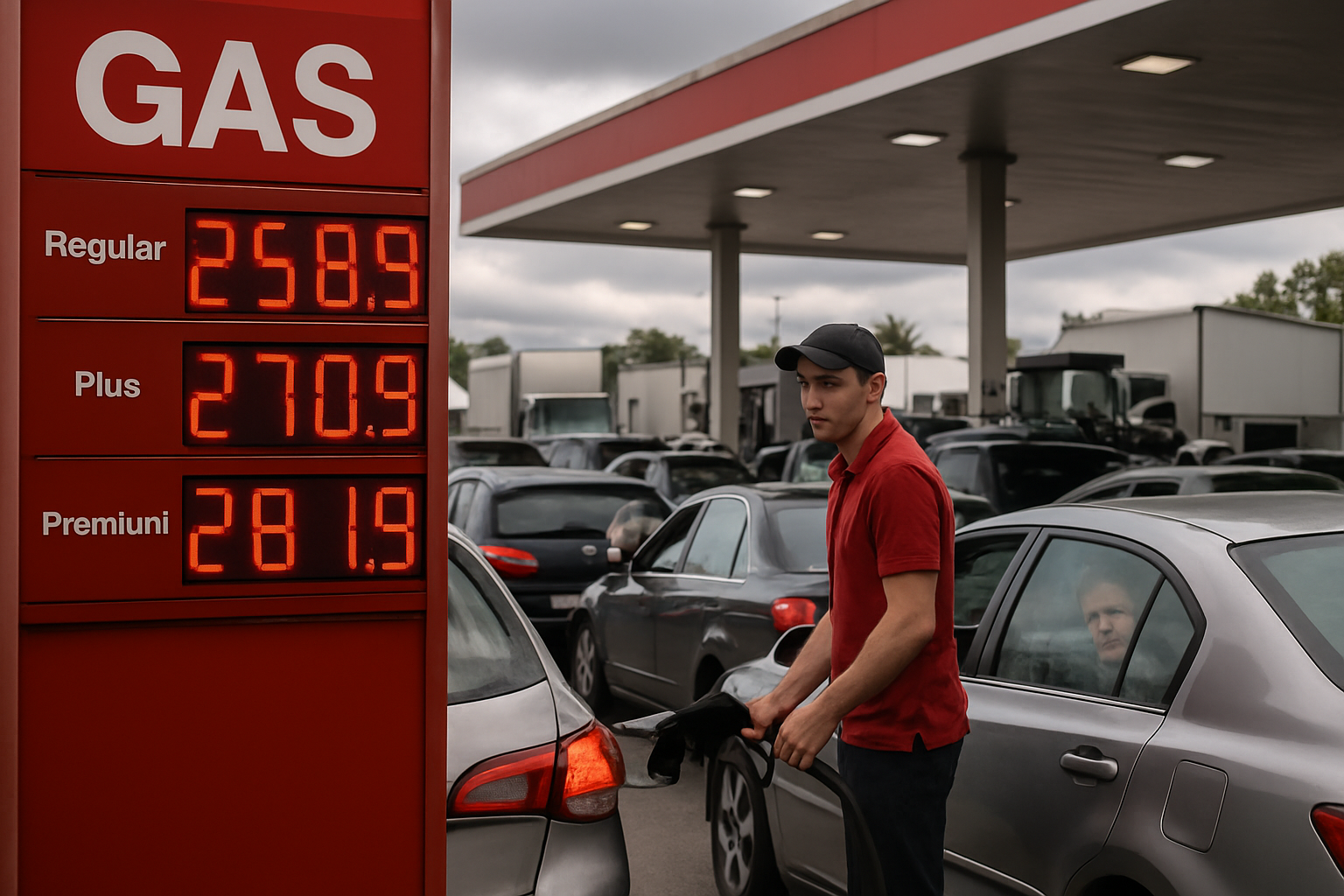
A devastating global fuel crisis has reached critical levels as governments worldwide implement emergency price controls, tax cuts, and strategic fuel reserve releases while five major European Union finance ministers demand coordinated windfall taxes on energy companies profiting from the ongoing Middle East conflict.
The crisis, triggered by Iran's Revolutionary Guard closure of the Strait of Hormuz affecting 40% of global seaborne oil transit, has forced unprecedented government interventions from Europe to the Pacific as diesel prices approach €2 per liter in some regions and fuel shortages spread across multiple continents.
EU Finance Ministers Demand Energy Company Windfall Taxes
Five European Union finance ministers from Germany, Italy, Spain, Portugal, and Austria issued a joint letter to the EU Commission on Friday demanding the implementation of windfall profit taxes on energy companies as a "signal that we stand united and are able to take action." The ministers argued such measures would send "a clear message that those profiting from wartime conditions cannot escape responsibility to support affected populations."
The coordinated call comes as energy companies across Europe report record profits while consumers face devastating price increases. German Finance Minister Christian Lindner emphasized that "extraordinary times require extraordinary measures," while Italian Finance Minister Giancarlo Giorgetti stated the tax would demonstrate European unity in crisis response.
Emergency Government Interventions Worldwide
Cyprus became the first nation to implement direct fuel tax relief, cutting consumption taxes by 8.33 cents per liter effective midnight Saturday. The emergency legislation, rushed through parliament on Thursday, aims to reduce 95-octane petrol prices to approximately €1.50 per liter and diesel to €1.83 per liter after a month of extreme volatility that saw diesel prices surge by 50 cents and petrol by 30 cents.
France announced the launch of an emergency loan programme to help small and medium-sized businesses cope with soaring fuel costs driven by the Middle East war. The initiative represents a significant departure from traditional market-based approaches as governments across Europe abandon free-market principles to protect consumers from price shocks.
In Eastern Europe, Romania has outlined five emergency scenarios to prevent diesel from exceeding 10 lei per liter, while Hungary implemented immediate price caps on gasoline and diesel to counter what officials term "war-driven price explosions."
Global Supply Chain Crisis Deepens
The fuel crisis has created severe supply disruptions worldwide, with Jamaica experiencing weekly fuel price increases of roughly $4.50 per adjustment during March. E10-87 gasoline rose from $148.87 in December to $172.38 by April 2, representing a 15.8% increase, while kerosene recorded the largest jump at 19.6%.
In Kenya, fuel shortages have been reported in major cities including Mombasa and Kakamega despite government assurances of adequate supplies. Petrol stations have reportedly hiked prices to Ksh 200 per liter as panic buying spreads, with some stations closing due to depleted supplies.
Australia faces particularly severe shortages as retail fuel prices surge past $2.50 per liter nationally, with regional areas experiencing complete station closures. Consumer advocacy groups warn that prices are approaching the critical $3 per liter threshold that could trigger rationing measures.
Historic Oil Price Surge and Strategic Response
International oil prices have breached $100 per barrel for the first time since 2022, with Brent crude peaking at $119.50 and WTI jumping a record 18.98% to $108.15. The surge follows Iran's declaration that the Strait of Hormuz is "unsafe for shipping," effectively blockading the critical 21-mile chokepoint through which 40% of global seaborne oil transits.
The International Energy Agency has announced the largest strategic petroleum reserve release in its 50-year history, deploying 400 million barrels from 32 member countries—more than double the 182.7 million barrels released during the 2022 Ukraine crisis. Japan is releasing 80 million barrels, marking the first deployment since the 2011 Fukushima disaster, while Germany and other European nations have confirmed participation.
"This represents the most severe energy security crisis in decades, exposing dangerous single-chokepoint vulnerabilities in our global energy system."
— Samuel Ciszuk, Energy Security Analyst
Aviation and Transport Industries in Crisis
The aviation sector faces unprecedented disruption with over 18,000 flights cancelled worldwide—the most extensive cancellations since COVID-19. Eight Middle Eastern countries have simultaneously closed their airspace, creating an "aviation black hole" that has forced airlines to suspend operations indefinitely.
Jet fuel costs have soared 122% from $85-90 per barrel to $150-200 per barrel, forcing airlines to implement emergency surcharges. Air New Zealand has cut over 1,000 flights affecting 44,000 passengers, while major carriers including Emirates, Air France-KLM, and Wizz Air have suspended operations.
Shipping Industry Paralysis
Major shipping companies Maersk and MSC have suspended all Persian Gulf operations, stranding over 150 oil and LNG tankers worth billions of dollars in cargo value. Iran has deployed an estimated 2,000-6,000 naval mines throughout the strait, forcing the U.S. Navy to destroy 28 Iranian mine-laying vessels in ongoing clearance operations.
Economic Impact and Market Response
Financial markets have crashed globally, with Pakistan's KSE-100 index recording its largest single-day decline in history at -8.97%. South Korea's KOSPI index fell 12%, triggering circuit breakers as the Korean won hit a 17-year low. The PayPal IPO worth $1.1 billion has been postponed indefinitely due to market volatility.
Natural gas prices have exploded 24% in Europe and 78% in the United States, reaching €47.32/MWh—the highest level since February 2025. Qatar has halted LNG production at its Ras Laffan and Mesaid facilities following Iranian attacks, affecting approximately 20% of global LNG exports.
Regional Coalition Under Strain
The crisis has severely strained the regional coalition of Saudi Arabia, UAE, Qatar, and Egypt, with civilian casualties mounting from Iranian retaliation attacks. The UAE reported one civilian killed in Abu Dhabi, Kuwait saw 32 injured in airport strikes, and Qatar sustained eight wounded while intercepting 65 missiles and 12 drones using Patriot defense systems.
Egyptian President Abdel Fattah el-Sisi condemned attacks on "sisterly countries," warning of "comprehensive chaos" if the conflict continues to escalate. The coalition, which had maintained consensus supporting diplomatic solutions, now faces difficult choices between alliance obligations and protection from Iranian retaliation.
Long-term Energy Security Implications
Energy experts warn that the crisis exposes fundamental vulnerabilities in global energy architecture that require systematic restructuring. The 21-mile Strait of Hormuz represents a critical single-point failure in modern logistics systems, with no realistic alternative routes capable of handling the diverted volume.
Qatar Energy Minister Saad Al Kaabi has warned that Gulf states may declare force majeure "within weeks" if oil approaches $150 per barrel, threatening to "bring down the economies of the world." Strategic petroleum reserves provide only temporary relief for sustained supply disruptions, highlighting the urgent need for supply diversification and renewable energy transitions.
"We are witnessing the greatest test of multilateral cooperation in crisis management in the modern era. The decisions made in the coming days will reverberate through international relations for decades."
— UN Secretary-General António Guterres
Nuclear Diplomacy Breakdown
The fuel crisis stems from the complete breakdown of U.S.-Iran nuclear negotiations despite achieving what negotiators described as "broad agreement on guiding principles"—the most progress since the 2018 JCPOA collapse. Iran excluded ballistic missiles and proxy forces as "red lines" in a nuclear-only approach, while the United States demanded comprehensive coverage including missiles, armed groups, and human rights.
The diplomatic collapse led to Operation Epic Fury, described as the largest coordinated operation since 2003, followed by Iranian retaliation under "Operation True Promise 4." Iran continues uranium enrichment to 60% purity with over 400kg of weapons-grade material, approaching multiple weapons capability as the New START treaty expired in February—the first time in over 50 years without U.S.-Russia nuclear constraints.
Government Emergency Responses Escalate
Beyond European initiatives, governments worldwide are implementing unprecedented emergency measures. Australia's competition watchdog is investigating potential price gouging as fuel approaches the critical $3 per liter threshold. New Zealand is considering "Muldoon-era" emergency measures including car-free days and petrol sale limits not seen since the 1970s oil crisis.
Bangladesh has implemented fuel rationing for 170 million people, while Pakistan has imposed wartime austerity measures including four-day government work weeks as fuel hits Rs 321.17 per liter—the highest in South Asia. Bosnia-Herzegovina reports only two days of gas reserves remaining, forcing immediate conservation measures.
The crisis has prompted calls for fundamental energy architecture transformation to reduce dependence on strategic chokepoints in volatile geopolitical regions. Recovery timelines remain uncertain, depending on military and diplomatic resolution of the underlying Middle East conflict.
As governments balance immediate crisis response with long-term energy security planning, the April 2026 fuel crisis represents a watershed moment that will likely reshape international energy policy and crisis management frameworks for decades to come.