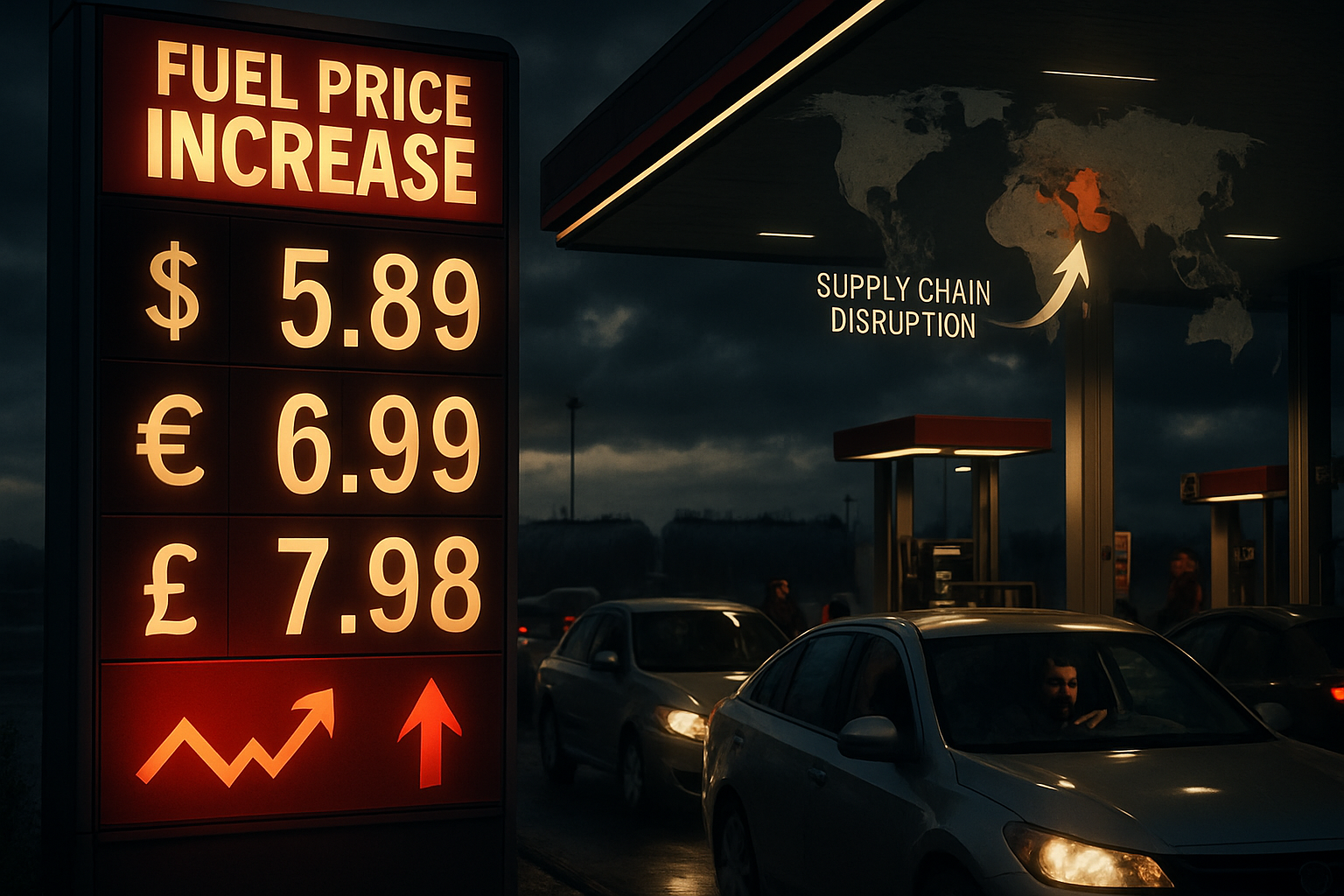
Global fuel and energy markets are experiencing the most severe crisis in decades as the escalating Middle East conflict forces oil prices above $80 per barrel and triggers massive fuel price increases worldwide, with governments from Canada to Pakistan scrambling to implement emergency relief measures.
The crisis reached unprecedented levels as Iran's Revolutionary Guard declared the critical Strait of Hormuz "unsafe," effectively closing the narrow waterway that handles 40% of the world's seaborne oil transit. This strategic chokepoint closure has sent shockwaves through global energy markets, with Brent crude surging 10% from $73 to over $80 per barrel in just days.
Strait of Hormuz Closure Creates Global Supply Emergency
The 21-mile-wide Strait of Hormuz, located between Iran and the Arabian Peninsula, has become the epicenter of a global energy security crisis. Major shipping companies Maersk and MSC have suspended all operations through the Persian Gulf, leaving more than 150 oil and LNG tankers stranded with billions of dollars worth of cargo.
"This is the most severe energy security crisis we've seen in decades," said Samuel Ciszuk, an energy analyst. "The single-chokepoint vulnerabilities of our global energy system have been completely exposed."
The disruption comes at a critical time when alternative routes around the Arabian Peninsula cannot handle the capacity, creating significant time delays and cost penalties for global oil shipments. OPEC+'s emergency production increase of 206,000 barrels per day has proven insufficient to offset the massive shipping disruption.
Natural Gas Markets Experience Historic Volatility
Natural gas markets have seen even more dramatic price movements, with European prices rocketing 50% to €47.32 per megawatt-hour—the highest levels since February 2025. In the United States, natural gas prices have surged 78%, creating severe energy supply concerns across both continents.
The situation deteriorated further when Qatar, which supplies approximately 20% of global LNG exports, halted production at its Ras Laffan and Mesaid facilities following Iranian drone attacks. Industry experts expect Qatar to declare force majeure on LNG supplies, potentially lasting weeks.
Consumer Impact Spreads Across Continents
The energy crisis is rapidly translating into higher costs for consumers worldwide. In Canada, where the crisis has particularly severe implications due to high energy dependence, gas stations across the country are displaying prices of 155.9 cents per liter, with experts warning these elevated prices could persist even after the conflict ends.
European nations are experiencing varied impacts based on their energy market integration. Sweden is predicting electricity increases of 10-20 öre and gasoline price rises of 1-2 kronor, with the southern Malmö region facing the most exposure due to its integration with continental European markets.
In Ireland, political leaders are denouncing what they call "brazen rip-offs" as home heating oil prices have shot up by almost 40% in less than a week, with petrol and diesel prices approaching €2 per liter at filling stations. Councillor Jack Murray from Buncrana has joined calls for the government to reduce the tax burden on consumers, noting that the government takes up to 65% in tax from every euro spent on fuel.
"Fuel price increases are out of control, and the reality is that the government is taking up to 65% in tax from every euro spent on fuel. At a time when families are already struggling with the cost of living, this simply isn't sustainable."
— Councillor Jack Murray, Buncrana
Asia-Pacific Region Faces Severe Energy Pressures
Pakistan has emerged as having the highest petrol prices in South Asia, with fuel costs reaching Rs321.17 per liter, sparking fears of a massive inflation wave. The government has also implemented a nearly 70% increase in kerosene prices, raising costs by Rs130.08 to Rs318.81 per liter, particularly impacting households in remote areas where access to liquefied petroleum gas is difficult.
The price increases are creating significant economic pressure for families already struggling with cost of living challenges, especially during the holy month of Ramadan. Economists warn that expensive fuel inevitably drives up transportation costs, which in turn increases prices of everyday essentials.
Supply Chain Disruptions Beyond Energy
The crisis extends far beyond fuel pumps and heating bills. The Persian Gulf serves as a critical hub for global trade, affecting not just energy supplies but consumer goods and industrial materials worldwide. The closure of this strategic waterway demonstrates the single-point failure risks inherent in modern logistics systems that depend heavily on specific transportation routes.
Aviation markets have been particularly hard hit, with over 18,000 flights cancelled worldwide as eight Middle Eastern countries simultaneously closed their airspace. Dubai International Airport, the world's busiest with over 86 million passengers annually, remains completely shut down due to missile damage, affecting hundreds of thousands of travelers globally.
Government Emergency Responses
Governments worldwide are implementing emergency measures to address the crisis. Strategic petroleum reserves are being deployed globally, with countries like Slovakia being forced to tap emergency supplies due to pipeline disruptions. However, experts warn these reserves provide only temporary relief for what could be a sustained disruption.
In the United States, Energy Secretary Christopher Wright is considering lifting additional sanctions on Russian oil to help ease the global supply shortage, demonstrating the severity of the situation. This would involve allowing Indian refiners to purchase Russian oil to maintain global supply stability.
European Union officials are rapidly developing emergency options to reduce energy prices, including state aid programs for energy-intensive industries and direct energy price compensation mechanisms. Heavy industries are already reporting factory closures due to unviable energy costs.
Financial Markets React with Historic Volatility
Global financial markets have responded with some of the most severe disruptions in years. Pakistan's KSE-100 index crashed 8.97% in the largest single-day decline in the exchange's history, while South Korea's KOSPI plunged 12% with circuit breakers activated. The Korean won hit a 17-year low as investors fled energy-intensive sectors.
Central banks, including the European Central Bank and Bank of Japan, are coordinating emergency liquidity provisions to prevent broader financial contagion. However, traditional monetary policy tools show limited effectiveness against structural geopolitical disruptions of this magnitude.
Long-term Implications for Energy Security
The crisis highlights fundamental vulnerabilities in global energy architecture that have developed over decades. The over-dependence on strategic chokepoints, particularly the narrow Strait of Hormuz, exposes the fragility of modern energy supply chains to geopolitical disruptions.
"This crisis demonstrates the urgent need for fundamental restructuring of our energy security architecture," noted Damien Boey, a portfolio strategist. "The situation is going on longer than initially thought, and financial markets are proving to be the ultimate constraint on prolonged conflict."
While alternative energy sources and supply diversification offer long-term solutions, such transitions require years or decades to implement effectively. The current crisis accelerates discussions about energy independence and renewable infrastructure, but provides little immediate relief for consumers facing soaring prices.
Nuclear Diplomacy Breakdown Context
The energy crisis stems from the complete collapse of nuclear diplomacy between the United States and Iran, despite what had been described as a "broad agreement on guiding principles" in Geneva talks—the most progress since the 2018 JCPOA collapse. Fundamental disagreements over scope, with Iran excluding ballistic missiles and regional proxies as "red lines" while the US demanded comprehensive agreements, proved insurmountable.
This diplomatic failure led to "Operation Epic Fury," the largest US-Israeli coordinated military operation since 2003, which in turn triggered Iran's massive retaliation and the subsequent energy market disruption.
Recovery Timeline Remains Uncertain
Unlike weather-related disruptions that have predictable timelines, recovery from this crisis depends entirely on military operations resolution and diplomatic normalization. Energy markets remain volatile with critical transit routes blocked, and traditional crisis management mechanisms show limited effectiveness against such structural geopolitical disruptions.
The aviation industry cannot make long-term scheduling decisions with multiple airspaces closed indefinitely, while energy companies face the challenge that increased production becomes meaningless if tankers cannot transit safely through traditional routes.
This crisis represents a template-setting moment for 21st-century energy security, with implications extending decades beyond current events. Success in containing the situation could provide a framework for future nuclear crisis resolution, while failure may accelerate military solutions over diplomatic engagement globally, reshaping geopolitics and energy markets for years to come.
As governments worldwide grapple with immediate consumer relief while planning long-term energy security reforms, the March 2026 Middle East crisis stands as the most dangerous challenge to global energy stability since the Cold War, with consequences that will influence international relations and energy policy for decades ahead.