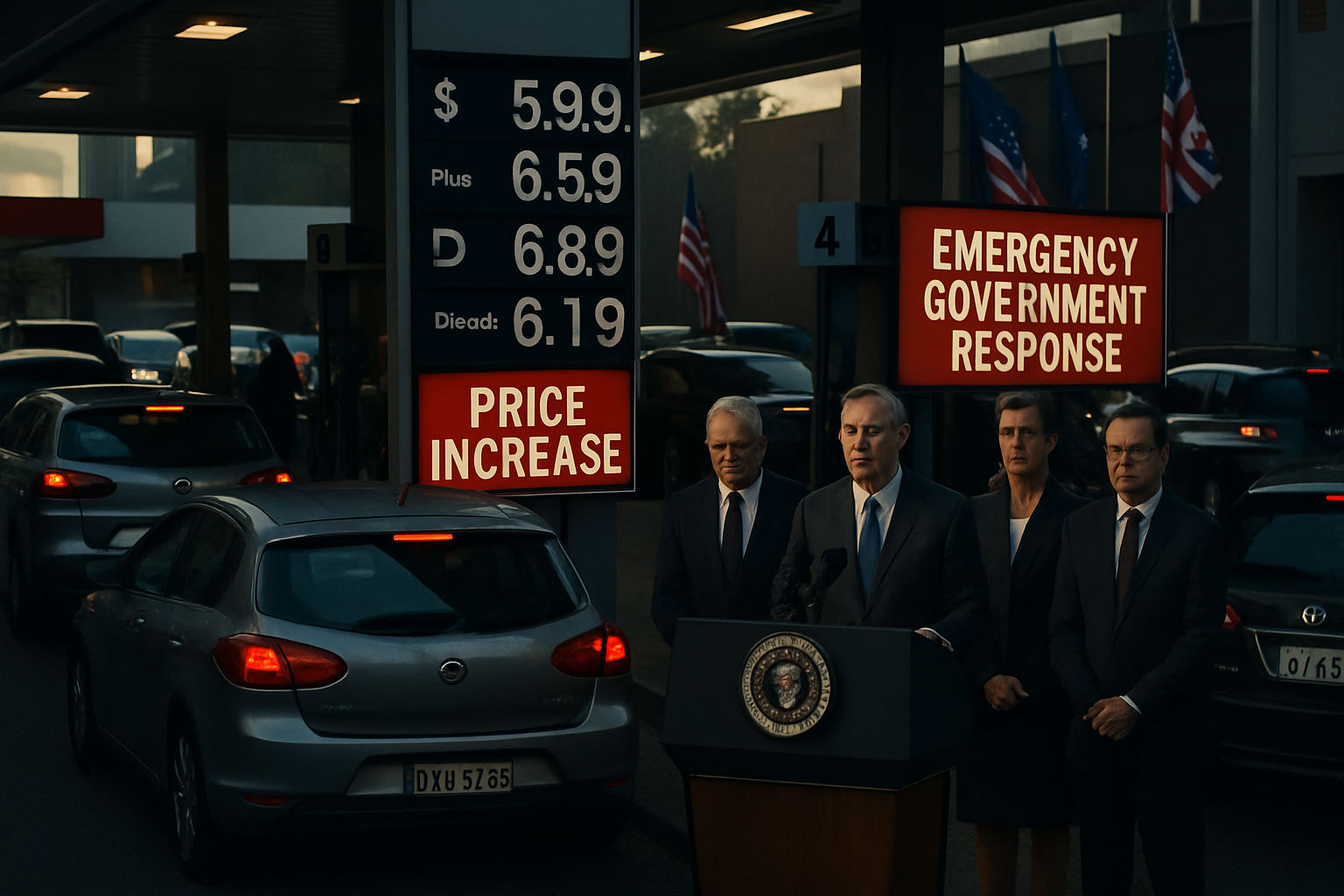
Governments across six continents are implementing emergency fuel price interventions as the ongoing Middle East conflict drives oil prices above $100 per barrel for the first time since 2022, creating the most severe global energy crisis in decades and triggering widespread panic buying at gas stations worldwide.
The crisis, precipitated by Iran's closure of the Strait of Hormuz affecting 40% of global oil transit, has forced nations from France to Paraguay to deploy unprecedented measures including price caps, fuel station inspections, and strategic reserve releases as Brent crude reached $119.50 per barrel—the highest since the Russia-Ukraine invasion.
European Governments Launch Emergency Interventions
French Prime Minister Sébastien Lecornu announced 500 comprehensive fuel station inspections across France beginning Monday, declaring that "war cannot serve as a pretext for abusive price increases." The three-day blitz represents the most extensive fuel market intervention in French history, targeting potential price manipulation amid regional supply disruptions.
Croatia moved swiftly to reintroduce fuel price caps through an extraordinary government session, with officials citing Iran's conflict as creating unprecedented market volatility. The caps, previously lifted during stable periods, mark the return of direct government intervention in Croatian energy markets.
"We cannot allow war profiteering to devastate household budgets during this crisis."
— Sébastien Lecornu, French Prime Minister
Romania's Energy Minister Bogdan Ivan revealed five emergency scenarios to prevent diesel prices from exceeding 10 lei per liter, including temporary tax and excise duty reductions. With 70% of fuel prices consisting of taxes, the government holds significant leverage to cushion consumer impacts.
Global Price Surge Hits Consumers Hard
The crisis has created immediate impacts worldwide, with Cyprus fuel prices climbing steadily as Brent crude touched unprecedented levels during Monday trading. Petrol station owners' association chairman Savvas Prokopiou warned of continued increases over the next two to three weeks, following initial rises of two cents per liter.
Ireland faces particularly acute pressure, with heating oil costs surging 40% in a single week and approaching €2 per liter. Local officials in Donegal report families struggling with the dual burden of rising energy costs and existing housing pressures from defective concrete block issues.
In Italy, the Ministry of Enterprise convened an emergency rapid alert commission at 2:30 PM Monday to address speculation concerns in fuel markets, highlighting the coordinated European response to potential market manipulation.
Latin American Nations Battle Energy Inflation
Paraguay's energy landscape reflects broader regional struggles, with Deputy Alejandro Aguilera criticizing private fuel companies for immediate price increases following the outbreak of Middle East conflict. The deputy emphasized the crucial role of state-owned PETROPAR in maintaining market stability and preventing speculative price gouging.
"PETROPAR is key to putting limits on these abuses and preventing some from earning millions at the expense of the people."
— Alejandro Aguilera, Paraguayan Deputy
The conflict's timing, occurring just days after hostilities began, has drawn criticism that private companies are using geopolitical tensions to justify excessive price increases that harm consumers disproportionately.
Energy Architecture Vulnerabilities Exposed
The crisis has laid bare the dangerous over-dependence on strategic chokepoints, with the 21-mile Strait of Hormuz representing a critical single-point failure in global logistics. Iran's Revolutionary Guard declaration that the waterway is "unsafe for shipping" has stranded over 150 oil and LNG tankers worth billions in cargo.
Natural gas markets have experienced parallel disruption, with European prices surging 50% to €47.32/MWh—the highest levels since February 2025. Qatar's halt of LNG production at key facilities affects approximately 20% of global LNG exports, creating severe supply shortages during the crucial winter transition period.
Alternative Arabian Peninsula routes lack adequate capacity and infrastructure to handle diverted volume, creating inevitable bottlenecks and cost increases that ripple through global energy markets.
Aviation and Supply Chain Cascading Crisis
The energy crisis has paralleled an unprecedented aviation disruption, with over 18,000 flights cancelled worldwide—the most extensive disruption since COVID-19. Eight Middle Eastern countries have simultaneously closed civilian airspace, while Dubai International Airport, the world's busiest with 86 million annual passengers, remains completely shut down from missile damage.
Major shipping companies Maersk and MSC have suspended Persian Gulf operations entirely, demonstrating how quickly regional conflicts can disrupt global supply chains extending far beyond energy sectors into consumer goods and industrial materials.
Strategic Reserve Coordination Efforts
The G7 nations are coordinating potential strategic petroleum reserve releases, with French Finance Minister Roland Lescure hosting a virtual meeting of finance ministers to discuss coordinated responses. Japan is considering its first national oil stockpile deployment since the 2011 Fukushima disaster, highlighting the severity of current supply disruptions.
However, strategic reserves provide only temporary buffers for sustained disruptions, and the fundamental restructuring needed to reduce dependence on volatile geopolitical regions requires years or decades of implementation.
Market Response and Consumer Protection
Financial markets have reflected the crisis's severity, with Pakistan's KSE-100 experiencing its largest single-day decline in history at -8.97%, while the Korean won hit 17-year lows amid capital flight. Central banks including the ECB and Bank of Japan are coordinating emergency liquidity provisions, though traditional monetary policy tools show limited effectiveness against structural geopolitical disruptions.
Individual countries are exploring various consumer protection mechanisms, from temporary fuel tax reductions to retail price caps and enhanced surveillance to prevent market manipulation. The coordinated nature of government responses reflects the global scale of the crisis and recognition that unilateral measures alone cannot address systemic supply chain vulnerabilities.
Long-term Energy Security Implications
Energy analysts warn that the current crisis represents a template-setting moment for 21st-century energy security planning. The rapid transformation from diplomatic breakthrough to military confrontation demonstrates the fragility of modern crisis management mechanisms in an increasingly multipolar world.
Supply diversification and renewable energy transitions, while essential for long-term security, require sustained investment and years of infrastructure development. The immediate crisis highlights how quickly geopolitical events can disrupt energy supplies that modern economies depend upon for basic functioning.
"This is the most severe energy security crisis in decades, exposing our single-chokepoint vulnerabilities."
— Samuel Ciszuk, Energy Security Analyst
Recovery timelines remain uncertain, dependent on military operations resolution and diplomatic normalization rather than predictable weather patterns or technical issues. Aviation industries cannot engage in long-term scheduling while airspace remains closed, and energy markets remain volatile with critical transit routes blocked.
Government Preparedness and International Cooperation
The crisis has tested government emergency response protocols on an unprecedented scale, with multiple nations simultaneously activating evacuation procedures and energy market interventions. Cyprus activated its ESTIA evacuation plan for the first time, while Sweden and other Nordic countries have implemented immediate evacuation orders for citizens in Iran due to "extremely uncertain" security conditions.
The coordinated international response highlights both the global nature of modern energy interdependence and the importance of multilateral cooperation in crisis management. Traditional bilateral relationships and established diplomatic channels have proven crucial for coordinating evacuation efforts and market stabilization measures.
However, the current crisis also exposes limitations in existing international coordination mechanisms for managing large-scale disruptions affecting multiple sectors simultaneously. Unlike weather-related disruptions with predictable patterns, geopolitical conflicts create structural uncertainties that challenge traditional planning assumptions.
As governments worldwide grapple with immediate consumer pressure and longer-term energy security concerns, the March 2026 crisis may prove to be a watershed moment that fundamentally reshapes international approaches to energy policy, supply chain resilience, and crisis management for decades to come.