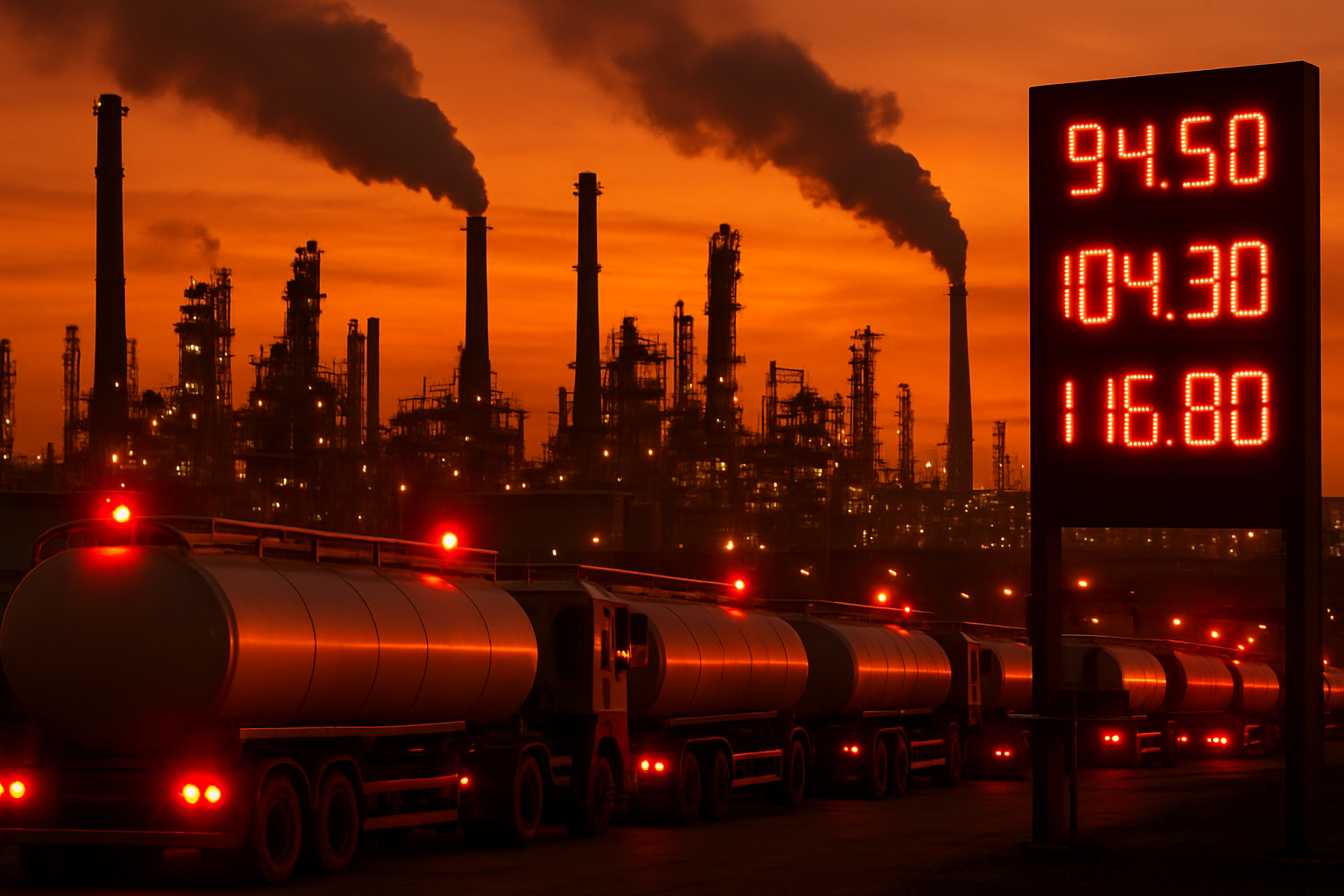
Countries across the globe are grappling with unprecedented fuel price surges and energy security concerns as ongoing Middle East conflicts disrupt critical supply chains, prompting governments to implement emergency measures and consider policy interventions to protect consumers.
The crisis has emerged as Iran's Revolutionary Guard maintains control over the Strait of Hormuz, a critical chokepoint that handles 40% of global seaborne oil transit. This disruption has sent shockwaves through international energy markets, with oil prices breaching $100 per barrel for the first time since 2022.
Government Responses to Rising Energy Costs
Ireland's government is finalizing what Tánaiste Simon Harris described as an "appropriate intervention" in response to rising fuel and oil costs. The measures, expected to be signed off at the next Cabinet meeting on Tuesday, come as consumers face what critics have termed "brazen rip-offs" at fuel stations nationwide.
Latvia's government is taking a different approach, with Prime Minister Evika Silina promising an "impressive" superprofit tax for fuel traders. The measure aims to capture excess profits during the current crisis while providing relief for consumers struggling with soaring energy bills.
In the Baltics, Estonia's Prime Minister Inga Ruginiene emphasized that any fuel price measures must comply with European Union commitments, highlighting the delicate balance governments must strike between domestic relief and international obligations.
Consumer Impact Across Continents
The energy crisis is hitting consumers worldwide with unprecedented force. In Australia, the monitoring website Petrol Spy reports page views have increased six to eight times since the Iran conflict began, reflecting growing anxiety about fuel availability and prices approaching the critical $3 per liter threshold.
"The situation demonstrates the interconnected nature of global energy markets and how regional conflicts can instantly become worldwide economic emergencies."
— Energy Market Analyst
US Vice President JD Vance has acknowledged the global nature of the crisis, telling American audiences that other countries "had it worse on petrol prices," a rare admission of the relative nature of the energy burden being shared internationally.
New Zealand faces particularly acute challenges due to its heavy dependence on fuel imports. With petrol prices already surging and the Automobile Association warning that "all bets are off" following attacks on Iran's gas fields, the country is considering emergency measures not seen since the 1970s oil crisis.
Supply Chain Disruption and Market Volatility
The current crisis has exposed fundamental vulnerabilities in global energy architecture. The 21-mile Strait of Hormuz represents a single-point failure in modern logistics, with no realistic alternatives capable of handling the massive volume of oil and gas transit.
Major shipping companies Maersk and MSC have suspended operations in the Persian Gulf, leaving over 150 oil and LNG tankers stranded with billions of dollars in cargo value. This has created a cascading effect throughout global supply chains, affecting everything from manufacturing to consumer goods.
The International Energy Agency has responded with the largest strategic petroleum reserve release in its 50-year history, deploying 400 million barrels from 32 member countries. However, analysts warn this represents only a temporary buffer against sustained supply disruptions.
Long-term Energy Security Implications
The crisis has accelerated discussions about fundamental energy architecture transformation. Countries heavily dependent on Middle Eastern oil, particularly Japan with its 95% dependence on the region, are reconsidering their strategic energy policies.
European nations are experiencing varied impacts based on their energy integration levels. Sweden's Malmö region, being most exposed to continental European market integration, faces electricity price increases of 10-20 öre and gasoline increases of 1-2 kronor.
Policy Measures and Economic Responses
Governments worldwide are implementing emergency measures ranging from price caps to tax reductions. Hungary has introduced immediate gasoline and diesel price caps to combat what officials term "war-driven price explosions," while France has deployed 500 fuel station inspectors to prevent price manipulation.
Romania is developing five scenarios to prevent diesel prices from exceeding 10 lei per liter, including temporary tax and excise duty reductions. Slovakia has activated strategic petroleum reserves for the first time under current protocols.
The crisis has also prompted unprecedented coordination among central banks. The European Central Bank and Bank of Japan are coordinating emergency liquidity provisions to prevent broader financial contagion, as traditional monetary policy tools show limited effectiveness against structural geopolitical disruptions.
Market Analysis and Future Outlook
Financial markets have experienced severe volatility, with Pakistan's KSE-100 posting its largest single-day decline in history at -8.97%, while South Korea's KOSPI fell 12% before circuit breakers were activated. The Korean won hit a 17-year low as foreign capital fled the region.
Energy analysts warn that natural gas prices have exploded by 24% in Europe and 78% in the US, reaching levels not seen since February 2025. Qatar's halt of LNG production at major facilities, representing approximately 20% of global exports, has intensified supply concerns.
"This represents the most severe energy security crisis in decades, exposing single-chokepoint vulnerabilities in our interconnected global system."
— Samuel Ciszuk, Energy Security Expert
Aviation and Transportation Sectors
The crisis extends beyond ground transportation, with over 18,000 flights cancelled worldwide - the most extensive disruption since COVID-19. Eight countries have simultaneously closed their airspace, creating what industry experts describe as an "aviation black hole" in a critical region for international travel.
Jet fuel costs have soared from $85-90 per barrel to $150-200 per barrel, representing increases of up to 122%. Airlines are implementing emergency fare increases and reducing capacity to manage unsustainable fuel costs.
Looking Ahead: Recovery and Resilience
The recovery timeline remains uncertain, as it depends on military and diplomatic developments rather than predictable economic factors. Unlike weather-related disruptions, the current crisis requires political resolution of underlying conflicts.
Experts emphasize that this crisis serves as a template-setting moment for 21st-century energy security planning. The events of March 2026 have demonstrated the urgent need for fundamental transformation to reduce dependence on strategic chokepoints that can be weaponized during geopolitical tensions.
As governments worldwide implement emergency measures and consumers adapt to higher energy costs, the crisis underscores the critical importance of energy security in an increasingly interconnected but volatile world. The coming weeks will be decisive in determining whether coordinated international action can contain what experts describe as the most dangerous energy crisis since the Cold War era.