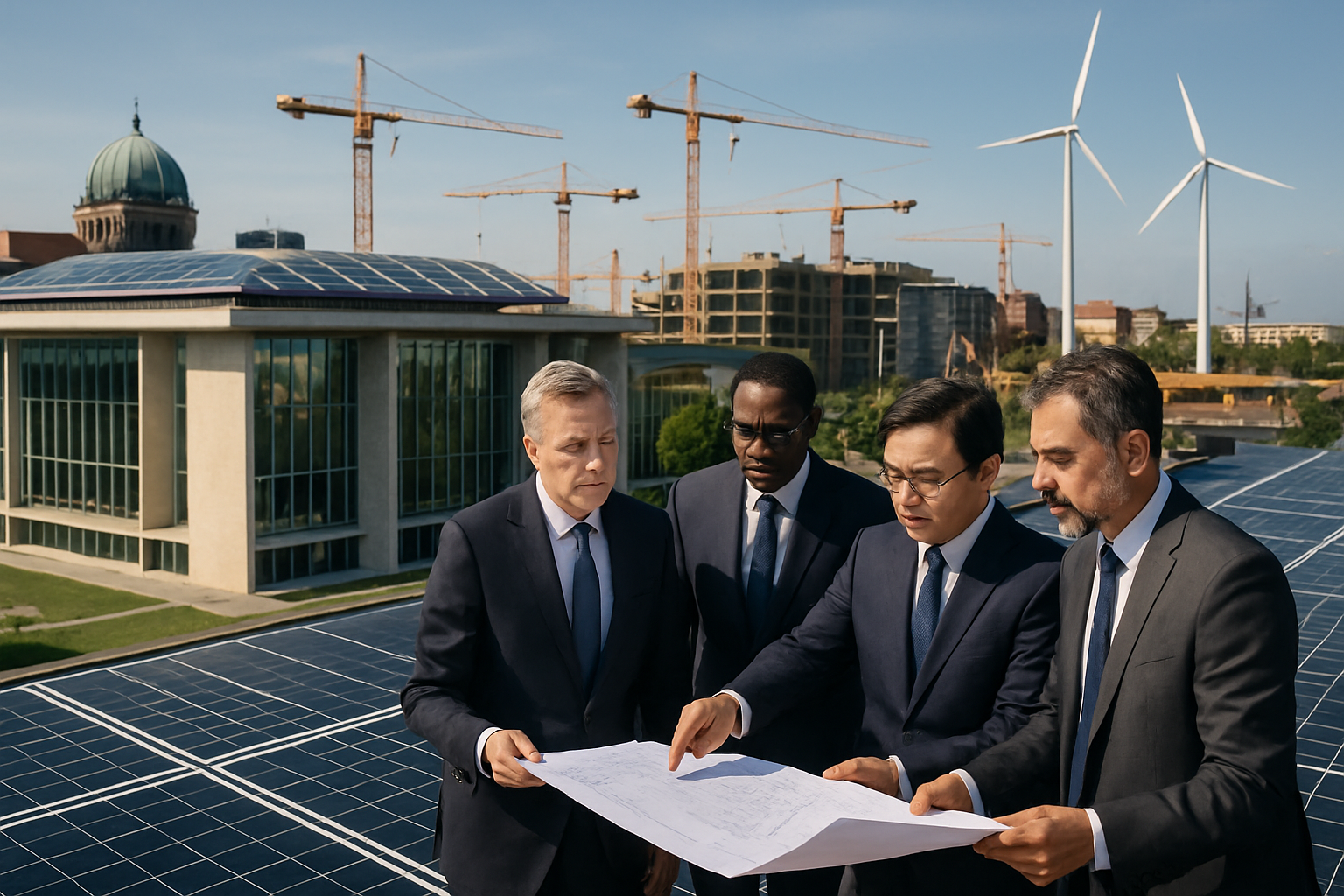
A sweeping analysis of government policy initiatives across multiple continents reveals a remarkable period of administrative innovation and infrastructure development, with nations from Barbados to Switzerland implementing transformative programs that could reshape public administration for decades to come.
From renewable energy expansion in the Caribbean to civil defense modernization in the Mediterranean, the first week of March 2026 has witnessed an unprecedented convergence of policy innovation that demonstrates how governments worldwide are adapting to 21st-century challenges through coordinated, forward-thinking initiatives.
Caribbean Energy Leadership: Barbados Expands Battery Storage Tender
In a significant move toward achieving 100 percent renewable energy by 2030, the Barbados government has extended the deadline for its ambitious 60-megawatt, 240-megawatt-hour Battery Energy Storage Systems project. Minister of Energy, Business Development and Consumer Affairs Kerrie Symmonds announced that potential investors will receive almost two additional months to submit their proposals, responding to private sector requests for more time to finalize comprehensive bids.
The decision reflects the government's commitment to ensuring robust competition and optimal technical solutions for this critical infrastructure project. Originally launched in November 2025 with a March 6 closing date, the tender extension demonstrates responsive governance that balances urgency with thoroughness in the renewable energy transition.
"This extension allows us to secure the highest quality proposals while maintaining our aggressive timeline for renewable energy independence. We're committed to having at least two entities providing battery storage to ensure system resilience."
— Kerrie Symmonds, Minister of Energy, Business Development and Consumer Affairs
The battery storage initiative forms part of Barbados's comprehensive renewable energy strategy, positioning the island nation as a Caribbean leader in sustainable energy transition. The project's success could provide a template for other small island developing states facing similar energy security challenges.
Economic Development Through Legal Vending Zones
Complementing its energy initiatives, the Barbados government is simultaneously advancing an innovative economic development program through the systematic establishment of legal vending zones across all 30 constituencies. Minister Symmonds has written to Members of Parliament requesting identification of optimal locations for these carefully planned commercial spaces.
The vending zones represent a sophisticated approach to economic formalization, featuring modern amenities including bathroom facilities, Wi-Fi connectivity, adequate lighting, and comprehensive support infrastructure. Acting Deputy Permanent Secretary Anderson Cumberbatch confirmed that preliminary work has identified at least 14 confirmed locations, with a systematic rollout planned to replace unregulated roadside vending with professionally managed commercial spaces.
This initiative demonstrates how governments can address informal economy challenges through infrastructure investment rather than enforcement alone, creating economic opportunities while improving urban planning and public safety standards.
Cyprus Strengthens National Defense Capabilities
The Cyprus Interior Ministry is preparing to submit a groundbreaking proposal to expand civil defense shelters across the island, with the plan expected to be presented at the next cabinet meeting. The comprehensive initiative aims to accommodate up to 45 percent of the island's population in its initial phase, representing the most significant civil defense expansion in the nation's modern history.
The proposal introduces innovative requirements for future residential developments, mandating that new apartment buildings allocate basement space for use as civil defense shelters equipped with essential facilities including toilets and drinking water. This forward-thinking approach integrates civil defense considerations into urban development planning, ensuring that national security infrastructure grows organically with population expansion.
Sources familiar with the matter indicate that the measure will no longer rely on voluntary compliance, representing a shift toward mandatory civil defense integration in new construction projects. This policy evolution reflects lessons learned from recent regional security challenges and demonstrates proactive governance in national preparedness.
Swiss Federal Council Rejects Solar Energy Mandate
Switzerland's Federal Council has rejected a Green Party initiative that would have made solar installations mandatory for all new buildings and major renovations, highlighting the complex balance between environmental objectives and property rights considerations. The government dismissed the proposal without offering a counter-proposal, arguing that mandatory solar requirements would infringe on private property rights.
While acknowledging the importance of renewable energy expansion, the Federal Council's decision reflects broader debates about the appropriate level of government intervention in private property development. The rejection comes amid Switzerland's ongoing energy security discussions and represents a more market-oriented approach to renewable energy deployment compared to some European neighbors.
The decision demonstrates how different nations are pursuing diverse pathways toward renewable energy goals, with some emphasizing mandates while others rely on incentives and market mechanisms to drive adoption.
Multilingual Governance Challenges in Fribourg
Switzerland continues to grapple with the practical realities of multilingual governance, as evidenced by ongoing language disputes in the city of Fribourg (Freiburg in German). Despite Switzerland's reputation as a harmonious multilingual nation, the reality proves more complex, with only about 13 percent of German-speaking Switzerland speaking French, and only around 14 percent of French-speaking Switzerland speaking German.
At language frontiers, linguistic politics can become particularly heated, challenging the idealized image of seamless multilingual coexistence. The Fribourg situation illustrates the ongoing tension between constitutional language rights and practical administrative realities in multilingual jurisdictions.
These challenges highlight the sophisticated administrative frameworks required to maintain effective governance in linguistically diverse societies, offering insights for other nations managing similar multilingual governance complexities.
International Context and Policy Implications
These diverse government initiatives occur within a broader context of accelerating global policy innovation. From renewable energy infrastructure in the Caribbean to civil defense modernization in the Mediterranean, governments are demonstrating remarkable adaptability in addressing 21st-century challenges through innovative policy frameworks.
The coordination visible across these initiatives suggests increasing international cooperation and knowledge sharing among governments facing similar challenges. Whether addressing energy security, economic development, national defense, or multilingual governance, the solutions being implemented show sophisticated understanding of how local initiatives can contribute to broader regional and global stability.

Technology Integration and Modern Governance
A common theme across these initiatives is the integration of modern technology into traditional governance structures. From Barbados's sophisticated battery storage systems requiring digital monitoring to Cyprus's comprehensive civil defense planning utilizing modern communications and coordination systems, governments are leveraging technological advancement to improve public service delivery.
The vending zone initiative in Barbados, with its emphasis on Wi-Fi connectivity and modern amenities, exemplifies how governments can use technology to formalize economic activity while improving living standards. Similarly, Cyprus's approach to civil defense planning incorporates modern construction techniques and emergency management systems that far exceed traditional shelter capabilities.
Economic Development Through Infrastructure Investment
The initiatives analyzed demonstrate governments' recognition that infrastructure investment serves as an economic development engine rather than merely a public service obligation. Barbados's battery storage project will create employment while enhancing energy security. The vending zones will formalize economic activity while generating tax revenue and improving urban environments.
Cyprus's civil defense expansion will create construction employment while enhancing national preparedness. Even Switzerland's rejection of mandatory solar installations reflects economic considerations, emphasizing market-based approaches over regulatory requirements.
Challenges and Implementation Considerations
Despite the innovation evident in these initiatives, significant implementation challenges remain. Funding sustainability, particularly for developing nations, requires sophisticated financial planning and often international cooperation. Technical capacity building demands sustained investment in human resources and institutional development.
Climate change adds complexity to all infrastructure projects, requiring adaptive management capabilities as environmental conditions evolve more rapidly than traditional planning cycles anticipated. Political sustainability across electoral cycles remains crucial for long-term policy success.
The multilingual governance challenges in Switzerland illustrate how even well-established policy frameworks require constant adaptation to changing social and demographic realities.
Regional Integration and International Cooperation
These policy initiatives demonstrate increasing recognition that effective governance in the modern era requires enhanced international cooperation. Small island states like Barbados can achieve renewable energy leadership through technology transfer and international financing mechanisms. Cyprus's civil defense planning benefits from European Union coordination frameworks and shared security arrangements.
Even Switzerland's energy policy decisions occur within broader European energy market contexts that influence national policy choices. The success of these initiatives often depends on regional integration frameworks that enable resource sharing, technology transfer, and coordinated responses to shared challenges.
Future Implications and Template-Setting Precedents
The government policy initiatives examined represent potential templates for other nations facing similar challenges. Barbados's approach to renewable energy transition could influence other Caribbean states. Cyprus's civil defense integration into urban planning may be adopted by other nations facing security challenges.
The sophisticated balance between economic development and regulatory frameworks evident in these policies suggests a maturation of governance approaches that could influence international development cooperation and policy transfer mechanisms.
Success in implementing these diverse initiatives could catalyze broader international cooperation and investment, creating positive cycles that strengthen both national capabilities and global resilience. The convergence of energy security, economic development, national defense, and multilingual governance challenges demonstrates the interconnected nature of modern policy-making.
As governments worldwide face similar pressures from climate change, economic development needs, security challenges, and social complexity, the innovative approaches being implemented across these diverse nations offer valuable lessons for the future of public administration and international cooperation in addressing shared global challenges.