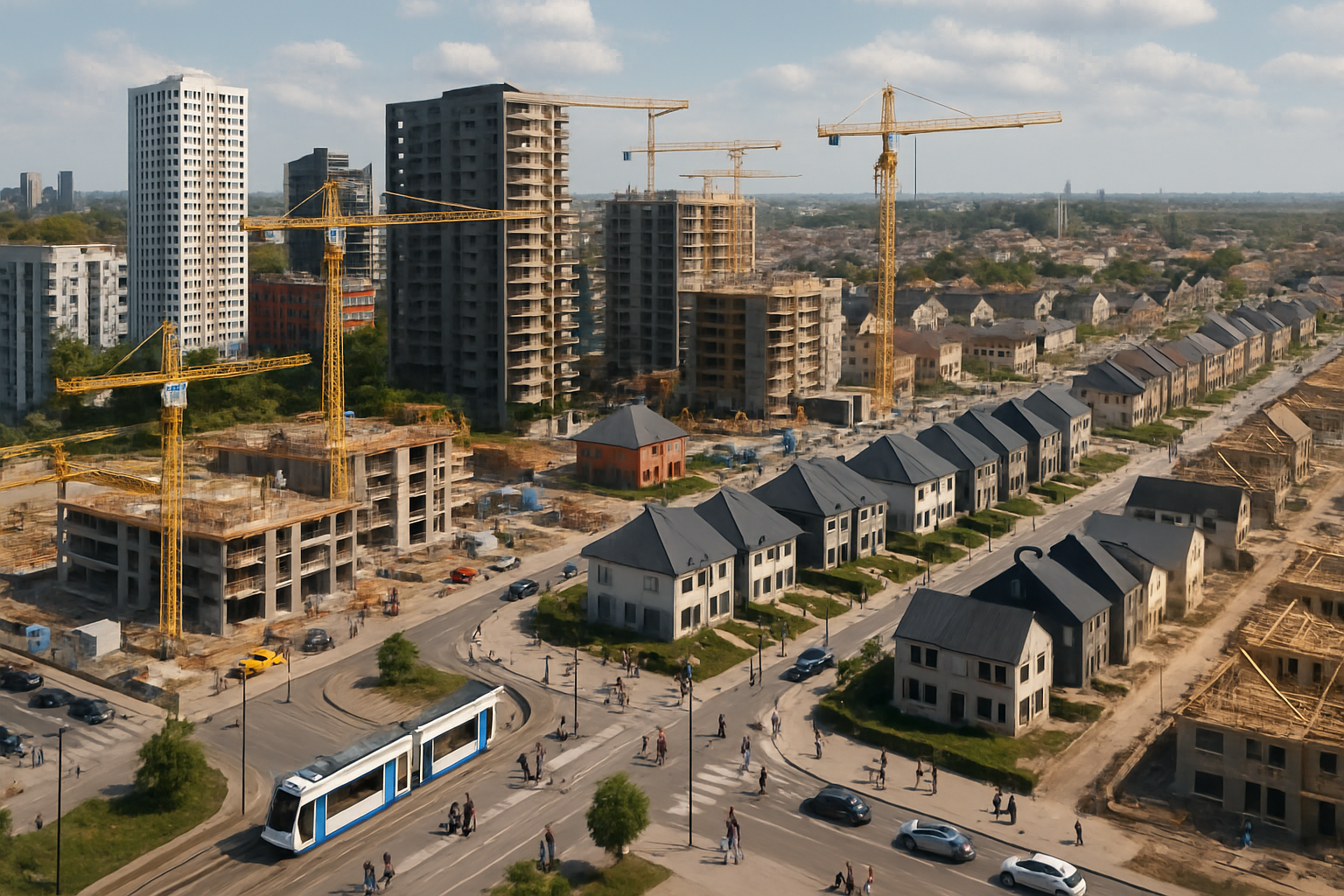
A comprehensive investigation across four continents reveals that housing markets and urban planning strategies are undergoing fundamental transformation, as cities from Australia to the Democratic Republic of Congo grapple with unprecedented challenges affecting millions of residents seeking affordable, accessible shelter.
The global housing crisis has intensified in March 2026, with developments in Brisbane, Sarajevo, Kolwezi, and Lisbon illustrating how diverse regional responses to universal challenges are reshaping urban landscapes. From revolutionary density plans to devastating displacement actions, these cases demonstrate the complex intersection of housing policy, urban planning, and social justice affecting communities worldwide.
Brisbane's Revolutionary Density Transformation
Australia's Brisbane is pioneering a dramatic shift away from suburban sprawl toward what experts describe as "Asian-style" density development. According to a new RSM report, the city is creating self-contained suburban hubs designed to eliminate the need for cross-town commutes, representing one of the most significant urban planning transformations in the Pacific region.
This strategic densification reflects broader Australian housing market pressures, with the Reserve Bank of Australia maintaining its cash rate at 3.85%, creating what analysts describe as "unprecedented challenges for first-time buyers and existing homeowners." The Brisbane approach offers a potential template for other Australian cities struggling with similar affordability and accessibility pressures.
The transformation occurs within the context of Australia's broader housing crisis, where Domain reports show existing homeowners possess a "financial shield" through record property profits while simultaneously widening the gap between established owners and first-time buyers to historic proportions. Young women are particularly affected, falling behind in homeownership despite expressing stronger ownership desires than males, creating systematic exclusion from traditional wealth-building pathways.
Sarajevo's Parking Infrastructure Crisis
In stark contrast to Brisbane's comprehensive planning approach, Sarajevo faces a different urban challenge that reflects inadequate infrastructure development. The Bosnian capital is experiencing what residents describe as "parking agony," with severe shortages of parking spaces creating significant problems for both drivers and pedestrians throughout the city.
Vehicles are increasingly abandoned on sidewalks, green spaces, and along streets, creating accessibility barriers for pedestrians and highlighting the consequences of urban development that failed to anticipate automobile ownership growth. The crisis raises critical questions about whether underground garages represent a viable solution to the space constraints affecting the historic city center.
The parking crisis exemplifies broader European urban planning challenges, where historic city centers developed before automobile transportation must adapt to modern mobility needs without compromising pedestrian access or environmental sustainability. Similar challenges affect cities across the Balkans and Mediterranean region, where rapid economic development has outpaced infrastructure investment.
Kolwezi's Devastating Housing Demolitions
The most dramatic housing development in our investigation comes from Kolwezi, in the Democratic Republic of Congo's Lualaba province, where provincial government authorities demolished hundreds of houses on March 20 in the Golf plateau/RVA cell of Dilala commune. The action left several families forced to spend the night outdoors, highlighting the extreme end of housing displacement affecting vulnerable populations.
These demolitions reflect broader challenges facing African urban centers, where rapid population growth, limited formal housing development, and inadequate urban planning create conditions where government authorities resort to forcible displacement to address perceived development priorities. The Kolwezi case demonstrates how housing challenges in developing economies can result in immediate homelessness for families with limited alternative options.
The Democratic Republic of Congo situation illustrates the global housing crisis's most severe manifestations, where formal housing markets cannot meet demand and informal settlements face constant threat of displacement. This contrasts sharply with housing challenges in developed economies, where affordability rather than basic shelter represents the primary concern.
Portugal's Housing Rights Movement
Portugal presents a third model of housing challenges, with the sixth manifestation of the "Casa Para Viver" (House to Live) movement demonstrating sustained civic engagement around housing rights. Despite smaller participation compared to previous protests, activists argue that street occupation represents an important tool for housing advocacy, though not the only approach needed for comprehensive solutions.
The Portuguese movement reflects broader European housing activism, where citizens organize to demand government action on affordability challenges affecting middle-class and working families. Portugal's approach includes policy innovations such as reclaiming 6,765 Lisbon accommodation licenses (a 40% reduction) targeting inactive properties for residential use, demonstrating government willingness to restructure tourism-oriented property markets.
Portugal's housing activism occurs within the broader European context of unprecedented coordination on housing policy. The European Union increasingly recognizes housing as a transnational challenge requiring coordinated responses, with Mediterranean countries leading innovative approaches including Croatia's program targeting 600,000 empty homes for affordable rental conversion and Cyprus's foreign investment restrictions.
Global Construction Industry Crisis
Underlying all these regional housing challenges is a deepening global construction crisis that affects every market segment from luxury developments to affordable housing projects. Rising material costs are creating negative developer profit margins worldwide, constraining new housing supply despite persistent demand across all surveyed markets.
Memory chip shortages have driven semiconductor prices to unprecedented levels—increasing sixfold due to AI development demand—affecting smart building technologies that are becoming standard requirements in modern developments. These supply chain disruptions add 20-30% to construction costs and are expected to continue until new fabrication facilities come online in 2027.
The construction crisis extends beyond traditional building materials to technological infrastructure requirements, affecting project viability fundamentally when costs outpace potential revenues. This creates market dynamics where existing properties gain value due to limited new competition while simultaneously restricting options for new buyers and renters.
Technology Integration and Smart City Development
Despite supply chain constraints, technology integration continues advancing across global housing markets. Smart city systems, sustainable materials, and community-centered design are transitioning from premium options to standard requirements in modern developments, reflecting evolved environmental consciousness and government mandates.
Digital infrastructure has become critical for attracting remote workers to secondary cities and rural areas, creating new residential demand patterns that are reshaping urban-suburban dynamics. Investment patterns increasingly favor markets with clear regulatory frameworks and transparent governance over those offering simple geographic diversification.
Environmental sustainability and energy efficiency are becoming baseline expectations rather than luxury features, with buyers viewing these elements as economic assets that reduce operating costs and provide long-term value. This evolution reflects growing awareness of climate adaptation requirements and resource scarcity affecting urban development globally.
Demographic and Social Implications
The global housing crisis is creating unprecedented demographic implications, particularly affecting younger generations and women. Research across multiple countries shows that under-30s are increasingly turning away from property investment as deposit requirements extend beyond reasonable saving timelines, creating generational wealth accumulation divides.
Gender disparities are emerging as a significant factor, with young women in countries like Australia and New Zealand falling behind in homeownership despite expressing stronger ownership desires than their male counterparts. This systematic exclusion from traditional wealth-building pathways creates long-term financial disadvantages that extend beyond immediate housing concerns.
Over half of surveyed populations across multiple countries believe that children born today will be financially worse off than their parents, reversing post-war optimism and creating social tensions around economic mobility and opportunity. Housing accessibility is increasingly determining whether cities can attract and retain diverse talent necessary for 21st-century innovation economies.
Vienna Model Provides Hope
Amid these challenges, Vienna continues to demonstrate that affordable housing is achievable in prosperous European cities through comprehensive policy frameworks that treat housing as essential infrastructure rather than a commodity. Social housing covers 60% of the rental market through sustained public investment, providing stable pricing and quality accommodations across income levels.
The Vienna model requires sustained political commitment, integration of housing policy with economic development strategies, and recognition that housing accessibility determines cities' ability to attract and retain the diverse talent necessary for innovation economies. This approach contrasts with market-only solutions that have proven insufficient for addressing current crisis scale and complexity.
Success factors in the Vienna approach include treating housing as a public good, maintaining long-term policy consistency across political cycles, and balancing market mechanisms with direct public provision to ensure accessibility across income levels. The model provides a template for other European cities grappling with similar challenges.
International Cooperation and Policy Innovation
The interconnected nature of global housing challenges requires unprecedented international cooperation and knowledge sharing. Migration patterns, investment flows, and economic spillovers mean that housing policies in one country increasingly affect neighboring markets, creating need for coordinated responses rather than isolated national approaches.
European Union initiatives represent the most advanced example of transnational housing policy coordination, with Mediterranean countries leading innovative approaches that could influence global housing policy for generations. The success of these coordinated efforts depends on sophisticated approaches balancing immediate supply needs with long-term sustainability goals.
Policy innovation requirements include developing sophisticated frameworks that balance housing supply adequacy, affordability for middle and lower-income populations, construction industry viability, and environmental sustainability simultaneously. Traditional approaches may prove insufficient for current crisis scale and complexity.
Strategic Implications for Urban Competitiveness
Current housing policy choices are shaping regional competitiveness and social stability for decades ahead. Housing accessibility increasingly determines whether cities remain accessible to diverse populations or transform into exclusive enclaves for wealthy residents, affecting social mobility, regional development, and economic competitiveness in the global innovation economy.
The window for effective action is narrowing due to demographic pressures, urbanization trends, and climate adaptation complexity requiring continued innovation in financing mechanisms and governance frameworks. Cities that successfully address housing challenges while maintaining economic dynamism will likely emerge as global leaders in the post-pandemic economy.
Success requires locally-adapted strategies that incorporate community input, environmental considerations, and sustainable urban development principles rather than universal policy templates. The diverse approaches demonstrated in Brisbane, Sarajevo, Kolwezi, and Portugal show that effective solutions must respond to specific regional conditions while contributing to broader sustainable development goals.
March 2026 represents a critical juncture in global housing policy, where choices made today will influence urban development patterns, social mobility, and economic competitiveness for decades to come. The stakes extend far beyond individual homeownership to encompass social stability, democratic governance effectiveness, and international cooperation in addressing interconnected global challenges affecting hundreds of millions seeking secure, affordable housing.