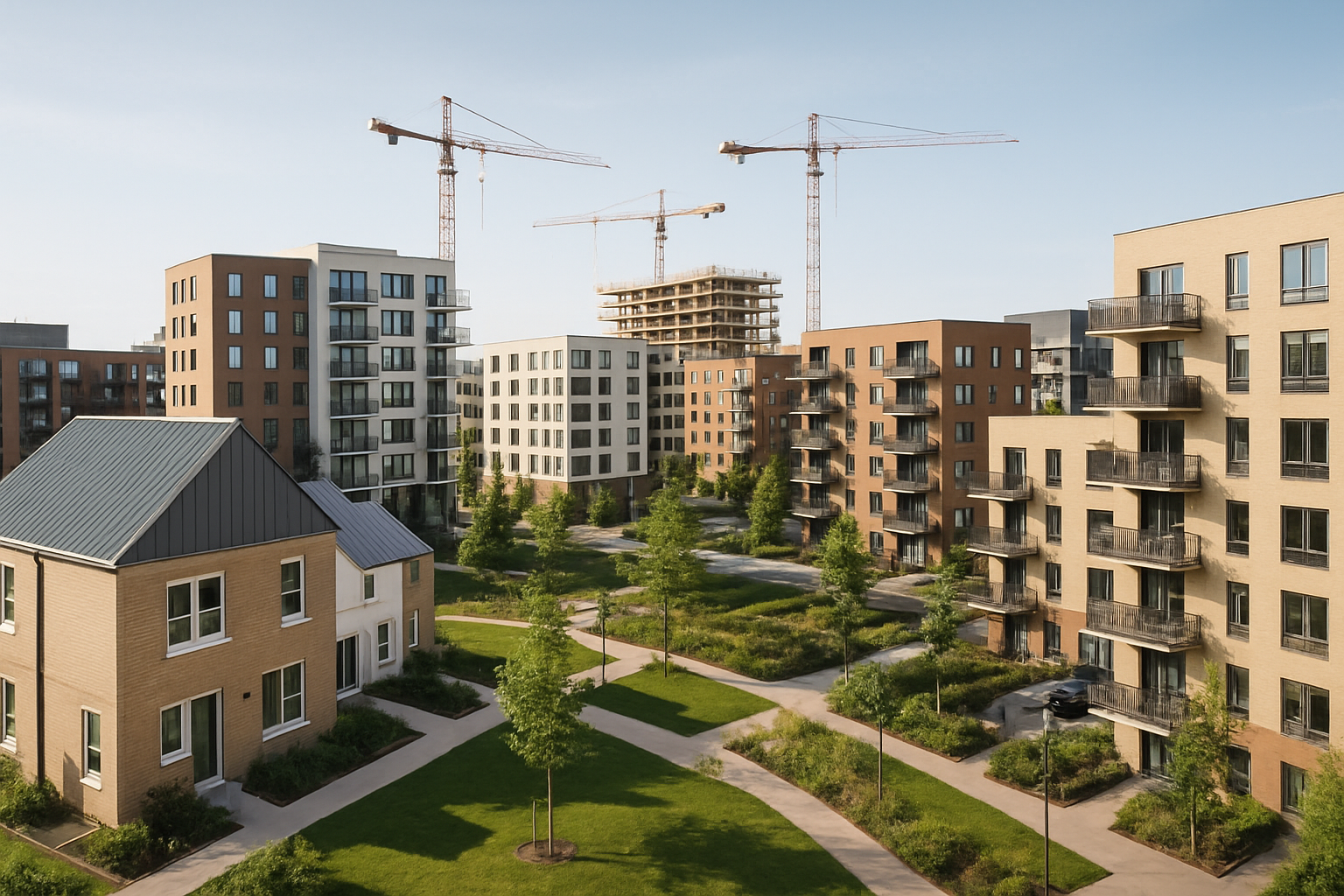
A coordinated global response to the deepening housing affordability crisis is taking shape across four continents, as cities from Croatia to New Zealand announce major construction projects and policy initiatives designed to address acute housing shortages affecting millions worldwide.
The international push comes as housing markets face unprecedented challenges, with construction costs rising dramatically and negative developer profit margins constraining supply across multiple regions. Recent data reveals that global housing markets are experiencing their most severe affordability crisis in decades, prompting governments to implement emergency measures and long-term strategic planning.
Croatia Leads European Affordable Housing Renaissance
Croatia has emerged as a leader in innovative housing solutions, with the Croatian government and Split authorities announcing a new investment cycle targeting over 300 affordable homes in the coastal city. The initiative represents part of a broader European strategy that includes Croatia's groundbreaking program to convert 600,000 empty vacation and investment properties into affordable rental accommodation.
This ambitious national program addresses a critical shortage of 230,000 residential properties across Croatia, representing one of Europe's most comprehensive housing initiatives. The strategy leverages dormant properties that were previously used for vacation rentals or investment purposes, converting them into accommodation for local residents facing affordability pressures.
"The scale of Croatia's housing program demonstrates how European nations are moving beyond traditional market-based approaches to direct intervention," said housing policy analyst Elena Petrov.
— Elena Petrov, European Housing Policy Institute
Luxembourg Border Region Faces Explosive Price Growth
The Luxembourg housing crisis has created severe ripple effects across neighboring French regions, with Longwy and Villerupt experiencing what local officials describe as an "explosion of prices" in the real estate market. The proximity to Luxembourg's high-wage economy has driven rental and purchase prices to levels comparable to major metropolitan areas.
Property market analysts report that the rental market in these border communities is "relatively tense," with demand significantly outpacing supply. The phenomenon highlights how housing pressures in one jurisdiction can rapidly spread across international boundaries, creating regional challenges that require coordinated policy responses.
The situation reflects broader European patterns where cross-border economic relationships create complex housing market dynamics. Workers earning Luxembourg wages but seeking more affordable housing in France have fundamentally altered local property markets, pricing out longtime residents and creating social tensions.
New Zealand Confronts Infrastructure and Housing Nexus
Wellington's city council has released its first comprehensive triennium plan in almost a decade, with fixing the failed Moa Point plant emerging as a critical component of the three-year strategic framework. The plan represents a recognition that housing development is inextricably linked to basic infrastructure capacity.
The Moa Point facility's failure has become emblematic of New Zealand's broader infrastructure challenges, which directly constrain housing development capacity. Without adequate water treatment and waste management systems, residential construction projects face significant delays and cost overruns.
The Wellington initiative reflects a growing international understanding that sustainable housing development requires integrated approaches combining residential construction with infrastructure modernization, environmental protection, and community service delivery.
Caribbean Nations Pioneer Inclusive Housing Strategies
Saint Vincent and the Grenadines has announced a groundbreaking approach to housing support that explicitly removes political affiliation as a criterion for assistance. Member of Parliament Kaschaka Cupid's "Together We Build" initiative in West St. George represents a shift toward non-partisan housing policy.
The program addresses a critical challenge in many developing nations where housing assistance has historically been influenced by political considerations. By committing to support all residents regardless of political affiliation, Saint Vincent and the Grenadines is establishing a model for inclusive development that could influence regional approaches.
The initiative comes amid broader Caribbean efforts to address housing shortages exacerbated by climate change, economic pressures, and limited land availability. Small island developing states face unique constraints requiring innovative approaches that maximize limited resources while ensuring equitable access to housing opportunities.
Global Construction Industry Crisis Deepening
The worldwide housing initiatives are unfolding against a backdrop of severe construction industry challenges. Material costs have risen substantially across all regions, creating negative profit margins for developers and constraining new housing supply even where demand remains strong.
Memory chip shortages have increased semiconductor prices sixfold, affecting smart building technologies that have become standard in modern developments. These supply chain disruptions extend construction timelines and increase costs for projects incorporating advanced building management systems.
The construction crisis affects all markets regardless of local housing policies. Until material costs stabilize and supply chains normalize, even innovative policy interventions face supply-side constraints that limit their effectiveness.
Mediterranean Policy Coordination Emerges
European Union recognition of housing as a transnational challenge has sparked unprecedented regional coordination. Mediterranean countries are implementing complementary policies including Cyprus's foreign investment restrictions and Greece's regional price variation analysis.
This coordinated approach reflects growing understanding that housing markets are increasingly interconnected through migration patterns, investment flows, and economic spillovers affecting neighboring regions. Isolated national policies have proven insufficient for addressing challenges that cross borders and affect multiple jurisdictions simultaneously.
Investment patterns are shifting toward localized strategies that emphasize clear regulatory frameworks and transparent governance over geographic diversification. Success requires balancing adequate housing supply with affordability for middle and lower-income populations while maintaining construction industry viability.
Technology Integration Despite Constraints
Despite supply chain challenges, technology integration continues advancing across global housing projects. Smart city systems, sustainable materials, and community-centered design are becoming standard requirements rather than premium options.
Digital infrastructure has become critical for attracting remote workers to secondary cities and rural areas, creating new residential demand patterns. The integration of environmental monitoring, energy efficiency systems, and automated building management reflects evolved understanding of housing as comprehensive living ecosystems rather than simple shelter provision.
However, the 20-30% cost increases from semiconductor shortages are creating implementation challenges for developers already facing margin pressures. Long-term infrastructure benefits are clear, but immediate costs constrain adoption rates.
Policy Implications and Future Outlook
The global housing developments of early 2026 represent a watershed moment requiring sophisticated policy responses. Traditional housing policy approaches may prove insufficient for current challenge scale and complexity. Success depends on innovative frameworks balancing multiple objectives: adequate supply, affordability, construction industry viability, and environmental sustainability.
International cooperation is essential for knowledge sharing and coordinated responses as housing challenges prove increasingly interconnected. The window for effective action is narrowing due to demographic pressures, urbanization trends, and climate adaptation complexity requiring continued innovation and adaptive management.
The diverse approaches represented by Croatian vacant property conversion, Luxembourg's cross-border market pressures, New Zealand's infrastructure integration, and Saint Vincent's inclusive policies demonstrate that housing solutions require locally-adapted strategies incorporating community input, environmental considerations, and sustainable urban development principles.
As cities worldwide grapple with affordability crises, the initiatives launched in early 2026 will provide crucial templates for addressing universal challenges through regionally-specific solutions. The success or failure of these programs will influence global housing policy for decades to come, determining whether societies can develop adaptive capacity for thriving in an interconnected, climate-challenged world.