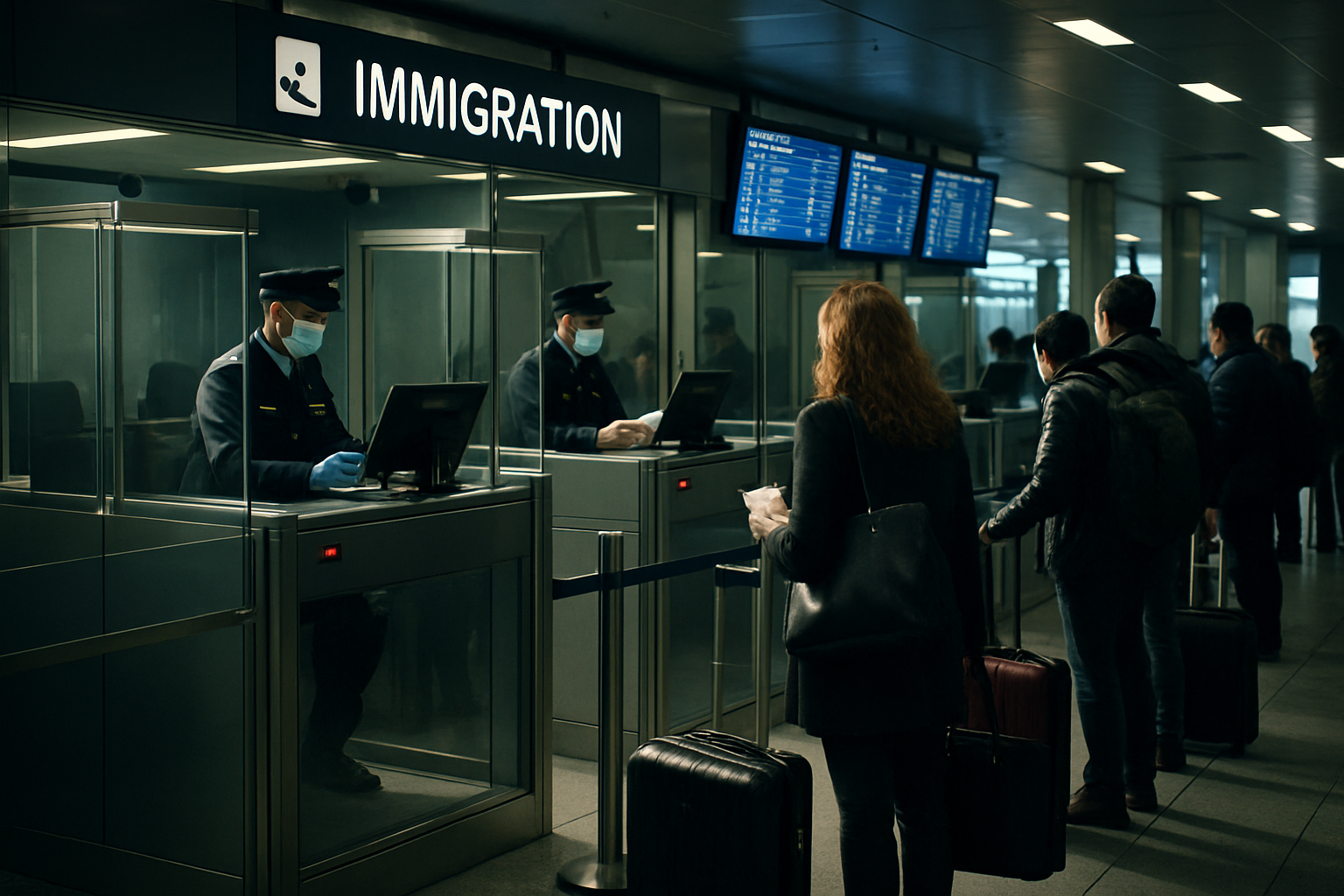
A mounting global immigration crisis is exposing deep fractures in international border policies as nations struggle to balance humanitarian obligations with security concerns, creating unprecedented challenges for migrants and governments alike.
From Canada's sudden work permit cancellations to France's controversial deportation procedures, new evidence reveals a coordinated tightening of immigration policies across Western democracies that is leaving thousands of migrants in legal limbo and sparking diplomatic tensions between nations.
Canada's Silent Immigration Enforcement
In British Columbia, Irish social worker Dillon Nolan discovered his work permit had been cancelled without his knowledge or any opportunity to respond, forcing him to abandon his mental health practice and return to Ireland. Nolan, who specialized in youth mental health services, believed he had followed all immigration requirements before Immigration, Refugees and Citizenship Canada (IRCC) made the unilateral decision.
"I thought I had done everything right," Nolan told CBC News, describing his shock at learning of the cancellation only when border guards arrested him on the street. The case highlights what immigration lawyers describe as a new pattern of enforcement without due process notifications.
The incident reflects broader challenges in Canada's immigration system, where processing delays and communication failures are leaving skilled workers vulnerable to sudden deportation despite their contributions to critical sectors like healthcare and education.
France and the Ethiopian Deportation Controversy
In a separate but related development, U.S. Immigration and Customs Enforcement (ICE) completed the deportation of Solomon Bogale, an Ethiopian national whose case has drawn international attention. According to French correspondent Tom Canetti's investigation, ICE determined that Bogale's online activity supported the FANO militia fighting against Ethiopia's government forces.
"ICE said Solomon Bogale posted messages calling for violence against Tigrayans and advocating ethnic persecution."
— Tom Canetti, FRANCE 24 Correspondent
The deportation represents a new frontier in immigration enforcement, where social media activity is being scrutinized for political affiliations that could justify removal. Legal experts warn this precedent could affect thousands of migrants whose home countries are experiencing civil conflicts.
Australia's Complex Deportation Decisions
Meanwhile, Australia's immigration system faced scrutiny over the case of Nathan Teraki, a New Zealand citizen who successfully argued against deportation after causing a fatal crash while driving under the influence. Despite living in Australia for 16 years, Teraki convinced authorities he had no meaningful connections left in New Zealand.
The case highlights the complexity of deportation decisions involving dual nationals and long-term residents, where personal ties and rehabilitation potential must be weighed against criminal behavior. Australian immigration officials are increasingly required to make nuanced determinations about individual circumstances rather than applying blanket policies.
Serbia-Kosovo Diplomatic Progress
In a rare positive development, EU Special Envoy Peter Sorensen successfully mediated an agreement between Kosovo authorities and Serbian officials regarding residence permits for Serbian students and educators. The one-year permits represent a breakthrough in the ongoing Belgrade-Pristina dialogue.
This diplomatic success contrasts sharply with the deteriorating immigration relations elsewhere, suggesting that targeted negotiations can still produce humanitarian outcomes even in politically sensitive contexts.
Broader European Policy Shifts
These individual cases occur against the backdrop of sweeping policy changes across Europe. Recent memory records show the UK implemented its first-ever "emergency brake" visa restrictions in March 2026, suspending study visas for nationals from Afghanistan, Cameroon, Myanmar, and Sudan due to what officials described as systematic abuse of legal migration channels.
The European Parliament has also approved historic asylum procedure changes allowing deportation to "safe" third countries, representing a fundamental shift from protection-based to deterrence-focused policies. Greece is leading a coalition with Germany, Netherlands, Austria, and Denmark to establish external processing centers in Africa for rejected asylum seekers.
Technology and Enforcement
The EU's Entry/Exit System (EES) has detected over 4,000 overstayers in its first four months of operation, demonstrating the effectiveness of biometric border controls. However, the system has also created processing delays that required partial summer suspensions, highlighting the tension between security objectives and practical implementation.

Human Rights Concerns Mount
Civil rights organizations are preparing constitutional challenges across multiple countries, arguing that new restrictive policies violate international humanitarian law principles. The principle of non-refoulement—which prohibits returning people to countries where they face persecution—is being tested by new external processing arrangements.
Legal experts note that 2026 is becoming a watershed year for international migration management, with policy decisions made now likely to influence approaches for decades to come. The success or failure of current enforcement strategies will provide crucial data for democratic border management globally.
Economic Implications
The economic impact of these policy shifts is already visible. Canada's sudden work permit cancellations are affecting critical sectors like healthcare and social services. The UK's student visa restrictions threaten billions in international education revenue and could damage academic partnerships built over decades.
In contrast, some countries are experiencing success with more welcoming approaches. Albania has successfully integrated 27,000 foreign nationals to address labor shortages in fishing, construction, manufacturing, and tourism sectors, demonstrating that strategic immigration can address demographic challenges.
Climate and Displacement Pressures
Underlying all these policy debates is the reality of increasing climate displacement. January 2026 marked the 18th consecutive month of global temperatures exceeding 1.5°C above pre-industrial levels, contributing to migration pressures that are only expected to intensify.
Demographic challenges, including aging populations and labor shortages, create tensions between economic needs for migration and political pressures for restrictions. This contradiction is forcing governments to choose between short-term political gains and long-term economic sustainability.
Looking Forward
The cases documented across Canada, France, Australia, New Zealand, and Serbia represent more than isolated incidents—they signal a fundamental transformation in how democratic nations approach immigration and border control. The balance between humanitarian commitments, security concerns, and economic needs remains precarious.
As international cooperation becomes increasingly difficult amid rising nationalism, individual migrants like Dillon Nolan find themselves caught in policy shifts beyond their control. The human cost of these macro-political decisions continues to mount, even as governments struggle to find sustainable approaches to unprecedented global migration challenges.
The success or failure of current policies will determine whether democratic nations can maintain their humanitarian values while effectively managing complex migration flows in an interconnected world facing climate change, regional conflicts, and economic disruption.