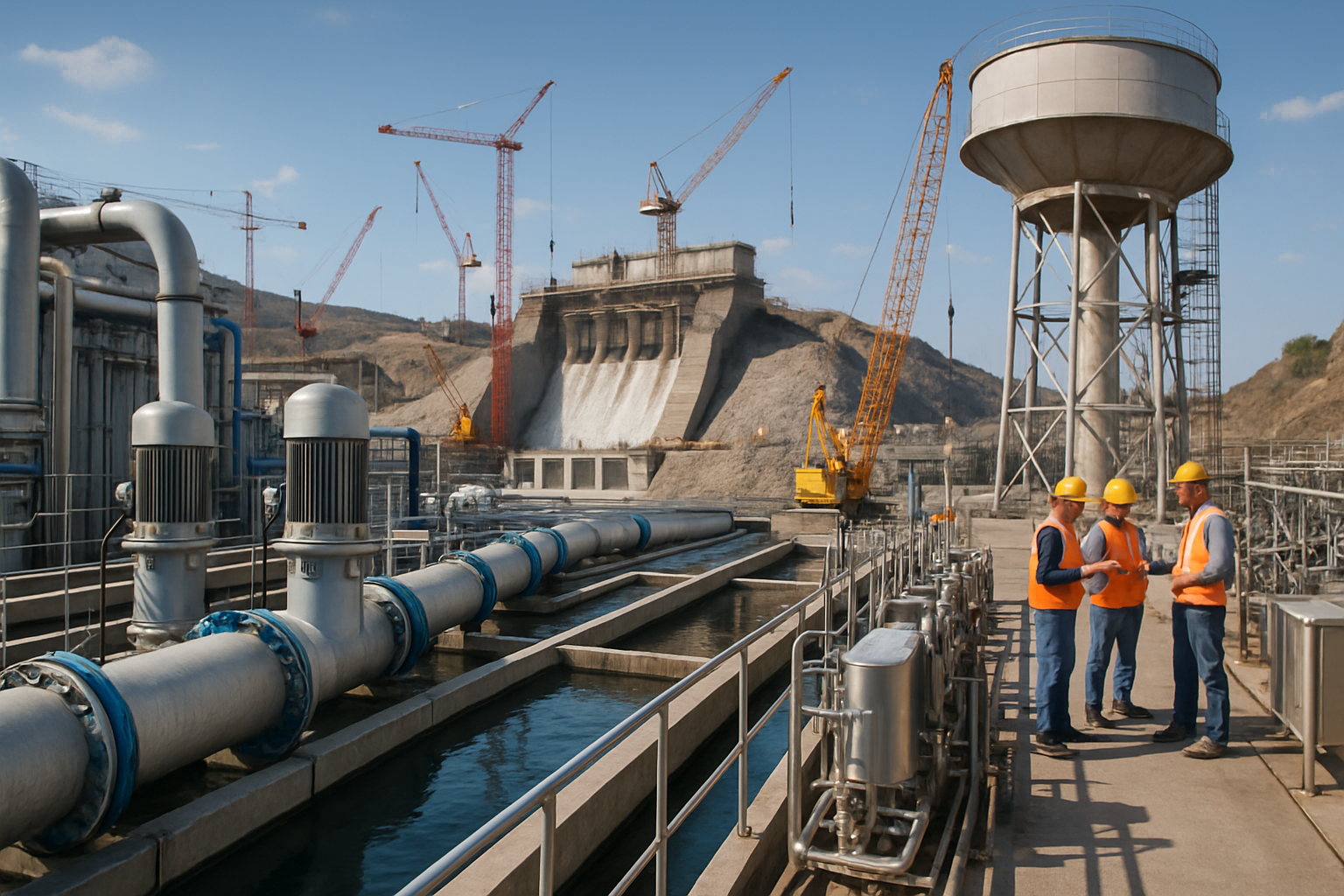
A coordinated global infrastructure renaissance is emerging across three continents, with major water system upgrades, hydroelectric power projects, and construction developments demonstrating unprecedented international investment in essential services and sustainable development.
From Colombia's historic water access projects to the Democratic Republic of Congo's renewable energy initiatives and Kuwait's groundbreaking housing infrastructure, February 2026 marks a pivotal moment in global infrastructure development, with projects collectively representing billions in investment and affecting millions of lives.
Colombia's Water Access Breakthrough
In a landmark achievement for Colombia's infrastructure development, the Santa Elena corregimiento is set to receive potable water service for the first time through a project that has reached 54% completion. The initiative, involving a $4.227 billion peso investment (approximately $1.1 million USD), will provide clean drinking water access to 650 inhabitants of El Rosario in Medellín, marking a historic milestone in fulfilling basic human rights through infrastructure development.
This project represents more than just technical achievement—it embodies Colombia's commitment to addressing decades of infrastructure inequality that have left rural and peripheral communities without access to basic services. The investment demonstrates how targeted infrastructure spending can transform lives and communities, providing the foundation for economic development and improved quality of life.
The Colombia project aligns with broader Latin American infrastructure initiatives documented in recent global analyses, including Ecuador's waste management system modernization and Paraguay's underground power line installations, indicating a regional infrastructure renaissance across South America.
Democratic Republic of Congo's Renewable Energy Vision
In the Democratic Republic of Congo's Maniema province, the Centre de recherche en ressources en eau du bassin du Congo (CRREBAC) has identified five strategic pilot sites for the construction of mini-hydroelectric dams and meteorological stations. This initiative forms part of the ambitious "Eau, Énergie et Écosystème" (WEEN) project, supported by German international cooperation through GIZ.
The project represents a sophisticated approach to infrastructure development that integrates water resource management, energy generation, and environmental monitoring. By focusing on mini-hydroelectric installations, the initiative addresses the DRC's massive energy access challenges while maintaining environmental sustainability and supporting local economic development.
This approach reflects emerging best practices in African infrastructure development, where projects increasingly emphasize local ownership, environmental sustainability, and technological transfer. The German cooperation partnership demonstrates how international collaboration can support African-led development initiatives while building local technical capacity.

Kuwait's Historic Housing Infrastructure Initiative
Kuwait's Public Authority for Housing Welfare has approved a historic tender for water tower construction as part of the country's affordable housing project, marking the first such initiative in the Authority's history. Deputy Director-General Amina Abdulkarim Al-Awadhi emphasized this represents a crucial step toward developing integrated residential cities with modern infrastructure ensuring sustainable water services and operational efficiency.
The project reflects Kuwait's broader strategy to diversify its economy and improve citizens' quality of life through comprehensive infrastructure development. By integrating water infrastructure directly into housing development planning, Kuwait demonstrates advanced thinking about sustainable urban development and community services integration.
This initiative aligns with broader Gulf Cooperation Council trends toward comprehensive infrastructure modernization, including the UAE's smart city initiatives and Saudi Arabia's NEOM project, indicating regional leadership in sustainable urban development approaches.
Global Infrastructure Investment Context
These projects occur within a broader context of unprecedented global infrastructure investment. Recent analysis indicates over $570 billion in transportation and utility infrastructure projects launched globally in early 2026, spanning continents from Australia's $9 billion renewable energy fast-track approvals to Estonia's advanced heat storage facilities and Guatemala's electricity procurement attracting 43 companies for 1,550 megawatts of generation capacity.
The coordination reflects lessons learned from the COVID-19 pandemic about the critical importance of resilient infrastructure systems. Governments worldwide recognize that infrastructure investment provides both immediate economic stimulus through job creation and long-term competitiveness through improved connectivity, energy security, and quality of life.
"This initiative reflects the Council of Ministers' directive to develop integrated residential cities with modern infrastructure to ensure sustainable water services and operational efficiency."
— Amina Abdulkarim Al-Awadhi, Deputy Director-General, Kuwait Public Authority for Housing Welfare
Technology Integration and Innovation
Modern infrastructure projects increasingly integrate advanced technology solutions. The DRC's meteorological station installations will provide real-time weather data supporting both energy generation optimization and climate adaptation planning. Kuwait's water tower project incorporates smart monitoring systems for operational efficiency. Colombia's water system includes advanced treatment technology ensuring water quality and system sustainability.
These technological integrations reflect broader global trends where infrastructure development incorporates digital monitoring, artificial intelligence for predictive maintenance, and renewable energy systems. Such approaches maximize long-term value while minimizing environmental impact and operational costs.
Climate Adaptation and Sustainability
All three projects demonstrate explicit attention to climate adaptation and environmental sustainability. The DRC's mini-hydroelectric dams provide renewable energy while supporting ecosystem services. Colombia's water system addresses increasing climate variability affecting rural water access. Kuwait's integrated housing approach anticipates future water scarcity challenges through efficient distribution systems.
This sustainability focus reflects global recognition that infrastructure investments must account for climate change impacts while contributing to greenhouse gas emission reductions. Projects that fail to incorporate climate considerations risk becoming stranded assets as environmental conditions change.
Economic Development Implications
Infrastructure development creates multiple economic benefits beyond immediate construction employment. Water access enables agricultural development, small business growth, and improved health outcomes reducing healthcare costs. Renewable energy provides affordable electricity supporting industrial development and household welfare. Housing infrastructure attracts investment and supports population growth in strategic areas.
Economic multiplier effects extend across sectors: construction materials, transportation, professional services, and long-term operational employment. Countries investing strategically in infrastructure position themselves for sustained economic growth and improved international competitiveness.
International Cooperation Models
The projects demonstrate diverse successful international cooperation models. The DRC-Germany partnership combines technical expertise with local knowledge and ownership. Kuwait's domestic initiative reflects hydrocarbon revenue reinvestment in sustainable development. Colombia's project represents government commitment to addressing historical infrastructure inequities.
Successful international cooperation requires balancing external technical and financial support with local ownership and capacity building. Projects that transfer knowledge and build local technical capabilities create lasting development benefits beyond immediate infrastructure improvements.
Implementation Challenges and Solutions
Infrastructure projects face common challenges: financing coordination, environmental considerations, technical complexity, and community engagement. Successful projects address these through comprehensive planning, stakeholder consultation, adaptive management approaches, and sustained political commitment.
The February 2026 projects demonstrate improved project management approaches learned from previous infrastructure initiatives. Early stakeholder engagement, environmental impact assessment, technology integration planning, and international cooperation frameworks provide foundations for successful implementation.
Future Infrastructure Trends
The Colombia, DRC, and Kuwait projects indicate several emerging trends in global infrastructure development: integration of multiple services (water, energy, housing), emphasis on sustainability and climate adaptation, technology incorporation from project inception, and international cooperation supporting local ownership.
Future infrastructure development will likely emphasize resilience, sustainability, and smart technology integration. Projects that successfully balance these priorities while serving community needs provide templates for scaling infrastructure investment globally.
As climate change impacts intensify and urbanization accelerates, infrastructure development becomes increasingly critical for sustainable development. The projects launched in February 2026 demonstrate that coordinated international investment, technological innovation, and commitment to equity can deliver transformative infrastructure serving current needs while building resilience for future challenges.