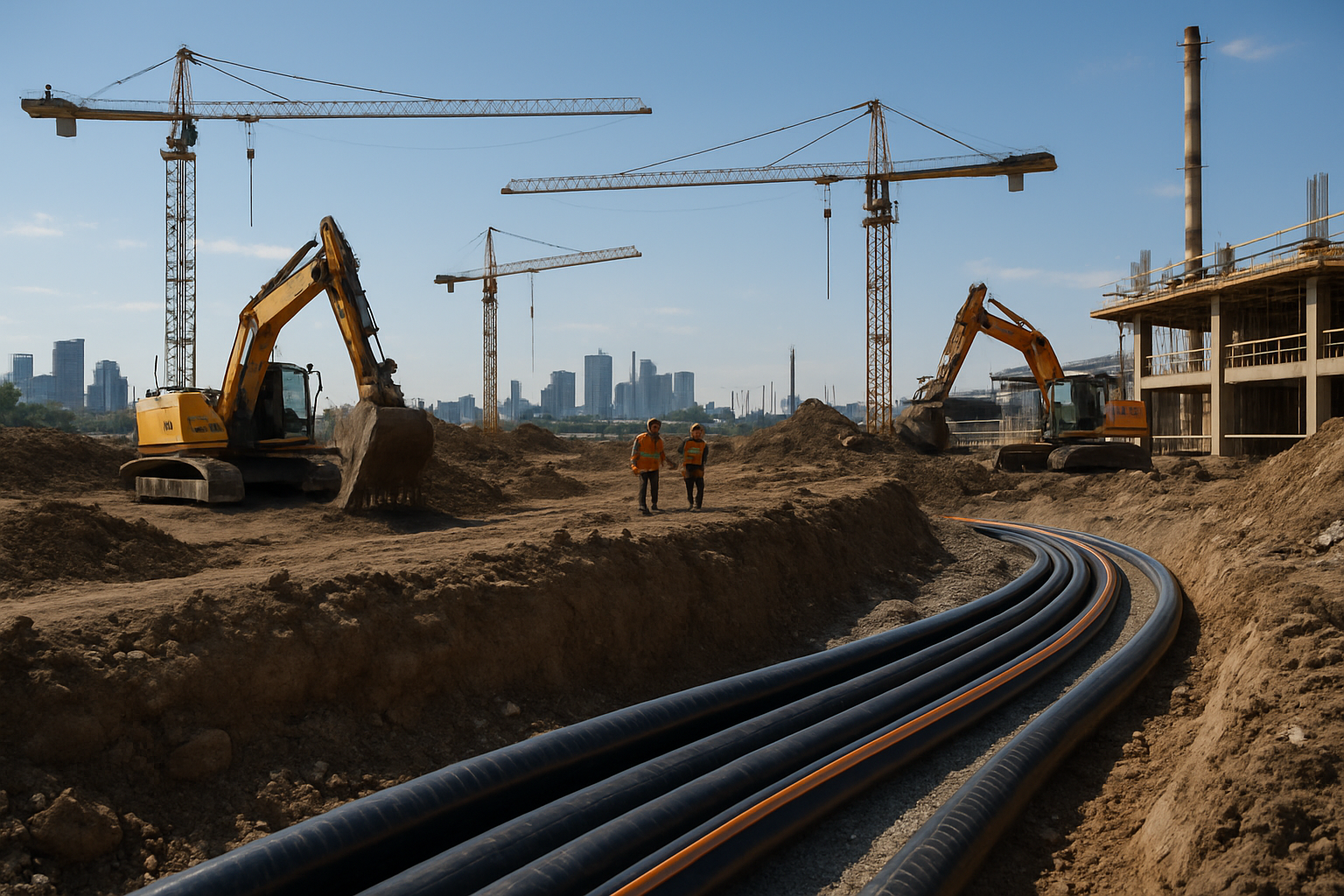
A coordinated wave of infrastructure development projects across four continents demonstrates the unprecedented scale of global investment in critical systems, with Kuwait, Paraguay, Uzbekistan, and New Zealand leading ambitious initiatives valued at hundreds of millions of dollars in early February 2026.
The Ministry of Electricity, Water and Renewable Energy in Kuwait announced the commencement of extensive fiber optic cable works linking existing main substations across multiple regions, beginning February 9 and continuing through February 14. The project encompasses excavation and backfilling operations as part of comprehensive efforts to enhance infrastructure and improve operational network efficiency.
The ambitious Kuwaiti initiative covers multiple strategic areas including the western Shuaiba Industrial Area (Blocks 3, 4, 5 and 7), Abdullah Al-Mubarak (Blocks 4, 5, 7 and 8), Jleeb Al-Shuyoukh (Block 4), Al-Jahra (Block 1), Al-Qadsiya (Block 5), Al-Zour, and the Shuwaikh Industrial-Educational area.
Latin America Advances Underground Infrastructure
Paraguay's Ministry of Public Works reported significant progress on civil and electrical works related to the underground installation of high-tension power lines along Costanera Norte Avenue in Asunción. The initiative aims to strengthen urban infrastructure while preserving public spaces and green areas to contribute to improved quality of life for residents.
During January 2026, a new phase of interventions continued actions initiated in late 2025, enabling substantial advances in the electrical modernization of one of the capital's most important roadway corridors. Work crews completed reconstruction of sidewalks and curbs, in addition to reconditioning railings on the Costanera Norte bridge and executing cleaning of storm drains and registers in the section between the General Santos rotunda and connecting streets.
"These projects represent our commitment to modernizing critical infrastructure while maintaining environmental sustainability and improving urban living conditions."
— Ministry of Public Works spokesperson
Central Asia Expands Healthcare Infrastructure
Uzbekistan's Ministry of Health announced plans for a large multi-profile hospital with 800-bed capacity in the Fergana region under a public-private partnership model. The healthcare facility represents a significant expansion of medical infrastructure in Central Asia, designed to serve the growing population and improve access to specialized medical services.
The project demonstrates Uzbekistan's commitment to modernizing healthcare infrastructure through innovative financing mechanisms that combine public oversight with private sector efficiency and expertise.
New Zealand Evaluates Renewable Energy Expansion
Two massive solar farm projects bidding for government fast-track approval near Lake Benmore have been instructed to assess their combined environmental impacts. The developments represent New Zealand's largest proposed solar energy installations, requiring comprehensive environmental review to determine potential cumulative effects on the local ecosystem.
The projects highlight New Zealand's commitment to renewable energy expansion while maintaining stringent environmental protection standards, balancing climate objectives with ecological preservation.
Global Context of Infrastructure Investment
These developments occur within a broader context of unprecedented global infrastructure investment estimated at over $570 billion across multiple continents. Recent major completions include Mexico's El Insurgente train ($5.56 billion), Vietnam's commitment to $120 billion in expressway development through 2050, and various energy cooperation initiatives spanning from Algeria-Italy partnerships to Armenia-Japan renewable energy agreements.
The February 2026 infrastructure surge demonstrates coordinated international recognition of infrastructure as fundamental to economic development, climate adaptation, and regional integration. Projects incorporate advanced technologies, sustainable development principles, and innovative financing mechanisms combining public and private resources.
Technology Integration and Innovation
Modern infrastructure projects increasingly incorporate smart technology integration, with Kuwait's fiber optic network expansion enhancing digital connectivity for industrial and residential areas. Paraguay's underground power line installation represents urban infrastructure modernization reducing visual pollution while improving system reliability and maintenance access.
The healthcare facility in Uzbekistan exemplifies public-private partnership models becoming standard for large-scale infrastructure development, enabling governments to leverage private sector expertise while maintaining public oversight of essential services.
Environmental and Economic Implications
New Zealand's rigorous environmental review process for solar farm development reflects growing recognition that renewable energy expansion must balance climate objectives with ecosystem protection. The requirement for cumulative impact assessment demonstrates sophisticated environmental planning approaches being adopted globally.
Economic implications extend beyond immediate construction employment to long-term competitiveness improvements through enhanced connectivity, reliable energy systems, and modern healthcare infrastructure. Projects create multiplier effects through improved business environments, reduced operational costs, and enhanced quality of life attracting investment and talent.
Implementation Challenges and Opportunities
Infrastructure development faces universal challenges including timeline coordination, environmental compliance, financing sustainability, and technical complexity management. However, 2026 projects demonstrate improved project management capabilities with enhanced international cooperation and technology transfer.
Success factors include comprehensive planning, stakeholder engagement, adaptive management responding to changing conditions, and integration with broader economic development strategies. Modern infrastructure projects increasingly emphasize sustainability, resilience, and community benefit alongside traditional engineering objectives.
The coordinated timing of major infrastructure announcements across multiple continents suggests growing recognition of infrastructure investment as essential for post-pandemic economic recovery, climate adaptation, and sustainable development objectives. These projects represent a fundamental shift toward strategic infrastructure planning addressing 21st century challenges through innovative approaches and international cooperation.