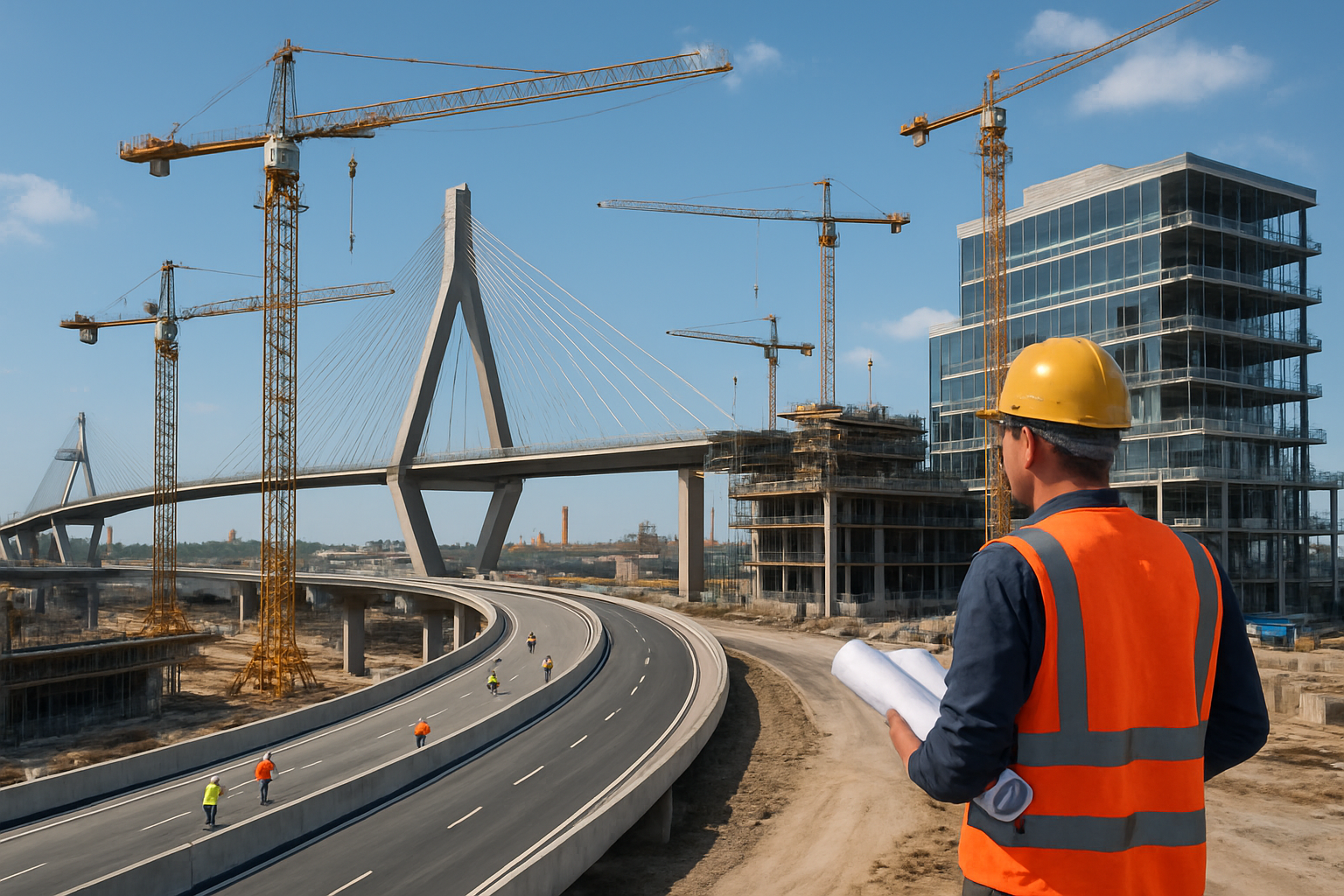
Cities across three continents are simultaneously launching transformative infrastructure projects that will reshape urban landscapes and connectivity for decades to come, with Algeria announcing a major administrative reorganization of its capital, Bosnia advancing its largest sports facility development, and Vietnam accelerating critical airport-city connections.
The developments represent a coordinated global response to 21st-century challenges, incorporating smart technology integration, climate adaptation measures, and comprehensive urban planning approaches that extend far beyond traditional construction projects.
Algeria's Strategic Capital Restructuring
President Abdelmadjid Tebboune has signed a presidential decree fundamentally reorganizing Algeria's capital region, reducing administrative districts from the previous structure to 13 strategic zones. The reorganization eliminates the Sidi Abdellah administrative district while transferring the municipalities of Maalma and Rahmania to the Zeralda district, streamlining governance and improving service delivery for millions of residents.
The administrative restructuring reflects broader North African infrastructure development trends, where governments are leveraging improved organizational frameworks to enhance urban management efficiency. The changes align with Algeria's broader modernization strategy, which includes significant public transportation investments and regional connectivity improvements that have emerged as priorities following decades of infrastructure underinvestment.
"This reorganization represents a fundamental shift toward more efficient urban governance that can better serve our citizens while supporting economic development goals."
— Presidential Decree 26-112, Official Gazette
Bosnia's Flagship Sports Infrastructure Development
Bosnia and Herzegovina is advancing its largest infrastructure project in years with the Trnovo Business-Sports Center on Bjelašnica Mountain, valued at 16.9 million KM and covering 11.21 hectares at approximately 1,300 meters elevation. The comprehensive development, situated near Babino Dol in the central sports-recreational zone of Bjelašnica, represents the country's most ambitious attempt to establish world-class sports and business facilities.
The project demonstrates Bosnia's strategic positioning for regional sports tourism and business development, leveraging its mountainous terrain and proximity to major urban centers. The facility is designed to serve multiple functions beyond traditional sports venues, incorporating business meeting spaces, accommodation facilities, and year-round recreational opportunities that could transform the region's economic profile.
Construction is proceeding under strict environmental protection standards, with the development incorporating sustainable building practices and minimal ecological impact measures essential for mountain environments. The project showcases how Balkan nations are balancing ambitious development goals with environmental responsibility, setting precedents for future regional infrastructure initiatives.
Vietnam's Transportation Revolution
Ho Chi Minh City is launching emergency construction of the Ben Thanh-Thu Thiem section of Metro Line No. 2, a $1.25 billion project designed to create strategic connectivity between the city center and the forthcoming Long Thanh International Airport. The initiative represents Vietnam's most aggressive urban transportation expansion, intended to reduce current three-hour journey times to just 30 minutes for Southeast Asia's planned largest aviation hub.
The metro development forms part of Vietnam's broader $120 billion commitment to building 9,000 kilometers of expressways by 2050, positioning the country as a critical logistics and transportation hub for the ASEAN region. The project incorporates advanced rail technology, climate-resilient design, and integration with existing transportation networks to create a comprehensive mobility ecosystem.
Vietnamese authorities have emphasized the project's importance for economic competitiveness, recognizing that efficient airport connectivity directly impacts the country's ability to attract international business, tourism, and investment. The development timeline reflects unprecedented political commitment to infrastructure modernization, with construction beginning in April 2026 despite complex technical and financial challenges.
Technology Integration and Smart Infrastructure
Modern infrastructure projects across all three nations incorporate sophisticated technology integration from the design phase, including real-time monitoring systems, predictive maintenance capabilities, digital payment platforms, and environmental optimization features. These technologies represent standard requirements rather than premium additions, reflecting the evolution of infrastructure development toward comprehensive smart systems.
Climate adaptation has emerged as a central design requirement, with projects incorporating enhanced drainage systems, weather-resistant materials, backup power infrastructure, and flood management capabilities designed for future climate conditions rather than historical patterns. This approach addresses the reality that January 2026 marked the 18th consecutive month of global temperatures exceeding 1.5°C above pre-industrial levels.
The global semiconductor shortage, which has driven memory chip prices sixfold higher, has created implementation challenges for smart building technologies but has accelerated innovation in alternative approaches, including more efficient algorithms and distributed processing systems that make infrastructure networks more resilient and adaptable.
Economic Multiplier Effects and Regional Integration
Infrastructure investments demonstrate substantial economic multiplier effects extending well beyond construction employment. Algeria's administrative reorganization is expected to improve business efficiency and reduce bureaucratic costs, while Bosnia's sports complex will create permanent hospitality and management employment alongside construction jobs. Vietnam's metro system will generate lasting benefits through reduced logistics costs, enhanced market access, and improved business productivity.
These projects support broader regional integration objectives, including the African Continental Free Trade Area (AfCFTA) goals, European Union connectivity initiatives, and ASEAN economic integration frameworks. The infrastructure serves as the physical foundation enabling increased commerce, cultural exchange, and economic cooperation across borders.
Success factors consistently include sustained political commitment, transparent governance frameworks, comprehensive community engagement, and adaptive management strategies that can respond to changing conditions while maintaining core development objectives.
Financing Innovation and International Cooperation
Contemporary infrastructure development demonstrates sophisticated financing approaches combining public-private partnerships, international development cooperation, and innovative funding structures. Algeria's project benefits from domestic investment combined with technical expertise sharing, while Bosnia leverages European development funds and regional cooperation agreements.
Vietnam's metro development showcases how developing nations can access international capital markets and technical assistance for large-scale transportation projects, creating models that other Southeast Asian cities are already studying for their own infrastructure needs.
International cooperation has evolved beyond traditional North-South aid relationships toward peer-to-peer knowledge sharing, with successful infrastructure models in one region providing templates for adaptation in different geographic and political contexts.
Implementation Challenges and Solutions
Universal infrastructure challenges include material cost inflation creating negative developer profit margins, skilled labor shortages requiring extensive training and knowledge transfer programs, environmental compliance adding complexity to project approvals, and coordination demands across multiple government agencies and private stakeholders.
Successful projects demonstrate adaptive management approaches that balance immediate development needs with long-term sustainability goals, incorporate extensive community consultation processes, and maintain flexibility to adjust timelines and specifications as conditions evolve.
Environmental compliance has evolved from an optional consideration to a fundamental requirement for project financing and regulatory approval, with modern infrastructure required to demonstrate climate resilience, renewable energy integration, and waste reduction protocols.
Strategic Significance for Global Development
March 2026 represents a watershed moment for global infrastructure development, with unprecedented coordination demonstrating how nations are addressing 21st-century connectivity challenges through the convergence of technological advancement, environmental awareness, and international cooperation.
These infrastructure decisions will influence development strategies worldwide for decades ahead, determining whether societies develop the adaptive capacity necessary to thrive in an interconnected, climate-challenged world. The choice between reactive crisis management and transformative infrastructure adaptation represents one of the most significant policy decisions of the current decade.
The global infrastructure renaissance of 2026 may be remembered as the moment when humanity began systematically building the physical foundations for sustainable prosperity in an uncertain but interconnected future, through sophisticated project management that integrates international best practices with local expertise and community needs.