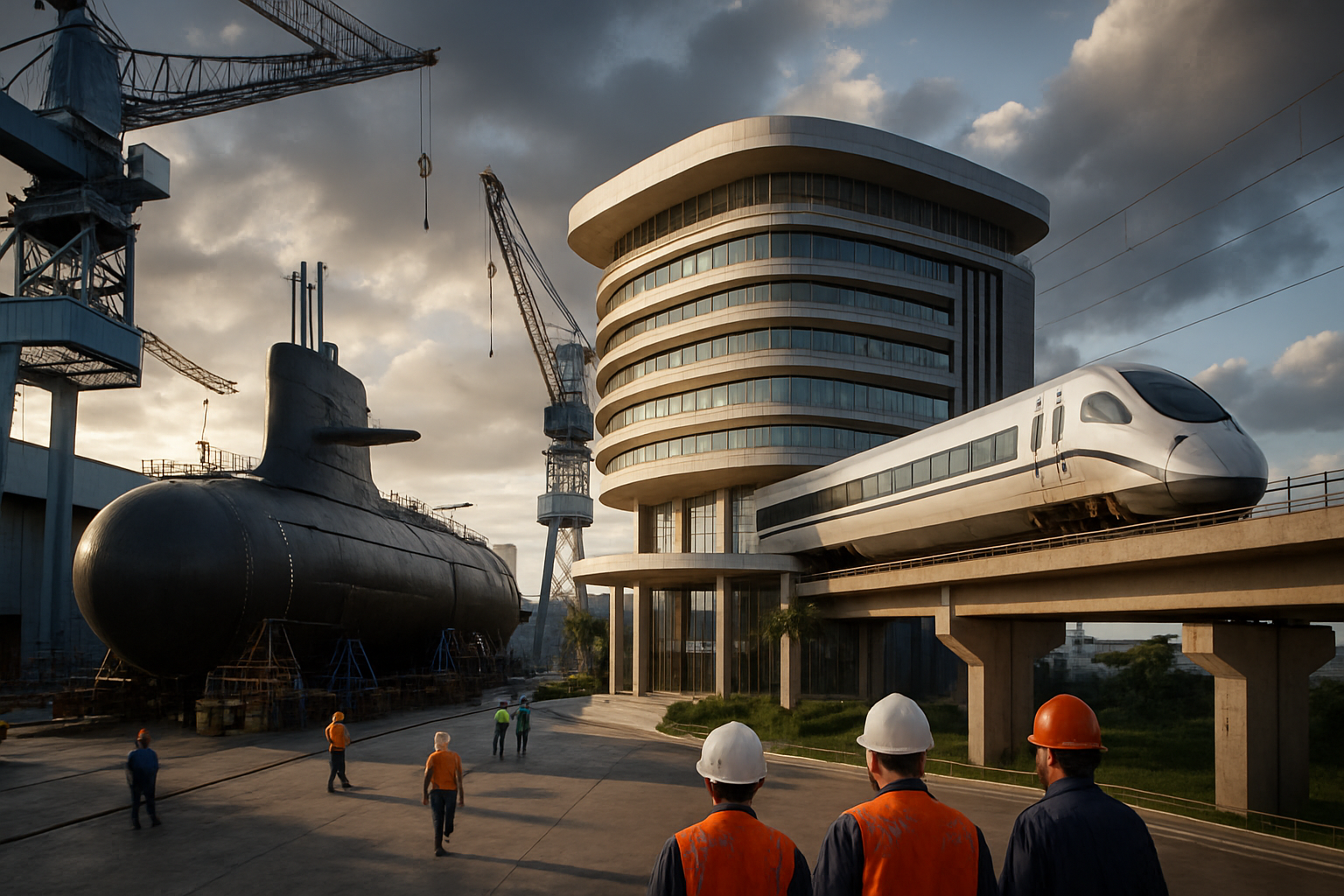
Major infrastructure developments across three continents highlight an unprecedented global investment surge, as Australia commits $30 billion to nuclear submarine construction, Guyana nears completion of a government services center, and Vietnam confronts transportation challenges ahead of its new airport opening.
Australia's Historic AUKUS Investment
Prime Minister Anthony Albanese has announced a transformative $3.9 billion federal investment in Adelaide's Osborne shipyard, representing the initial "downpayment" toward a total $30 billion nuclear submarine construction program. This massive infrastructure project will support 10,000 skilled workers required to build nuclear-powered submarines under the AUKUS defense partnership with the United Kingdom and United States.
The Osborne shipyard in Adelaide has been selected as the primary construction facility, requiring extensive upgrades to accommodate nuclear propulsion systems, advanced materials, and complex integration systems. This investment marks Australia's entry into an exclusive group of just seven nations capable of constructing nuclear submarines, alongside the United States, United Kingdom, Russia, China, France, and India.
"This represents the largest defense investment in Australian history, fundamentally reshaping our naval capabilities for decades to come."
— Anthony Albanese, Australian Prime Minister
The workforce development component represents one of the largest skills development programs in Australian defense history, requiring extensive training in nuclear technology, advanced manufacturing, and submarine construction methodologies. Workers will need nuclear materials handling certification and specialized equipment operation capabilities.
Guyana's Government Services Revolution
In Guyana, Minister Madanlall Ramraj within the Ministry of Public Works visited the newly constructed Government Services Centre at Cotton Field, Region Two, as the facility moves closer to completion. The center forms part of the government's broader effort to deliver passports, registrar services, and digital services closer to residents in the region.
This infrastructure development represents Guyana's commitment to modernizing public service delivery and reducing the burden on citizens who previously had to travel long distances to access government services. The center incorporates modern digital infrastructure and sustainable design elements, positioning Guyana as a regional leader in government service innovation.
The project aligns with broader Caribbean infrastructure initiatives focused on improving connectivity and service delivery across island and coastal communities. The timing of this completion demonstrates effective project management amid global supply chain challenges.
Vietnam's Airport Connectivity Challenge
Vietnam faces a significant transportation infrastructure challenge as the upcoming Long Thanh Airport prepares for its opening. Currently, the trip from downtown Ho Chi Minh City to the new airport can take up to three hours, with even longer delays during congestion periods. Vietnamese authorities are now pursuing an ambitious goal to reduce this travel time to just 30 minutes.
This connectivity challenge highlights the critical importance of integrated transportation planning in major infrastructure projects. Long Thanh Airport, positioned to become Southeast Asia's largest aviation hub, requires sophisticated ground transportation networks to realize its full potential for economic development and regional connectivity.
The solution involves multiple transportation modes, including high-speed rail connections, dedicated highway infrastructure, and integrated digital traffic management systems. Success in addressing this challenge will establish Vietnam as a model for airport-urban integration in rapidly developing economies.
Global Infrastructure Investment Context
These developments occur within an unprecedented $570+ billion global infrastructure investment surge that has characterized early 2026. From Vietnam's $120 billion expressway commitment to build 9,000 kilometers of new roads by 2050, to Kenya's accelerated highway completions and Nicaragua's Chinese-engineered airport partnerships, nations worldwide are prioritizing infrastructure as essential for post-pandemic recovery and climate adaptation.
The diversity of projects—from Australia's defense-focused submarine program to Guyana's citizen services center and Vietnam's transportation solutions—demonstrates how different nations are addressing their unique development priorities while participating in a coordinated global infrastructure renaissance.
Technology Integration and Innovation
Modern infrastructure projects increasingly incorporate smart technology, climate resilience planning, and environmental sustainability as standard requirements rather than optional additions. Australia's submarine program includes advanced materials science and digital monitoring systems. Guyana's government center features integrated digital services delivery. Vietnam's airport connectivity solutions involve AI-enabled traffic management and real-time analytics.
This technology integration represents a fundamental evolution from traditional infrastructure toward comprehensive systems supporting economic development, environmental protection, and social connectivity simultaneously. Success requires sophisticated project management, international cooperation, and adaptive implementation strategies.
Economic Multiplier Effects
Infrastructure investments create significant economic multiplier effects beyond their immediate construction value. Australia's $30 billion submarine program will establish an entire ecosystem of suppliers, contractors, and specialized manufacturers, positioning South Australia as a nuclear submarine manufacturing hub with impacts extending far beyond direct employment at the Osborne facility.
Guyana's government services center will improve business environment conditions, reduce transaction costs for citizens and enterprises, and demonstrate institutional capacity that attracts additional investment. Vietnam's airport connectivity improvements will enhance tourism potential, business development opportunities, and regional trade facilitation.
Implementation Challenges and Opportunities
Each project faces distinct implementation challenges requiring specialized solutions. Australia must establish comprehensive nuclear regulatory capabilities, workforce development programs, and technology transfer protocols. Guyana needs to ensure sustainable operations and community engagement for its new facility. Vietnam requires coordinated multi-modal transportation planning and massive construction execution.
However, these challenges create opportunities for international cooperation, knowledge sharing, and technological advancement. Australia's nuclear submarine program involves deep collaboration with UK and US partners. Regional integration initiatives support shared infrastructure development costs and expertise sharing.
Strategic Regional Implications
Beyond their immediate national benefits, these infrastructure projects contribute to broader regional integration and international cooperation frameworks. Australia's nuclear submarine capability enhances Indo-Pacific security cooperation and alliance relationships. Guyana's modernized government services support Caribbean regional development and integration objectives. Vietnam's airport connectivity improvements strengthen ASEAN economic integration and competitiveness.
The success of these projects will influence infrastructure planning approaches worldwide, establishing precedents for balancing immediate development needs with long-term sustainability, security considerations, and international cooperation requirements.
Looking Forward
February 2026 represents a pivotal moment in global infrastructure development, with nations demonstrating unprecedented political commitment and financial resources toward comprehensive modernization. The convergence of defense investments, public service improvements, and transportation innovations illustrates how infrastructure serves as the foundation for economic development, social progress, and international competitiveness in the 21st century.
As these projects advance toward completion, their success will provide crucial lessons for the broader global infrastructure surge, demonstrating whether massive investments can deliver transformative outcomes while maintaining fiscal sustainability, environmental responsibility, and community benefits. The stakes extend far beyond individual projects to encompass national development trajectories and international cooperation frameworks for decades ahead.