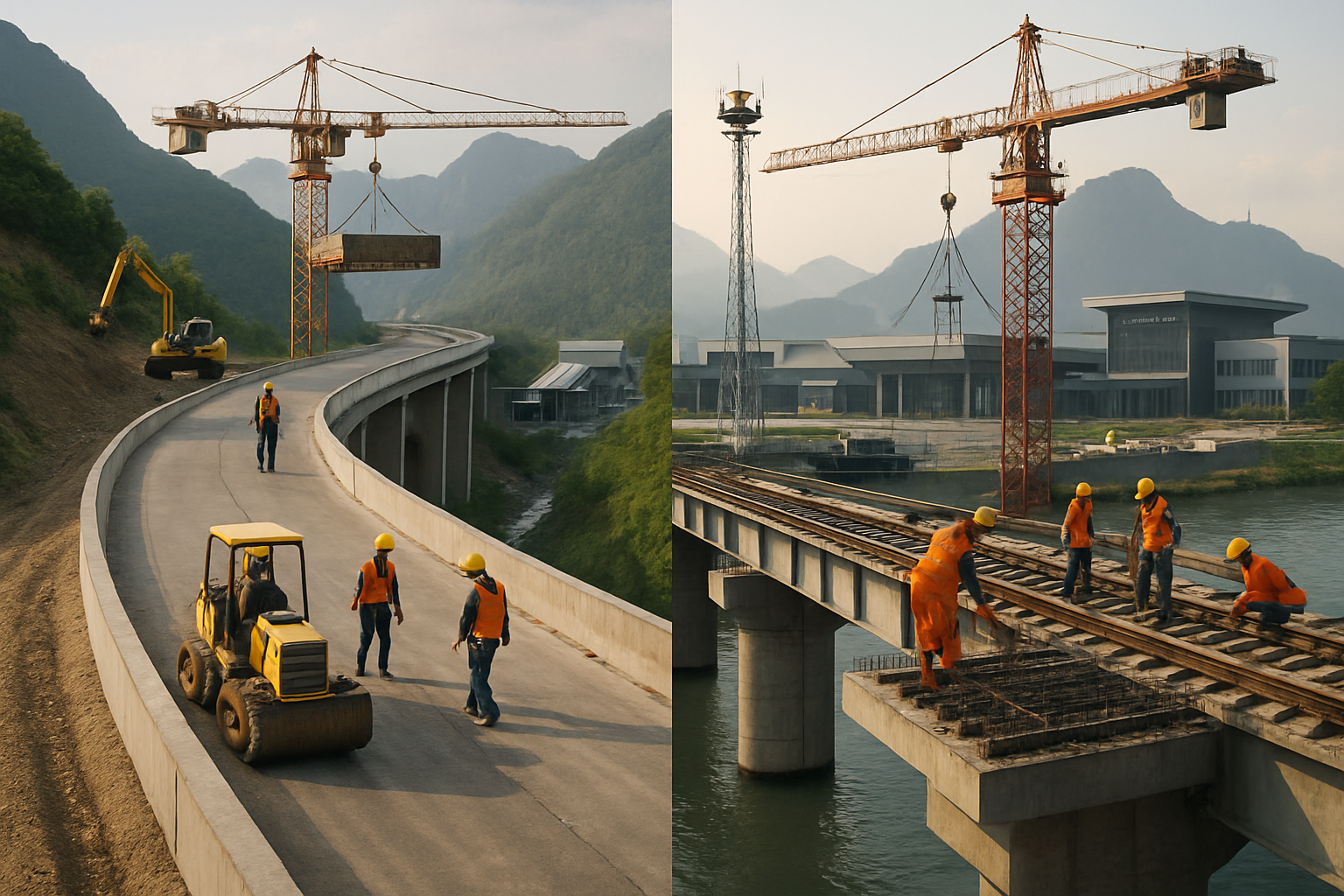
Three significant transportation infrastructure developments across Vietnam, Peru, and Brunei demonstrate the accelerating pace of the global $570+ billion infrastructure surge, as nations simultaneously advance major construction projects while responding to climate-related disruptions and energy security challenges.
Vietnam's Revolutionary Mountain Expressway
Vietnam is constructing a VND25 trillion ($953 million) mountain expressway that will fundamentally transform connectivity between two of the nation's premier tourist destinations. The ambitious project will slash travel time between the coastal city of Nha Trang and the highland resort town of Da Lat from nearly four hours to under two hours, representing one of Southeast Asia's most challenging mountain engineering projects.
This development is part of Vietnam's broader $120 billion commitment to build 9,000 kilometers of expressways by 2050, positioning the country as a major logistics hub within the ASEAN economic framework. The project incorporates sophisticated technology integration from the design phase, including real-time monitoring systems, predictive maintenance capabilities, and climate adaptation features essential for mountain terrain subjected to monsoon conditions.
Peru's Emergency Rail Infrastructure Response
Peru faces a critical transportation challenge as a huaico (debris flow) has interrupted the railway route connecting Hidroeléctrica with Machu Picchu Pueblo, known as the "Amazónica" route. The disruption specifically affects the vital link that serves both tourists visiting Peru's most famous archaeological site and local populations dependent on rail connectivity in the mountainous region.
In response to this infrastructure emergency, the District Municipality of Machu Picchu has announced plans to install a provisional aerial bridge to guarantee continued transit access. This temporary solution highlights the increasing frequency of climate-related infrastructure disruptions that require rapid, innovative responses to maintain connectivity to economically vital destinations.
"The provisional bridge will ensure that both visitors and local residents can continue to access Machu Picchu safely while we work on permanent repairs to the railway infrastructure."
— District Municipality of Machu Picchu
Brunei's Energy Security Border Measures
Brunei has implemented stringent new fuel requirements for foreign-registered vehicles entering the country starting April 1, 2026, requiring all vehicles to cross borders with at least three-quarters of their fuel tanks filled. The Department of Energy's announcement reflects growing concerns about protecting subsidized fuel supplies for domestic use amid global energy market volatility.
These measures come as the global economy faces its most severe oil shock in decades, with the blockade of the Strait of Hormuz—resulting from ongoing conflicts involving the United States, Israel, and Iran—triggering acute energy shortages worldwide. Brent crude oil prices have reached historic levels, forcing nations to implement protective measures for their energy security.
Foreign vehicles failing to meet the three-quarters tank requirement will be denied entry at Brunei's borders, with only official government vehicles exempted from these regulations. This policy represents a significant shift toward energy nationalism as countries prioritize domestic fuel security over traditional cross-border mobility.
Global Infrastructure Context and Climate Adaptation
These three developments occur within the context of unprecedented global infrastructure investment, with 2026 marking the 22nd consecutive month of global temperatures exceeding 1.5°C above pre-industrial levels—the longest sustained warming period in recorded history. This climate reality is driving fundamental changes in how infrastructure projects are conceived, designed, and implemented.
Modern infrastructure projects increasingly incorporate climate adaptation as a mandatory requirement rather than an optional feature. Enhanced drainage systems, weather-resistant materials, backup power infrastructure, and flood management capabilities are becoming standard components of major transportation projects, designed for future climate conditions rather than historical patterns.
Technology Integration and Smart Systems
The current infrastructure renaissance is characterized by sophisticated technology integration from the design phase. Projects now incorporate real-time monitoring systems, predictive maintenance capabilities, digital payment integration, and environmental optimization features as standard requirements. This represents a fundamental shift from traditional infrastructure approaches that viewed technology as retrofitted additions.
However, the global semiconductor shortage, which has caused sixfold price increases through 2027, is accelerating innovation toward more efficient algorithms and distributed processing systems. This constraint is paradoxically driving the development of more resilient and adaptable infrastructure networks that require fewer specialized components while delivering superior performance.
Economic Multiplier Effects and Regional Integration
These infrastructure developments create substantial economic multiplier effects beyond their immediate transportation benefits. Vietnam's mountain expressway will generate thousands of construction jobs while permanently reducing logistics costs and enhancing market access between coastal and highland regions. The improved connectivity supports ASEAN regional integration objectives by facilitating tourism and trade flows.
Peru's emergency response to the Machu Picchu rail disruption demonstrates how critical infrastructure protection supports tourism-dependent economies. The archaeological site attracts millions of international visitors annually, making reliable transportation access essential for both local communities and national economic objectives.
Brunei's fuel security measures, while restrictive, reflect broader regional efforts to maintain energy independence and economic stability amid global supply chain vulnerabilities. These policies may influence cross-border transportation patterns and logistics planning throughout Southeast Asia.
Challenges and Implementation Strategies
Current infrastructure projects face multiple implementation challenges, including material cost inflation, skilled labor shortages, environmental compliance requirements, and the need for sophisticated cross-border coordination. Success factors increasingly include comprehensive stakeholder engagement, transparent governance frameworks, and adaptive management capabilities that can respond to changing conditions.
The memory chip shortage affecting smart transportation systems has forced infrastructure planners to develop more resilient approaches that balance technological advancement with backup systems and human oversight. This constraint is creating more robust and adaptable infrastructure networks that can function effectively even when sophisticated digital systems face disruptions.
Future Implications for Global Transportation
March 2026 represents a watershed moment in global infrastructure development, where the choice between transformative adaptation and reactive crisis management becomes increasingly critical. The convergence of technological advancement, environmental awareness, and international cooperation is creating new development models that prioritize sustainability alongside economic growth.
Vietnam's mountain expressway establishes precedents for complex terrain engineering in tropical climates. Peru's emergency response demonstrates adaptive management for climate-vulnerable heritage sites. Brunei's energy security measures may influence regional approaches to resource protection amid global supply chain instability.
These developments collectively demonstrate that successful infrastructure investment in the 21st century requires balancing immediate mobility needs with long-term sustainability, national priorities with regional integration, and technological advancement with environmental responsibility. The projects established in 2026 will influence global transportation strategies for decades ahead, determining whether investments become foundations for sustainable prosperity or climate-vulnerable assets.
As nations navigate unprecedented environmental volatility and economic pressures, the infrastructure choices made today will determine societies' ability to thrive in an increasingly interconnected and climate-challenged world. The success of current projects in Vietnam, Peru, and Brunei will provide valuable templates for the global infrastructure renaissance continuing throughout the remainder of this critical decade.