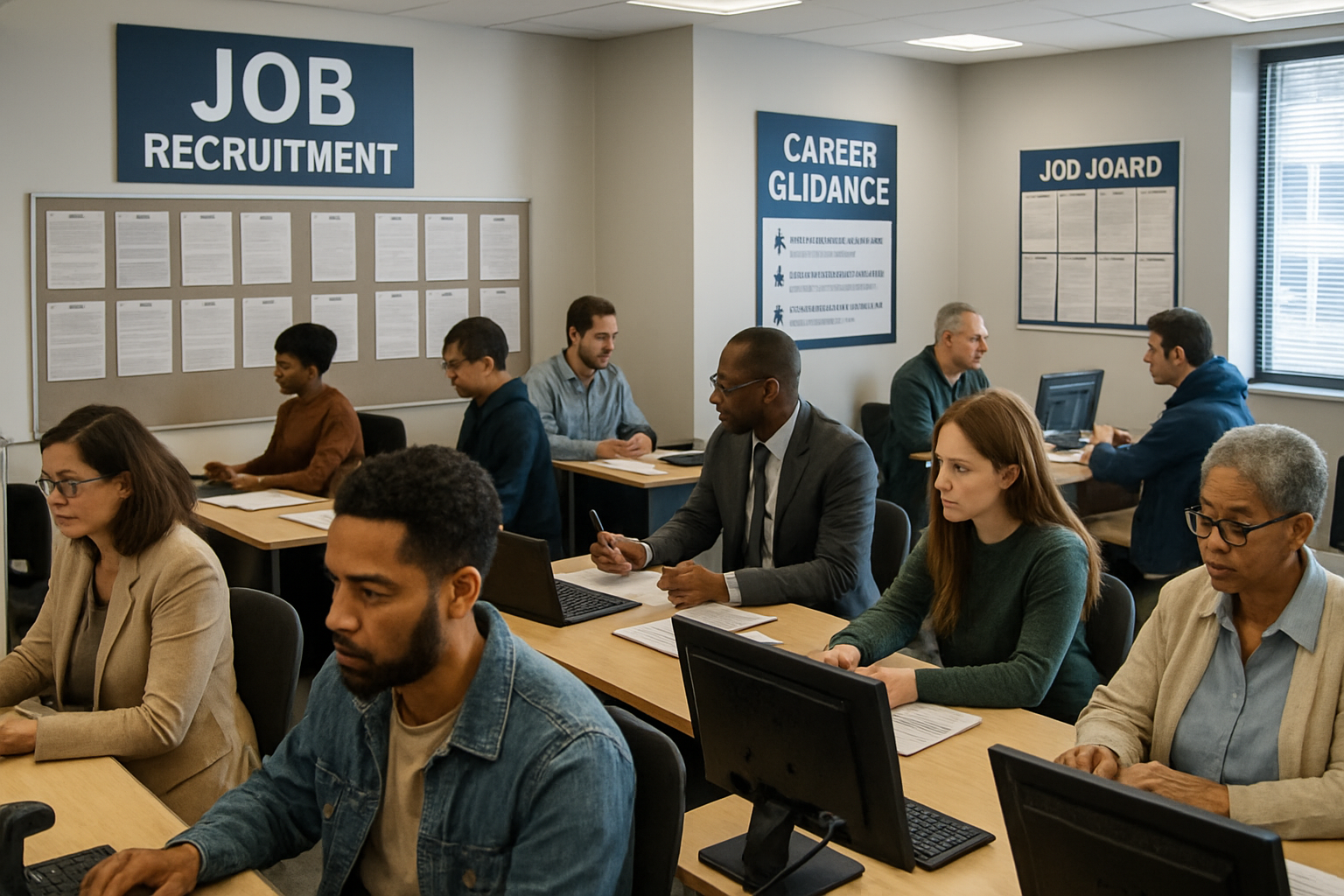
The global job market presents a tale of contrasts in March 2026, with the United States posting a surprisingly robust recovery by adding 178,000 jobs and reducing unemployment to 4.3%, while other developed nations struggle with persistent youth employment crises and structural barriers to meaningful work.
The U.S. Labor Department reported Friday that March hiring marked a significant rebound from February's devastating loss of 133,000 jobs, with gains approximately three times what economists had forecast. The unemployment rate declined from 4.4% in February, partly due to a reduction in the labor force as some workers stopped actively seeking employment.
US Recovery Defies Expectations
American employers demonstrated remarkable resilience in March, with job creation spanning multiple sectors including healthcare and hospitality. The employment surge comes amid broader economic uncertainty and represents the strongest monthly performance since early 2026, providing validation for current economic policies.
The recovery appears particularly significant given the challenging global context. Health care and hospitality sectors led the charge in adding workers, suggesting consumer confidence and demand for services remain robust despite broader economic headwinds affecting international markets.
"The job gains were about three times what economists had forecast, demonstrating the underlying strength of the American economy."
— U.S. Labor Department Report
International Challenges Paint Different Picture
While the United States celebrates employment gains, international data reveals a more sobering reality for job seekers worldwide. In New Zealand, the employment crisis for young people has reached critical levels, with Stuart Baker representing thousands of job seekers who face an impossible choice between basic survival and career advancement.
Baker, who has applied for more than 50 positions, exemplifies the harsh reality facing many job seekers globally—having leads and applications but lacking the financial resources to attend interviews. This paradox highlights the systemic barriers that prevent qualified candidates from accessing available opportunities.
Youth Employment Crisis Reaches Breaking Point
The situation in New Zealand reflects a broader international pattern documented throughout 2026. Student Job Search received 38,000 applications in January competing for only 4,600 available positions—an overwhelming 8-to-1 ratio that forces students to "juggle multiple jobs" just to survive financially while pursuing education.
In the United Kingdom, nearly 957,000 young people aged 16-24 are classified as NEET (Not in Employment, Education, or Training), representing 12.8% of the workforce and marking the second-highest level in over a decade. Bank of England Chief Economist Huw Pill has noted that the NEET rate serves as a better indicator than headline unemployment figures for understanding youth labor market difficulties.
Structural Barriers to Employment
The employment challenges extend beyond simple job availability to encompass systemic issues that prevent qualified candidates from accessing opportunities. The phenomenon of "ghost jobs"—fictitious job postings used for corporate database building and growth appearances without genuine hiring intention—has created additional frustration for job seekers who invest time and energy in applications for positions that never existed.
This practice makes genuine employment opportunities increasingly difficult to identify, particularly affecting younger workers who lack the experience and professional networks to distinguish between legitimate opportunities and corporate theater.
AI and Automation Add New Complexity
The employment landscape faces additional pressure from artificial intelligence and automation technologies. Microsoft's Mustafa Suleyman has predicted that the majority of office workers could face replacement within two years, with lawyers and auditors potentially displaced within 18 months. This timeline compression prevents the gradual workforce adaptation that economists typically assume during technological transitions.
Block Inc.'s elimination of 4,000 positions—40% of its workforce—in February 2026 marked the first major corporate layoff explicitly attributed to AI advancement rather than financial pressures, establishing a concerning precedent for AI-driven employment displacement.
Regional Variations in Recovery
The global employment picture reveals significant regional variations in both challenges and solutions. While Western companies have generally implemented traditional layoffs followed by selective AI hiring, Asian economies have pursued more comprehensive worker transition programs.
Malaysia achieved a remarkable 97.82% teacher placement rate, filling 42,315 of 43,257 available positions while pioneering the world's first AI-integrated Islamic school. This success demonstrates the potential for comprehensive approaches that combine technological advancement with human-centered employment policies.
Indian IT giants including Infosys, Wipro, and HCL have implemented worker evolution programs rather than wholesale elimination, showing how companies can adapt to technological change while maintaining employment stability.
Success Models Emerge
Despite the challenges, several success models have emerged that demonstrate the potential for positive employment outcomes when comprehensive approaches are implemented. Canadian AI teaching assistants have maintained critical thinking standards while enhancing educational capabilities, showing how human-AI collaboration can amplify rather than replace human capabilities.
Singapore's WonderBot 2.0 heritage education program represents another successful integration model, demonstrating how technology can serve specific cultural and educational needs while creating meaningful employment opportunities in emerging sectors.
"Digital adaptability is paramount—continuous learning capability versus discrete technical proficiency is what will determine success in the modern job market."
— Catherine Fisher, LinkedIn Career Expert
Infrastructure Constraints Provide Adaptation Time
Paradoxically, global infrastructure constraints may provide a crucial buffer for workforce adaptation. The semiconductor crisis has driven memory chip prices up sixfold, affecting companies like Samsung, SK Hynix, and Micron until 2027. These constraints force selective AI deployment rather than comprehensive automation, providing valuable time for workforce retraining and adaptation programs.
The World Bank projects that AI water demand for data center cooling will reach 4.2-6.6 billion cubic meters in 2027—equivalent to four to six times Denmark's annual consumption—creating additional deployment bottlenecks that may slow the pace of AI-driven job displacement.
Skills for the Future
The employment landscape of 2026 requires new skill combinations that blend technological proficiency with uniquely human capabilities. Essential competencies include AI collaboration, data interpretation, emotional intelligence, creative problem-solving, and cultural competency. The future belongs to workers who can effectively leverage AI tools while preserving the creative, empathetic, and cultural understanding that artificial intelligence cannot replicate.
Critical thinking remains paramount, as workers must be able to evaluate AI outputs, identify potential biases, and apply human judgment to automated recommendations. The ability to adapt continuously and learn new skills has become more important than mastery of specific technical tools.
Policy Implications and Future Directions
The mixed global employment picture highlights the urgent need for comprehensive policy responses that address both immediate job creation and long-term workforce adaptation. Prevention-first approaches have demonstrated superior economic outcomes through reduced crisis intervention costs, improved productivity, and enhanced international competitiveness.
Countries implementing comprehensive approaches—including infrastructure investment, educational reform, and systematic worker retraining—are showing greater resilience to global employment disruptions. Success requires unprecedented coordination between governments, educational institutions, and private sector employers.
March 2026: A Critical Juncture
March 2026 represents a critical juncture for global employment policy. The window for proactive adaptation is narrowing rapidly as technological change accelerates and global economic pressures intensify. The United States' employment success provides hope, but the persistent challenges facing young workers worldwide demonstrate that economic growth alone is insufficient to address structural employment barriers.
The stark contrast between American job creation and international youth employment crises underscores the need for targeted interventions that address the specific challenges facing different demographic groups and regional economies. Generic approaches that assume economic growth will automatically translate into employment opportunities have proven inadequate.
Looking Ahead
The global job market recovery remains uneven and fragmented, with success stories like the United States coexisting alongside persistent crises affecting millions of young workers worldwide. The employment landscape of 2026 requires new approaches that balance technological advancement with human welfare, economic efficiency with social stability, and global competitiveness with local community needs.
As the world navigates this complex transition, the examples of successful adaptation—from Malaysia's comprehensive teacher placement to Singapore's heritage education innovation—provide blueprints for creating employment opportunities that serve both economic and human development goals. The challenge lies in scaling these successes while addressing the systemic barriers that continue to prevent qualified workers from accessing meaningful employment opportunities.
The path forward requires sustained political commitment, adequate resources, and innovative approaches that treat employment as fundamental community infrastructure rather than a simple market outcome. The stakes include not just individual economic security, but social cohesion, democratic resilience, and the collective capacity to address the complex challenges of an interconnected, rapidly changing world.