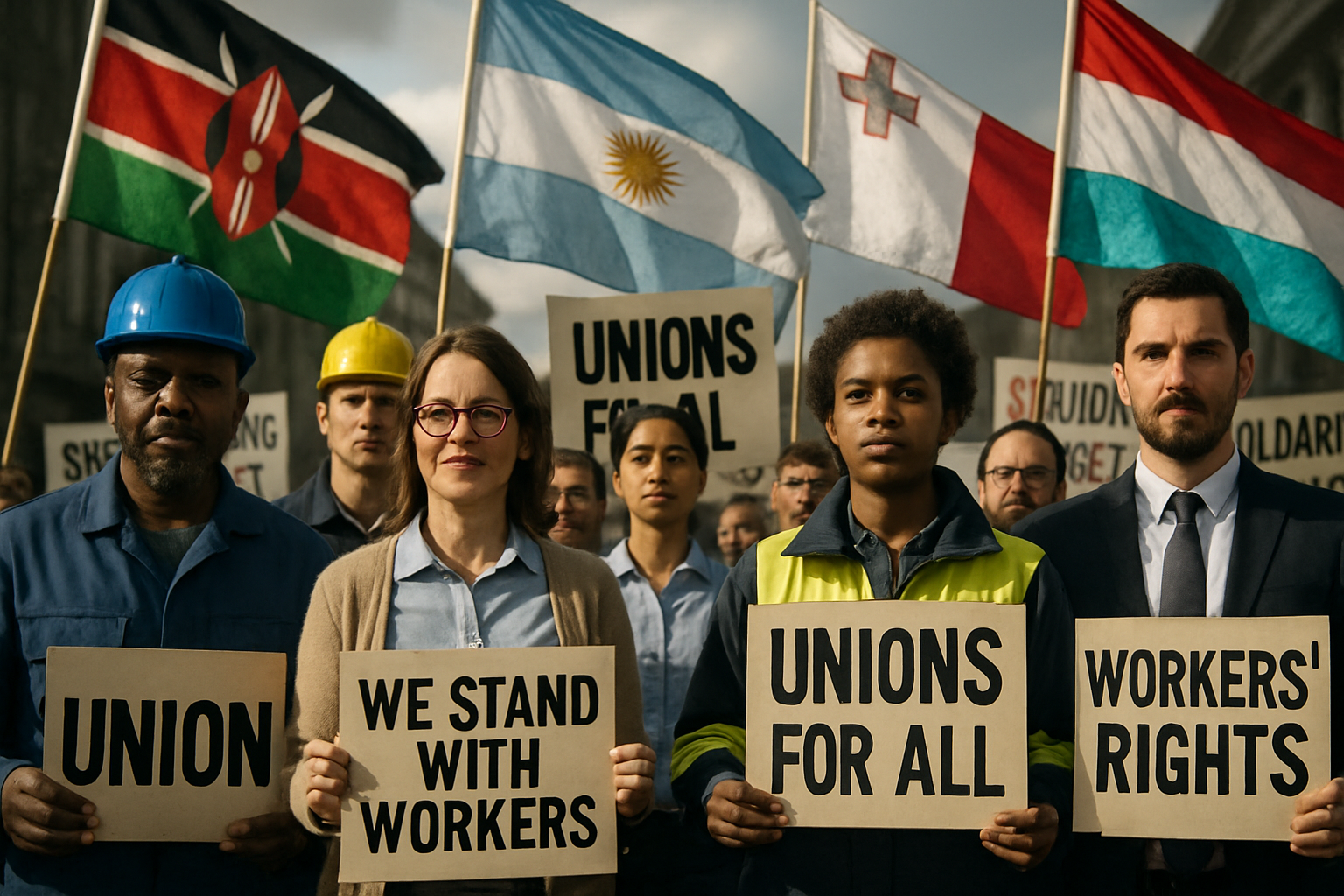
A wave of labor disputes is sweeping across multiple continents as workers from Argentina to Kenya mobilize against government policies that threaten employment security and workplace rights, revealing deep tensions between economic modernization efforts and traditional worker protections.
The coordinated resistance spans diverse sectors and political systems, from Argentina's tire manufacturing workers facing mass layoffs to Kenyan civil servants demanding salary adjustments, demonstrating how labor movements are adapting their strategies to confront 21st-century economic pressures.
Argentina's Labor Reform Sparks Historic Opposition
Argentina has emerged as the epicenter of Latin American labor unrest, where President Javier Milei's controversial labor reform legislation has triggered the most sustained union opposition since the country's return to democracy. The General Confederation of Labor (CGT) has organized four consecutive general strikes, including a massive February 19 action that achieved complete nationwide paralysis.
The strike demonstrated unprecedented tactical sophistication, designated as "without mobilization" to avoid the violent street confrontations that marked earlier protests in February. Instead, unions focused on economic pressure through coordinated work stoppages that shut down transportation networks, closed banks, and disrupted aviation services.
"The doors remain closed, workers are presenting themselves to work, but the plant is still shut down,"
— SUTNA Union Representatives, referring to the FATE tire plant closure
The economic impact was staggering. The National Institute of Economic and Social Research (INECO-UADE) calculated the February 19 strike cost Argentina $489 million—equivalent to 0.8% of the country's February GDP and 17.3% of single-day output. The disruption extended beyond Argentina's borders, with Chile canceling flights and Paraguay reporting over 1,000 stranded passengers.
Political analyst Julio Bárbaro characterized the labor reform as "a law for delinquents, a return to slavery," reflecting the intensity of opposition to legislation that introduces a "bank of hours" overtime system and modified severance structures. The reform's supporters argue it will attract foreign investment and complement the US-Argentina trade agreement eliminating over 1,600 tariffs.
Kenya's Civil Service Crisis
In Kenya, the Kenya Union of Post-Primary Education Teachers (KUPPET) has tabled comprehensive demands to the government over longstanding grievances affecting civil servants nationwide. The union's demands encompass salary adjustments, medical scheme improvements, and accelerated promotions for educators who have waited years for career advancement.
The Kenyan situation reflects broader challenges facing public sector workers across developing economies, where government austerity measures often target civil service benefits while demanding increased productivity. Union leaders have warned that continued government inaction could force them to consider industrial action, potentially disrupting education services for millions of students.
The dispute highlights the delicate balance governments must strike between fiscal responsibility and maintaining adequate compensation for essential public services. Kenya's civil servants argue that their working conditions have deteriorated significantly while their responsibilities have expanded, particularly in the education sector where teachers face overcrowded classrooms and inadequate resources.
Malta's Cultural Leave Controversy
Malta presents a unique case study in contemporary labor disputes, where the government's proposal to introduce "cultural leave" for public sector workers has sparked fierce opposition from the business community. The Malta Chamber of Commerce has strongly opposed the plan, arguing it would create dangerous distortions in an already tight labor market.
Culture Minister Owen Bonnici and Labour MEP Daniel Attard proposed granting additional leave days for public employees participating in traditional feasts, Carnival, and similar cultural events. While acknowledging the importance of preserving Maltese culture, business leaders warn the policy could exacerbate existing labor shortages in the private sector.
The Malta Chamber's opposition reflects broader concerns about public-private sector compensation disparities that could drive talent away from businesses already struggling with recruitment challenges. The controversy demonstrates how cultural preservation can become entangled with labor market dynamics in small island economies where every worker shortage has magnified impacts.
Luxembourg's Industrial Uncertainty
The situation at the Pierburg factory in Basse-Ham, near Thionville, illustrates how global economic pressures are reshaping traditional manufacturing employment. The 246-worker facility faces potential closure after German parent company Rheinmetall put its automotive division up for sale, leaving employees uncertain about their future.
Union representatives have made clear they oppose any relocation of production activities, even minor ones, demonstrating how workers are taking increasingly firm stances against corporate restructuring efforts. The Pierburg case reflects broader challenges facing European manufacturing as companies restructure to compete with lower-cost producers in Asia.
Workers at the facility have threatened to file strike notices if management proceeds with significant changes to operations. This preemptive stance represents an evolution in labor tactics, where unions are acting to prevent job losses rather than simply responding to them after decisions are made.
Historical Context and Global Patterns
The current wave of labor disputes builds on months of escalating tensions between workers and governments implementing economic reforms. Argentina's experience is particularly instructive, having witnessed the evolution from violent protests with Molotov cocktails and over 50 arrests during Senate debates to the sophisticated economic pressure tactics employed in recent strikes.
The February 2026 labor unrest occurs against the backdrop of broader economic challenges. Argentina has lost 21,938 companies under the Milei administration, affecting 290,602 workers according to labor risk data. The symbolic closure of the 80-year-old FATE tire plant, eliminating 920 jobs, has become emblematic of industrial decline under trade liberalization policies.
Similar patterns emerge globally, where workers face the dual pressures of technological change and international competition while governments prioritize fiscal consolidation and market reforms. The result is a growing disconnect between policy makers focused on macroeconomic indicators and workers experiencing direct impacts on employment security and living standards.
Tactical Evolution in Labor Movements
Modern labor disputes reveal significant tactical sophistication compared to traditional strike actions. Argentina's CGT demonstrated this through its "without mobilization" approach, which maximized economic disruption while avoiding the negative publicity associated with street violence. This evolution reflects unions' recognition that public opinion increasingly influences political outcomes.
The coordination across multiple countries and sectors also represents a new development. While each dispute has local characteristics, the timing and common themes suggest growing international awareness among labor movements about shared challenges from globalization and technological change.
Economic pressure tactics have proven particularly effective when timed to coincide with critical political moments. Argentina's strike during legislative debates maximized political impact, while threats of future action in other countries serve as warnings to governments considering similar reforms.
Government Responses and Policy Adaptations
Government responses to labor unrest reveal varying approaches to balancing economic reform with social stability. Argentina's Interior Minister Patricia Bullrich demonstrated tactical flexibility by modifying over 30 articles of the labor reform legislation to secure broader political support, showing how sustained pressure can force policy modifications.
The Milei administration's dismissal of strikes as "senseless" and holding back progress reflects a confrontational approach that views labor opposition as obstacle to necessary modernization. This contrasts with more accommodating responses in other jurisdictions where governments seek to address worker concerns while maintaining reform momentum.
Malta's situation shows how cultural and political factors can complicate straightforward economic calculations. The government's cultural leave proposal reflects electoral considerations and national identity concerns that may override pure economic efficiency arguments from business groups.
Economic Implications and Market Impacts
The economic costs of labor disputes extend far beyond immediate strike-related losses. Argentina's experience demonstrates how sustained labor unrest can disrupt supply chains, affect international confidence, and complicate implementation of economic reforms designed to attract foreign investment.
The $489 million cost of a single day's strike in Argentina illustrates the leverage that organized labor retains despite broader economic pressures. When transportation networks shut down and banks close, the immediate economic impact forces political attention regardless of governments' ideological preferences.
International investors monitoring these disputes face complex calculations about political risk and reform sustainability. While market-oriented reforms may promise longer-term benefits, immediate disruption and political instability can undermine investor confidence in the short term.
International Dimensions and Regional Spillovers
Labor disputes increasingly have international dimensions, both through direct economic spillovers and political influence. Argentina's strikes affected neighboring countries through transportation disruptions, while the broader reform agenda has implications for regional trade agreements and international partnerships.
The coordination of strike timing with legislative processes demonstrates sophisticated understanding of political dynamics, suggesting that labor movements are developing more strategic approaches to influencing policy outcomes. This evolution may make future disputes more disruptive but also more politically effective.
Regional patterns suggest that labor movements are learning from each other's experiences and adapting successful tactics across different political contexts. The emphasis on economic pressure over street protests, for example, appears to be spreading as unions recognize its effectiveness.
Future Outlook and Implications
The current wave of labor disputes appears likely to continue as economic pressures intensify and governments pursue reforms that affect traditional employment arrangements. The sophistication of tactics and international coordination suggest that labor movements are adapting effectively to 21st-century challenges.
The outcome of these disputes will significantly influence future government approaches to economic reform and labor relations. Successful resistance by workers may embolden similar movements elsewhere, while government victories could provide templates for overcoming organized labor opposition.
The balance between economic modernization and social stability remains precarious across multiple countries. The ability of democratic institutions to manage these tensions while implementing necessary but unpopular reforms represents a fundamental test of governance capacity in an era of rapid economic change.
As these labor disputes continue to evolve, they reveal the persistent power of organized workers to influence political outcomes even in an era of globalization and technological change. The success or failure of current resistance efforts will likely determine the trajectory of labor relations and economic policy for years to come.