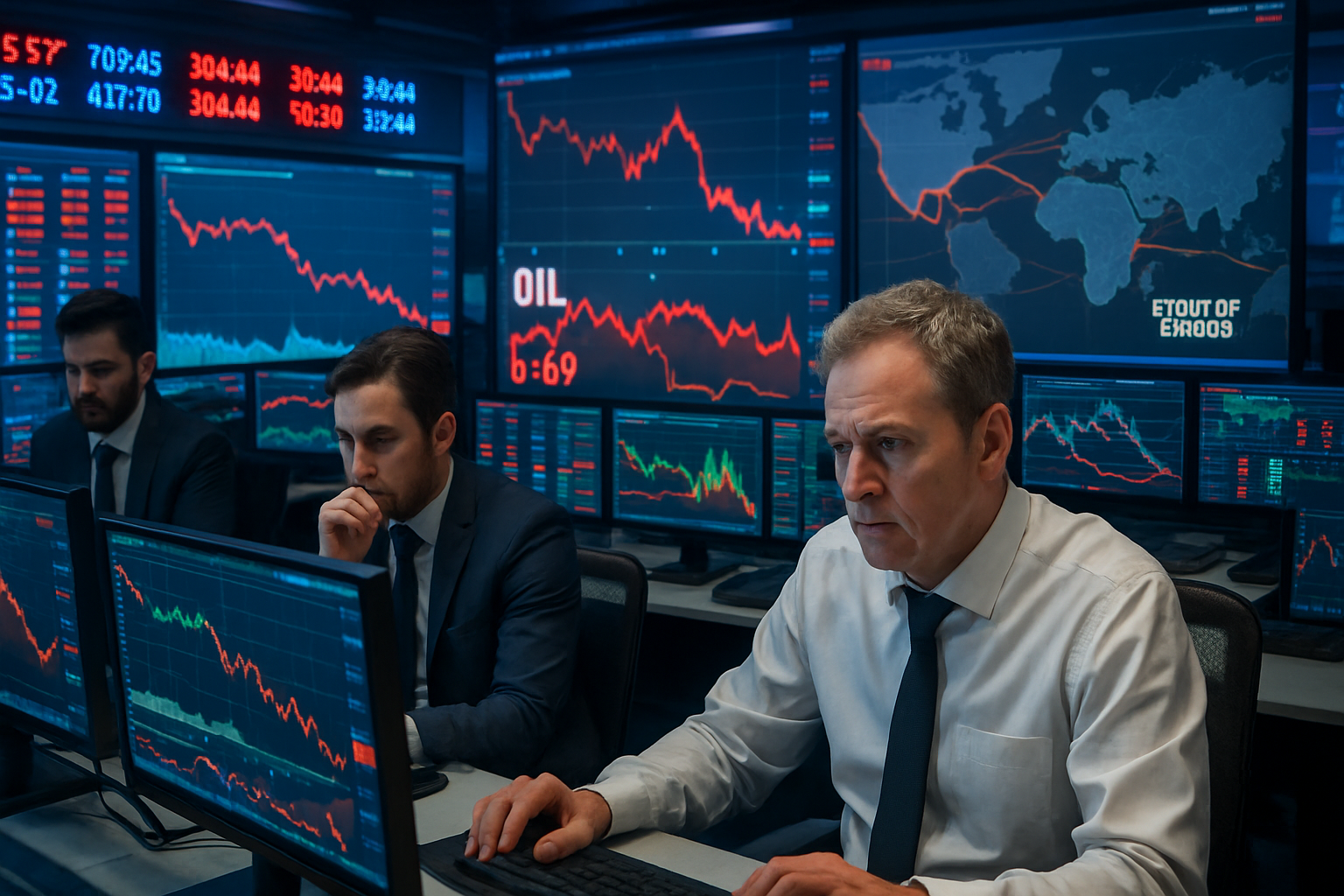
Global financial markets are experiencing one of their most severe disruptions in recent years as the ongoing Middle East conflict drives oil prices past $100 per barrel for the first time since 2022, while economic indicators from around the world paint a complex picture of resilience and vulnerability in an increasingly interconnected global economy.
Energy Crisis Reshapes Global Markets
The closure of the Strait of Hormuz by Iran's Revolutionary Guard has created an unprecedented energy security crisis, affecting 40% of global seaborne oil transit through the critical 21-mile waterway. Brent crude has surged to peaks of $119.50 per barrel, while West Texas Intermediate jumped a record 18.98% to $108.15, marking the largest single-day increase on record.
The crisis extends beyond oil markets, with natural gas prices exploding 24% in Europe and 78% in the United States, reaching €47.32/MWh—the highest levels since February 2025. Qatar's decision to halt LNG production at Ras Laffan and Mesaid facilities, representing approximately 20% of global exports, has intensified supply concerns.
"This is the most severe energy security crisis in decades, exposing single-chokepoint vulnerabilities that threaten the entire global logistics system."
— Samuel Ciszuk, Energy Analyst
Financial Markets in Crisis Mode
The energy crisis has triggered massive selloffs across global equity markets. South Africa's JSE All Share Index has officially entered correction territory, closing more than 10% below its recent peak as the Iran war impact spreads to emerging markets. Pakistan's KSE-100 index recorded its largest single-day decline in history, falling 8.97%, while South Korea's KOSPI plunged 12% with circuit breakers activated and the Korean won hitting a 17-year low.
Aviation has been particularly hard hit, with over 18,000 flights cancelled worldwide—the most extensive disruption since COVID-19. Dubai International Airport, the world's busiest with 86 million passengers annually, remains completely shut down after sustaining missile damage. Major carriers including Emirates, Air France-KLM, Wizz Air, and Bulgaria Air have suspended operations indefinitely.
Regional Economic Divergence
Despite the global turmoil, several economies are demonstrating remarkable resilience and growth. Azerbaijan reported a spectacular 43.4% year-over-year increase in e-commerce transactions during 2025, with the total value rising 29.8% to AZN 86.4 billion according to the Central Bank of Azerbaijan. This digital commerce boom reflects the country's successful adaptation to modern payment systems and online trade platforms.
Croatia received significant recognition from global financial markets, with Standard & Poor's upgrading the country's credit rating to 'A', marking another major vote of confidence in the nation's fiscal management and economic trajectory. This upgrade positions Croatia among the stronger European economies and should reduce borrowing costs while attracting additional foreign investment.
Banking Sector Shows Mixed Signals
Italy's banking sector is experiencing positive developments according to the latest ABI monthly bulletin, with bank deposits increasing while non-performing loans improve. Significantly, interest rates on new home purchases have declined to 3.42% in February, down from previous months, providing relief for potential homebuyers despite broader economic uncertainty.
The improvement in Italy's mortgage rates contrasts sharply with global trends, where many central banks maintain elevated rates to combat inflation. The European Central Bank's 2% deposit rate policy appears to be having differentiated effects across member states.
Digital Transformation Accelerates
The crisis is accelerating digital transformation across multiple sectors. Azerbaijan's remarkable e-commerce growth demonstrates how countries with robust digital infrastructure can maintain economic momentum even during global disruptions. The surge in online transactions reflects both technological advancement and changing consumer behavior patterns that have persisted beyond the pandemic era.
Financial technology continues to provide stability in uncertain times, with digital payment systems proving more resilient than traditional banking infrastructure during periods of volatility. This trend is particularly evident in emerging markets where mobile banking and digital currencies are becoming primary financial tools.
Supply Chain Vulnerabilities Exposed
The Strait of Hormuz closure has exposed dangerous over-dependence on strategic chokepoints in global supply chains. Major shipping companies including Maersk and MSC have suspended operations, with over 150 oil and LNG tankers stranded in the Persian Gulf representing billions in cargo value. The crisis highlights the need for fundamental restructuring of energy architecture to reduce dependence on volatile geopolitical regions.
Manufacturing sectors dependent on Gulf logistics networks—including automotive, electronics, and textiles—are experiencing severe disruptions. China has suspended refined fuel export contracts, while Singapore faces 30% increases in logistics costs, demonstrating the global reach of regional conflicts.
Central Bank Coordination and Response
Central banks worldwide are coordinating emergency responses to prevent financial contagion, with the European Central Bank and Bank of Japan leading liquidity provision efforts. However, traditional monetary policy tools are proving less effective against structural geopolitical disruptions compared to conventional economic challenges.
The divergence in central bank policies—with the ECB maintaining a 2% deposit rate while Australia's RBA stands at 3.85%—is creating complex currency dynamics that add another layer of uncertainty for international trade and investment.
Long-Term Implications
The current crisis represents a watershed moment for global economic architecture, forcing a reevaluation of supply chain dependencies and energy security strategies. While strategic petroleum reserves provide temporary buffers, the scale of the disruption demands fundamental changes in how the global economy manages geopolitical risks.
Recovery timelines remain uncertain, depending on military and diplomatic resolution rather than predictable market cycles. Unlike weather-related disruptions with clear endpoints, the current crisis involves complex geopolitical factors that could persist for extended periods.
"The situation is going longer than people initially thought. Financial markets are becoming the ultimate constraint on prolonged conflict."
— Damien Boey, Portfolio Strategist
As global markets continue to navigate this unprecedented combination of energy crisis, geopolitical tension, and economic uncertainty, the resilience of individual economies increasingly depends on their institutional capacity, technological infrastructure, and ability to adapt rapidly to changing conditions. The current crisis may accelerate trends toward economic regionalization and energy independence that could reshape international trade patterns for years to come.