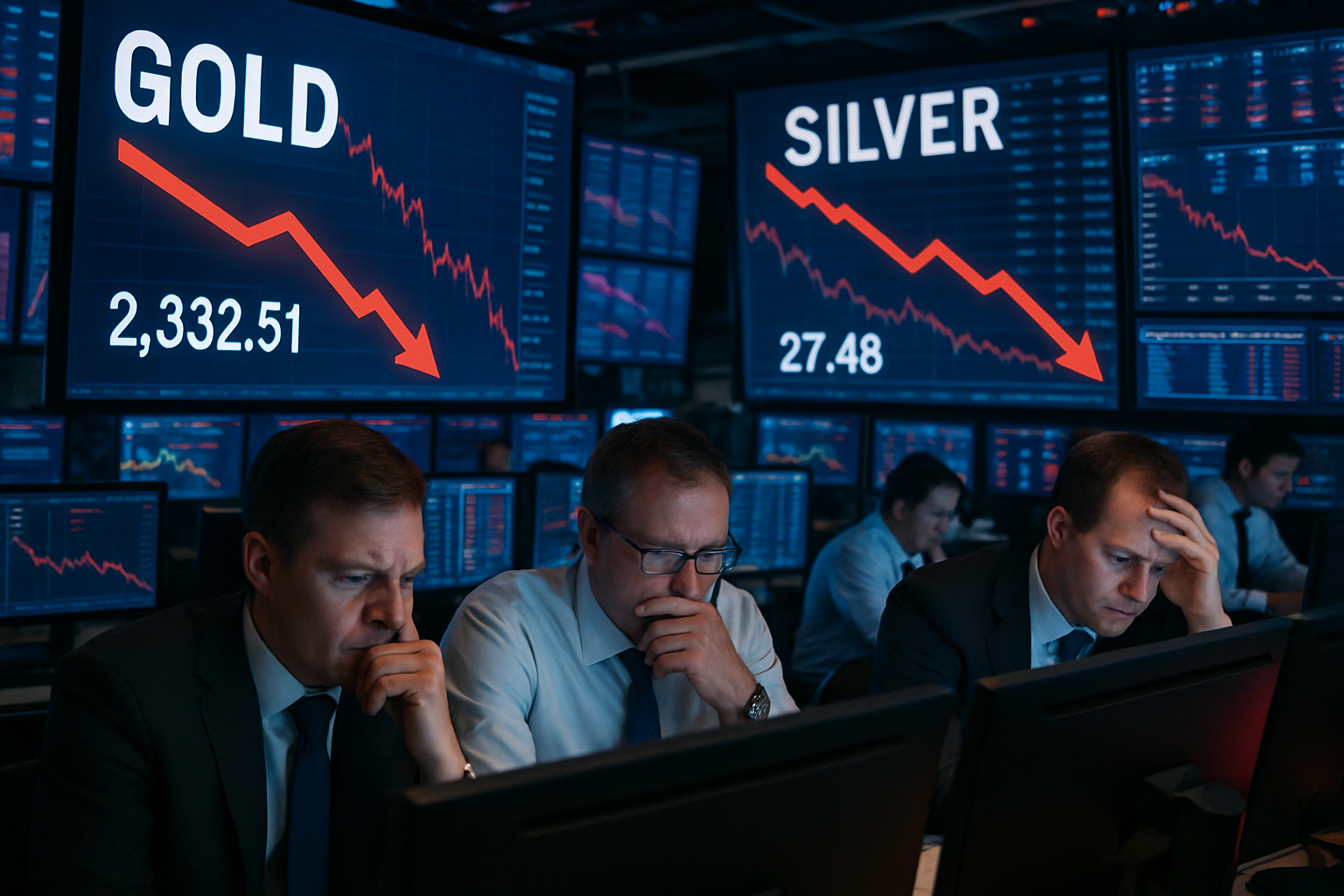
Global financial markets are reeling from an unprecedented collapse in precious metals prices, with gold experiencing its worst crash in a decade and silver plummeting 36% in a single day, while equity markets across Europe, North America, and Asia display divergent performance patterns amid ongoing corporate earnings season.
The precious metals rout, which began last week and intensified on February 2, 2026, has drawn comparisons to the infamous Hunt Brothers silver crash of March 1980. According to Slovak financial publication TREND, the collapse was triggered by a "record wave of Chinese speculation, options madness, and sudden Federal Reserve policy changes" that created market conditions unseen in the precious metals sector for decades.
The Anatomy of a Precious Metals Massacre
The scale of the precious metals crash has stunned even seasoned commodity analysts. Gold, which had reached record highs of $5,600 per ounce in January, plummeted to $4,770 - a devastating $830 decline that wiped out billions in market value. Silver's performance was even more catastrophic, opening at $105.93 before collapsing 36% in what Swedish financial daily Svenska Dagbladet described as a move "from euphoria to total panic."
Russian financial newspaper Kommersant reported that the January surge in precious metals had driven futures trading volumes to historic records of nearly 9 trillion rubles, primarily driven by speculative activity. The dramatic reversal has left these same speculators nursing massive losses as the market underwent what analysts are calling a complete capitulation.
"From euphoria to total panic. And then a cautious recovery. The price development for gold and silver in recent days is nothing for the faint-hearted."
— Svenska Dagbladet Analysis
Chinese Capital Flight Fuels Market Chaos
The Slovak analysis points to Chinese speculative capital as a primary catalyst for both the meteoric rise and spectacular fall of precious metals prices. The report suggests that Chinese investors, seeking alternatives amid domestic economic uncertainty, flooded global precious metals markets with unprecedented volumes before suddenly withdrawing, leaving markets without crucial liquidity support.
The timing coincided with what market participants describe as "options madness" - excessive speculation in precious metals derivatives that amplified both the upward and downward price movements. When combined with unexpected Federal Reserve policy signals, the perfect storm for a market collapse was created.
Russian Markets Set Records Before the Fall
Kommersant's reporting reveals that Russian exchanges experienced record trading volumes in precious metals futures during January, reaching nearly 9 trillion rubles as both institutional and retail investors piled into what appeared to be a one-way bet on rising gold and silver prices. The subsequent crash has left many of these investors with substantial losses and has highlighted the risks of speculative trading in commodity markets.
Global Equity Markets Show Resilience Despite Turmoil
While precious metals markets imploded, equity markets demonstrated remarkable resilience with divergent regional performances. Wall Street opened February 2 with gains, according to Mexican financial publication El Financiero, with the Dow Jones advancing 0.38% to 49,038.85 points as investors focused on corporate earnings rather than commodity market chaos.
The S&P 500 and other major U.S. indices also posted gains, suggesting that equity investors are treating the precious metals crash as a sector-specific event rather than a broader market risk signal. This divergence highlights the increasingly complex relationship between different asset classes in modern financial markets.
Corporate Earnings Provide Market Anchor
Corporate earnings season has provided a stabilizing influence for equity markets even as commodity prices crater. Disney's mixed quarterly results, reported by TREND, showed the complexity of the current business environment. While the entertainment giant's overall profits declined year-over-year in its first fiscal quarter, strong growth in streaming services and record theme park revenues demonstrated resilient consumer demand in key sectors.
Disney's performance illustrates broader themes in corporate America, where companies are navigating challenging macroeconomic conditions while benefiting from specific growth drivers in their core businesses. The streaming segment's robust performance reflects ongoing secular shifts in media consumption, while record theme park revenues suggest continued consumer willingness to spend on experiences despite economic uncertainties.
Federal Reserve Policy Shift Creates Market Uncertainty
The Slovak analysis emphasizes the role of unexpected Federal Reserve policy changes in triggering the precious metals collapse. While specific details of the policy shift were not elaborated, the market reaction suggests investors perceived a more hawkish stance from the central bank, potentially reducing the appeal of non-yielding assets like gold and silver.
This policy uncertainty comes at a time when global central banks are navigating complex inflation dynamics and economic growth concerns, making precious metals - traditionally seen as inflation hedges - increasingly volatile based on monetary policy expectations.
Regional Market Performance Varies Significantly
The global nature of the precious metals crash has created ripple effects across different regional markets, with some showing more resilience than others. Mexican markets, celebrating Constitution Day, provided a respite from trading volatility, while European and Asian markets continued to grapple with the commodity market disruption.
Swedish analysts, despite noting the extreme volatility in precious metals, maintain a cautiously optimistic outlook for commodity markets longer-term, suggesting that the current crash may represent a healthy correction rather than a fundamental shift in precious metals demand dynamics.
Market Recovery Signals Emerge
Despite the severity of the crash, some analysts are beginning to identify potential recovery signals. Swedish commodity experts note signs of "cautious recovery" following the initial panic selling, though they caution that markets remain extremely volatile and unsuitable for conservative investors.
The scale of the selling appears to have created oversold conditions in some precious metals markets, potentially setting the stage for a technical rebound as speculative positions are unwound and more stable long-term investors begin to assess value opportunities.
Implications for Global Economic Stability
The precious metals crash raises important questions about global financial stability and the role of speculative capital flows in commodity markets. The speed and severity of the decline demonstrate how quickly market sentiment can shift when leveraged positions are forced to unwind.
For central banks and policymakers, the episode highlights the challenges of managing monetary policy in an era of globally interconnected markets where policy signals can trigger massive capital movements across asset classes and geographic regions.
The divergent performance between precious metals and equity markets also suggests that investors are becoming more discriminating in their risk assessment, treating sector-specific developments as isolated events rather than systemic risks to the broader financial system.
Looking Ahead: Market Stabilization and Recovery Prospects
As markets attempt to stabilize following the precious metals crash, attention is turning to whether the current volatility represents a temporary disruption or signals a more fundamental shift in commodity market dynamics. The role of Chinese capital flows, Federal Reserve policy, and speculative trading volumes will likely remain key factors in determining the trajectory of precious metals prices.
For equity markets, the focus remains on corporate earnings and economic fundamentals, with investors demonstrating an ability to look beyond commodity market turmoil when evaluating individual company prospects. This selective approach to risk assessment may help insulate broader markets from sector-specific volatility.
The coming weeks will be crucial in determining whether precious metals markets can establish a new equilibrium or face additional volatility as investors continue to reassess the fundamental drivers of gold and silver demand in a changing global economic environment.