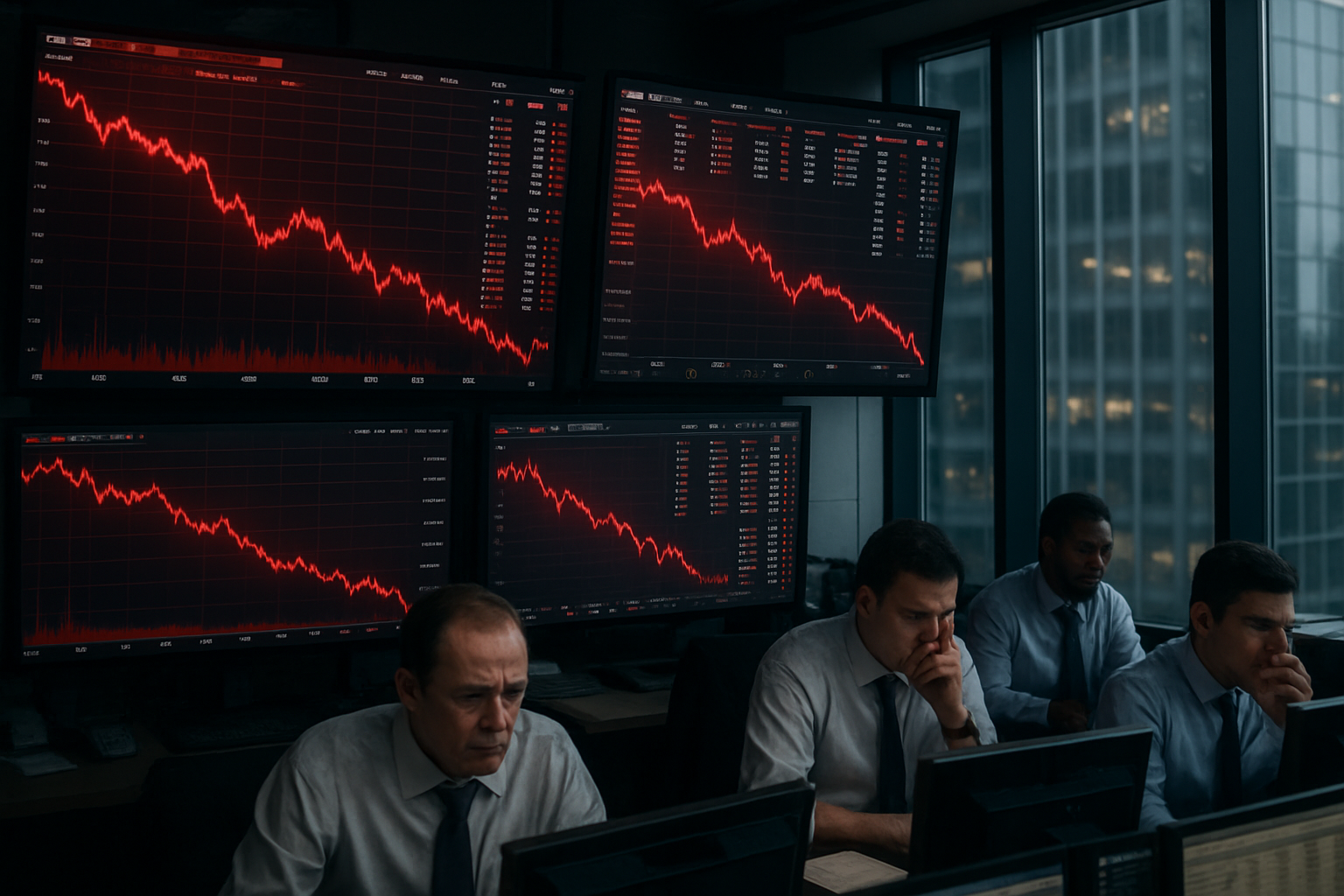
Global financial markets are experiencing fresh volatility as artificial intelligence sector concerns spread across continents, triggering significant drops in major indices and pushing Argentina's country risk indicator back above 500 points for the first time in weeks.
The market turbulence, which has affected exchanges from Buenos Aires to Frankfurt, comes after a brief period of stability following the massive precious metals crash and AI sector selloff that occurred in early February. The renewed concerns highlight the interconnected nature of global markets and the growing influence of technology sector valuations on worldwide investor sentiment.
Argentina Bears Brunt of Global Sell-Off
Argentina's financial markets suffered their second consecutive day of losses, with the Buenos Aires stock exchange falling 2.2% to 3,038,541 units on Tuesday. The decline followed what traders described as an "ideal" January, where both stocks and bonds had performed strongly before February's downturn.
The country's risk indicator, measured by JP Morgan, closed at 503 units, marking a sharp reversal from the downward trend seen in recent weeks. This represents a critical psychological threshold, as the indicator had been declining consistently before external pressures and local statistical controversies created renewed investor anxiety.
Among the hardest-hit stocks in Buenos Aires were Edenor, which dropped 5.2%, Sociedad Comercial del Plata falling 5%, and Transportadora de Gas del Norte declining 4.4%. The sell-off occurred amid an increasingly adverse international climate and local controversy surrounding the resignation of Marco Lavagna from the National Institute of Statistics and Censuses (INDEC).
Germany Braces for AI-Driven Market Pressure
German markets are preparing for another challenging session as artificial intelligence concerns continue to weigh on investor sentiment. The DAX, Germany's benchmark index, is expected to open lower as optimism from earlier in the week evaporates amid global technology sector volatility.
German financial media reported that AI-related concerns are once again gripping markets worldwide, with particular focus on valuations in the technology sector. This marks a continuation of the volatility that began with the massive AI sector selloff that wiped $285 billion from software stocks earlier in February, triggered by Anthropic's Claude Cowork AI assistant and its potential threat to traditional software providers.
The renewed pressure on European markets comes despite recent recovery attempts following the precious metals crisis that shook global commodities markets at the beginning of February. The DAX's anticipated weak opening reflects broader concerns about the sustainability of AI sector valuations and their impact on global market stability.
Pakistan Provides Rare Bright Spot
Contrasting with the global trend, Pakistan's KSE-100 index provided a rare positive note in the international landscape, trading higher by 1,105.24 points or 0.59% to reach 188,005.97 points during Wednesday morning trading. The index's rise from Tuesday's close of 186,900.73 points demonstrated healthy trading volumes of over 60 million shares.
Leading the Pakistani market's advance were several key stocks, with K-Electric Limited rising 1.09% to Rs7.43 on volume of over 20 million shares. First National Equities Limited gained 2.30% to Rs1.78, while Ghani Chemworld Limited surged 5.37% to Rs23.94. Top performers included Asim Textile Mills Limited, which jumped 10.02%, and Apna Microfinance Bank Limited, rising 10.01%.
The Pakistani market's resilience highlights the varied regional responses to global market pressures, with emerging markets sometimes providing refuge during periods of developed market volatility.
AI Sector Concerns Drive Global Uncertainty
The current market volatility has its roots in growing concerns about artificial intelligence sector valuations, particularly following the "SaaSpocalypse" event earlier in February when $285 billion was wiped from software stocks. The selloff was triggered by the launch of Anthropic's Claude Cowork AI assistant with new plugins that threatened traditional software providers, particularly in the legal technology sector.
Compounding these concerns, OpenAI's expressed dissatisfaction with Nvidia chips and active search for alternatives since 2025 has created uncertainty about hardware dependencies in the AI ecosystem. The company's focus on inference chip markets rather than training chips represents a significant shift that could reshape the entire AI hardware landscape.
The memory crisis affecting the technology sector, with prices surging sixfold and affecting major manufacturers like Samsung, SK Hynix, and Micron, has added another layer of complexity to AI sector valuations. This supply constraint has forced companies to seek cost-effective alternatives and has contributed to the overall uncertainty surrounding technology investments.
Historical Context and Market Interconnections
The current volatility comes against the backdrop of a turbulent start to 2026 for global markets. February began with the historic precious metals crash that saw silver plummet 36% in a single day and gold fall from record highs above $5,600 to below $4,800 per ounce. While commodity markets have shown signs of stabilization, the reverberations continue to affect investor confidence across asset classes.
The interconnected nature of modern global markets means that concerns in one sector or region can quickly spread worldwide. The AI sector's growing importance to global technology valuations has made it a critical driver of market sentiment, with companies and investors increasingly sensitive to developments in artificial intelligence and related technologies.
Recent market history shows a pattern of sector-specific volatility spreading to broader market concerns. The precious metals crash demonstrated how rapid deleveraging in one asset class can create liquidity pressures across multiple markets, while the AI sector concerns highlight how technology valuations have become central to global investor confidence.
Regional Variations and Local Factors
While global themes are driving much of the current volatility, local factors continue to play important roles in individual market performance. Argentina's renewed pressure stems not only from international conditions but also from domestic political uncertainty surrounding statistical agency leadership and concerns about economic data reliability.
The controversy over Marco Lavagna's departure from INDEC has created additional uncertainty for investors who rely on accurate economic statistics for investment decisions. This local factor has amplified the impact of global market pressures on Argentine assets, pushing the country risk indicator back above the psychologically important 500-point level.
Germany's market concerns reflect both global AI sector worries and the country's position as a major industrial economy sensitive to technology sector developments. The anticipated weak opening for the DAX demonstrates how global technology concerns can particularly affect markets with significant industrial and technology sector exposure.
Market Outlook and Investor Strategies
Market analysts are watching several key indicators as global markets navigate this period of renewed volatility. The sustainability of AI sector valuations remains a critical concern, particularly given the rapid adoption of artificial intelligence across industries and the corresponding investment flows into related companies.
The memory crisis affecting technology companies represents a structural challenge that could persist, potentially forcing continued adaptation and alternative sourcing strategies. Companies like OpenAI's move away from Nvidia chips and toward alternative suppliers illustrates how supply chain pressures are reshaping technology sector relationships.
Emerging markets like Pakistan, which have shown resilience during the current volatility, may continue to attract investors seeking diversification away from developed market technology concerns. However, the interconnected nature of global finance means that no market remains completely isolated from worldwide trends.
The coming weeks will be crucial for determining whether current volatility represents a temporary adjustment to AI sector valuations or the beginning of a more sustained period of market uncertainty. Investors are likely to remain focused on technology sector developments, supply chain issues, and regional political factors that could either amplify or moderate global market pressures.