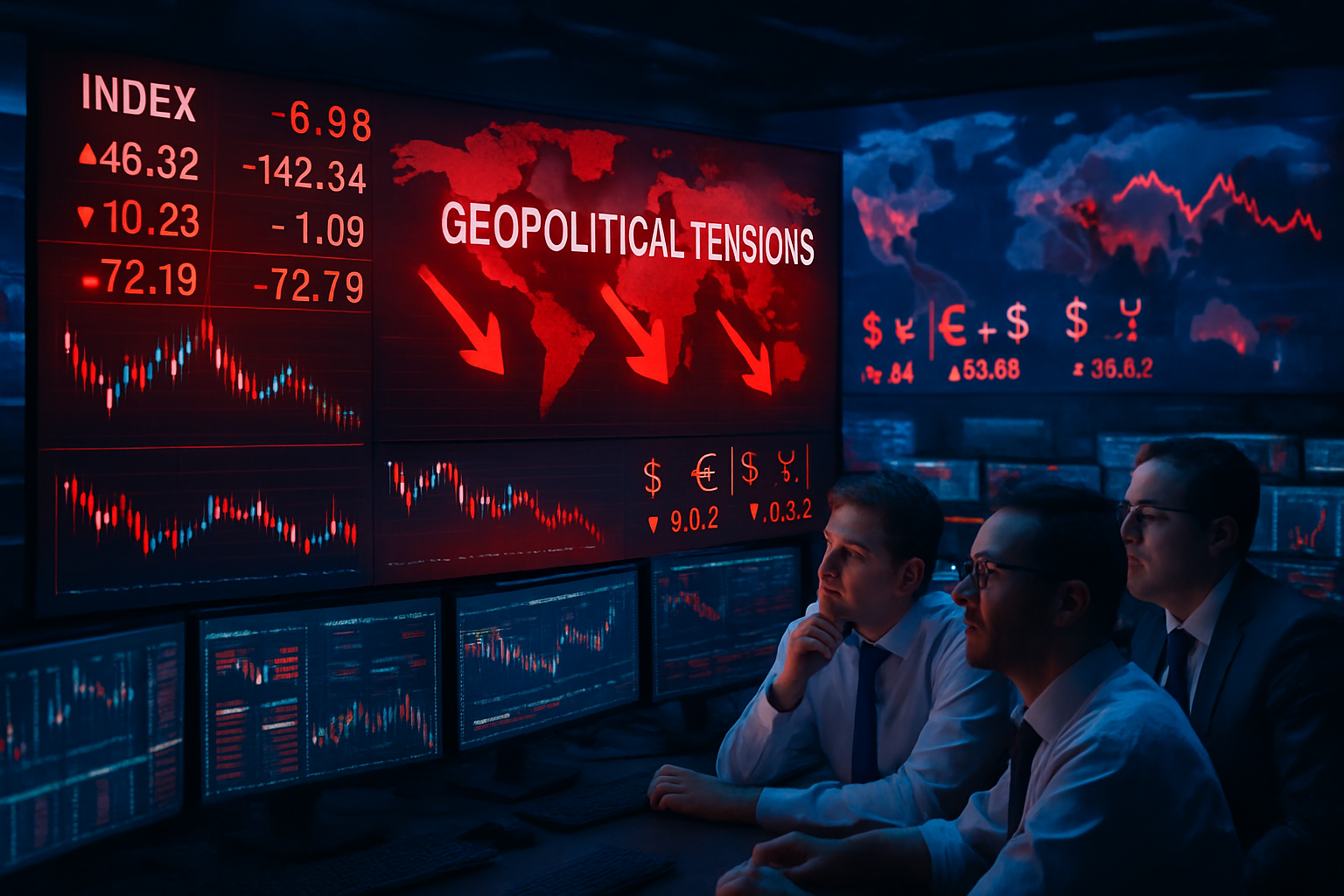
Global financial markets are experiencing their most severe disruption in years as escalating Middle East conflict creates an unprecedented energy crisis, with credit rating agencies issuing warnings across multiple European economies amid the most dangerous international crisis since the Cold War.
The crisis intensified dramatically on March 6, 2026, as oil prices surged past $80 per barrel—a 10% increase—following Iran's effective closure of the Strait of Hormuz, which handles 40% of global seaborne oil transit. The Iranian Revolutionary Guard declared the strategic waterway "unsafe," creating the most severe energy security threat in decades.
Credit Rating Warnings Across Europe
Credit rating agencies have issued stark warnings as the crisis spreads beyond energy markets. Canadian rating agency DBRS maintained Greece's credit rating at "BBB" with stable outlook, praising the country's fiscal surpluses and debt reduction achievements. However, the agency warned that Greece's economy faces significant external pressures from regional energy disruptions.
Romania faced more concerning developments as Moody's issued warnings about the country's economic trajectory. The rating agency, which currently places Romania on the lowest investment grade with negative outlook, cited challenges in corruption control and fiscal policy efficiency. Moody's specifically highlighted "reform fatigue, rotation of prime ministers, and 2028 elections threatening deficit reduction" as key risks.
Slovakia's economy showed resilience amid the turmoil, with local media reporting that European stocks experienced their "worst week since Trump introduced tariffs," attributed to the Iranian war's dramatic impact on oil prices and broader economic anxiety.
Energy Crisis Creates Perfect Storm
Natural gas prices exploded by 24% in Europe and 78% in the United States, creating severe energy shortages as winter transitions to spring. European gas prices rocketed to €47.32/MWh, the highest level since February 2025. Qatar, a major LNG supplier, halted production at its Ras Laffan and Mesaid facilities following Iranian drone attacks, affecting approximately 20% of global LNG exports.
Major shipping companies Maersk and MSC suspended Persian Gulf operations entirely, leaving over 150 oil and LNG tankers stranded in the Persian Gulf, representing billions in cargo value. The crisis exposes critical vulnerabilities in global supply chains that depend heavily on Middle Eastern energy transportation networks.
Global Aviation Industry Paralyzed
The aviation sector faced unprecedented disruption with over 18,000 flights cancelled worldwide—the most extensive disruption since the COVID-19 pandemic. Eight Middle Eastern countries simultaneously closed their airspace: Iran, Iraq, Israel, UAE, Qatar, Syria, Kuwait, and Bahrain.
Dubai International Airport, the world's busiest with over 86 million passengers annually, completely shut down after sustaining missile damage during Iranian retaliation strikes. Major carriers including Emirates, Air France-KLM, Wizz Air, and Bulgaria Air suspended operations indefinitely, stranding hundreds of thousands of passengers globally.
Financial Markets Crash Worldwide
Stock markets crashed across multiple continents as investors fled to safe-haven assets. Pakistan's KSE-100 index crashed by 8.97% in the largest single-day decline in the exchange's history. South Korean markets plunged over 12% with circuit breakers activated, while the Korean won hit a 17-year low as foreign capital fled technology positions.
"The situation is going on longer than people initially thought," said Damien Boey, Portfolio Strategist at Barrenjoey. "We're seeing unprecedented coordination between energy markets, aviation networks, and financial systems creating systemic vulnerabilities."
— Damien Boey, Portfolio Strategist
European markets also suffered severe losses, with Germany's DAX continuing its steep decline and Italy's Milan exchange falling over 4%. The pan-European STOXX 600 dropped 1.3%, reflecting broad-based investor concern about energy security and regional stability.
Central Bank Emergency Responses
Central banks across major economies coordinated emergency liquidity provision to prevent broader financial contagion. The European Central Bank and Bank of Japan announced coordinated measures to maintain market stability amid the structural disruptions caused by geopolitical tensions rather than traditional economic factors.
PayPay's planned $1.1 billion US IPO was postponed indefinitely due to market volatility, highlighting how geopolitical crises now directly impact corporate decision-making and capital markets access globally.
Diplomatic Breakdown Behind Crisis
The current crisis stems from the complete collapse of US-Iran nuclear diplomacy, despite what had been the most promising engagement in years. Geneva talks had achieved "broad agreement on guiding principles"—the most progress since the 2018 JCPOA collapse—but fundamental disagreements over scope proved insurmountable.
Iran excluded ballistic missiles and regional proxies as "red lines," demanding nuclear-only talks, while US Secretary of State Marco Rubio insisted on comprehensive agreements addressing missiles, armed groups, and human rights. This structural disagreement led to "Operation Epic Fury," the largest US-Israeli coordinated military operation since 2003, and Iran's massive retaliation dubbed "Operation True Promise 4."
Economic Impact on Consumers
The crisis is already affecting consumers worldwide through energy price increases. Sweden predicts electricity prices will rise by 10-20 öre with gasoline increasing by 1-2 kronor per liter. Southern Sweden's Malmö region faces the greatest exposure due to continental European market integration.
Australia issued fuel price warnings, while Mexico faces "gasolinazo" concerns—dramatic fuel price increases that historically trigger social unrest. The crisis demonstrates how regional conflicts in the Middle East immediately translate to economic pressures for consumers thousands of miles away.
Supply Chain Vulnerabilities Exposed
The Persian Gulf serves as a critical global trade hub extending far beyond energy, affecting consumer goods and industrial materials worldwide. The 21-mile Strait of Hormuz represents a single-point failure risk for modern logistics systems that depend on stable geopolitical conditions.
Singapore retailers warned of logistics cost increases of up to 30% for some goods, while manufacturing centers dependent on Gulf energy networks face production disruptions extending from automotive to electronics and textiles industries.
Currency Market Developments
Currency markets reflected the global uncertainty, with emerging market currencies particularly affected. Peru's central bank reported daily exchange rate volatility as markets attempted to price in extended regional conflict scenarios. The dollar strengthened against most major trading partners as investors sought safe-haven assets amid unprecedented geopolitical uncertainty.
Central banks across emerging markets faced the challenge of maintaining price stability while their economies absorb energy price shocks and supply chain disruptions originating from Middle Eastern conflict zones.
Nuclear Governance Crisis Context
The current crisis occurs against the backdrop of broader nuclear governance challenges. The New START treaty between the US and Russia expired on February 5, 2026—the first time in over 50 years without nuclear constraints between the superpowers. China's nuclear expansion and UN Secretary-General warnings that nuclear risks are at their "highest in decades" create additional complexity.
The collapse of Iranian nuclear diplomacy, despite significant progress in Geneva, raises questions about the viability of negotiated solutions to modern nuclear crises and may influence international approaches to territorial and sovereignty disputes globally.
Recovery Timeline Uncertain
Unlike weather-related or technical disruptions, recovery timelines depend entirely on military operations resolution and diplomatic normalization. Aviation industry leaders report they cannot make long-term scheduling decisions with multiple countries' airspace closed indefinitely.
Energy markets remain volatile with critical transit routes blocked, and traditional monetary policy tools have limited effectiveness against structural infrastructure and geopolitical disruptions. The interconnected nature of modern global systems means regional conflicts now have immediate worldwide implications.
Template-Setting Crisis for 21st Century
Analysts describe March 2026 as a watershed moment for global financial markets, exposing strategic chokepoint vulnerabilities and interconnected supply chain fragility. The crisis represents the most dangerous international situation since the Cold War's end, affecting regional war prevention, energy markets, nuclear governance credibility, and international law enforcement simultaneously.
"This is the most severe energy security crisis in decades, with single-chokepoint vulnerabilities completely exposed," said Samuel Ciszuk, Senior Energy Analyst at Energy Intelligence. "The global economy's dependence on stable Middle Eastern energy flows has never been more apparent."
— Samuel Ciszuk, Energy Intelligence
Success in containing the crisis could provide a framework for future nuclear dispute resolution and strengthen diplomatic precedents. However, failure may accelerate military solutions over diplomatic engagement, reshaping Middle Eastern geopolitics for decades while encouraging nuclear proliferation globally and undermining diplomatic credibility for international crises.
The coming days represent the greatest test of multilateral cooperation and crisis management in the modern era, with decisions affecting not just economic stability but the fundamental principles governing post-World War II international order. As markets remain volatile and geopolitical tensions escalate, the world faces a template-setting moment that will influence 21st-century approaches to conflict resolution, energy security, and financial system resilience.