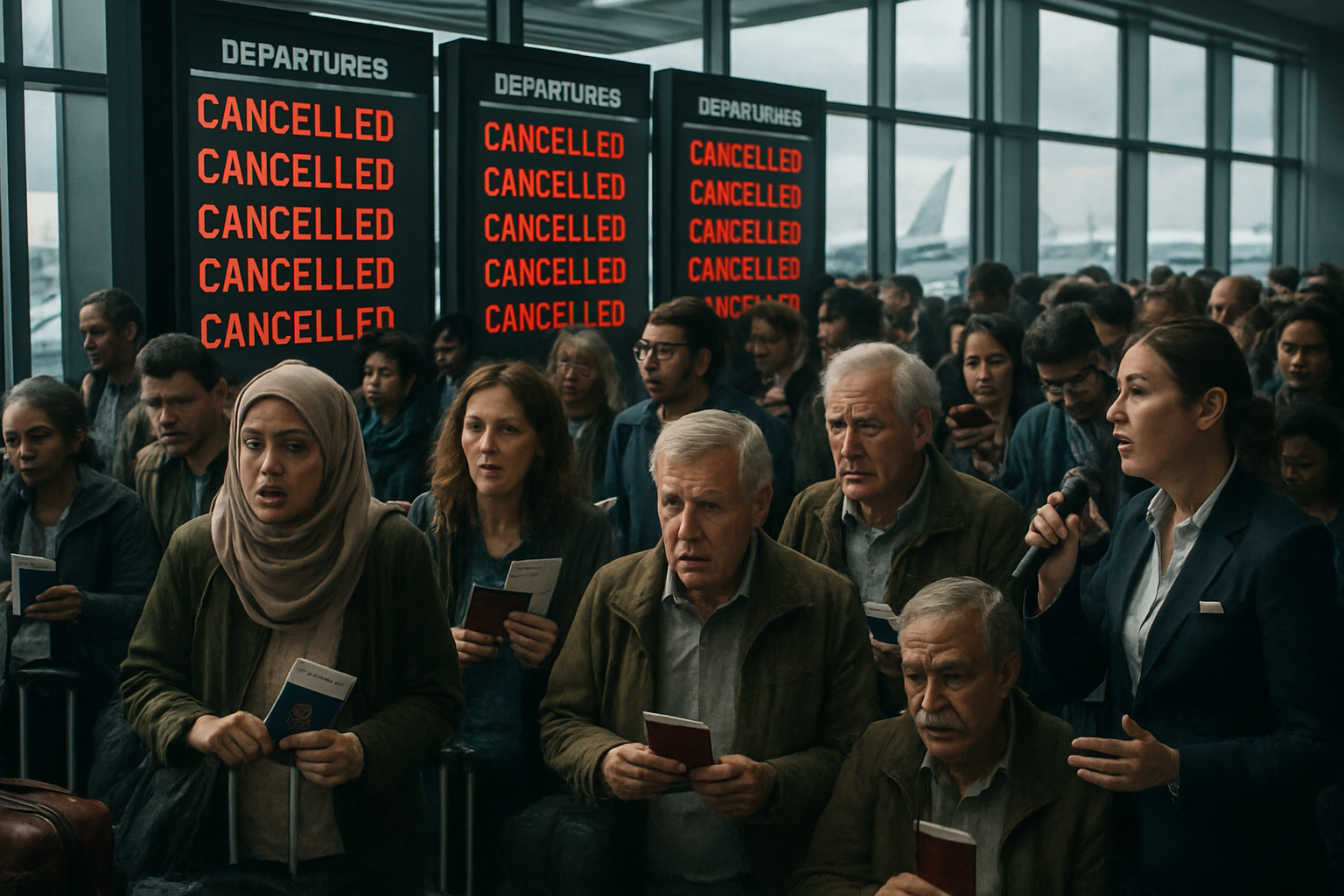
Nations across the globe have launched the largest coordinated evacuation effort since the Arab Spring, rushing to extract hundreds of thousands of their citizens from Middle East conflict zones as warfare spreads across the region following the death of Iran's Supreme Leader Ali Khamenei and massive retaliatory strikes.
The unprecedented evacuation crisis has emerged as countries scramble to protect their nationals amid the escalating conflict that began with US-Israeli "Operation Epic Fury" strikes on Iran and subsequent Iranian retaliation through "Operation True Promise 4." With over 18,000 flights cancelled worldwide and critical transportation hubs shut down, governments are deploying emergency protocols on a scale not seen since 2011.
Scale of Global Evacuations Unprecedented
The scope of evacuation operations stretches across multiple continents, with nations mobilizing diplomatic, military, and commercial resources to extract citizens from conflict zones. Australia faces the challenge of evacuating 115,000 nationals trapped across the Middle East, with the Australian Defence Force convening a special taskforce to investigate evacuation options as Prime Minister Albanese stages crisis talks with the UAE.
European nations are coordinating massive repatriation efforts. Austria has nearly 18,000 citizens registered in the crisis region and has arranged evacuation flights from Muscat, Oman. Germany reports approximately 30,000 tourists stranded, with the first Emirates special flight already departing Dubai for Frankfurt. Italy estimates 30,000 nationals in the UAE alone, while Romania is evacuating 300 citizens from Israel via Egypt.
"We are witnessing the most extensive aviation crisis since COVID-19, with entire regions of airspace closed simultaneously. This is unprecedented in modern history."
— Aviation Industry Official
Aviation Crisis Compounds Evacuation Challenges
The simultaneous closure of airspace by Iran, Iraq, Israel, UAE, Qatar, Syria, Kuwait, and Bahrain has created the most comprehensive aviation disruption since the COVID-19 pandemic. Dubai International Airport, the world's busiest with over 86 million passengers annually, remains completely shut down after sustaining missile damage during Iranian retaliatory strikes.
Major airlines including Emirates, Air France-KLM, Wizz Air, and Bulgaria Air have suspended Middle East operations, affecting hundreds of thousands of passengers globally. The crisis has severed the critical Europe-Asia connecting hub, forcing complex rerouting and dramatically increasing travel costs and times.
Cyprus has activated its national ESTIA evacuation plan for the first time, coordinating the departure of European and third-country nationals from the region. The United States has authorized the departure of non-essential embassy personnel from 15 Middle Eastern countries, marking the most extensive diplomatic evacuation since the Arab Spring.
Individual Nation Responses
Nordic countries have taken particularly swift action. Sweden and Norway have thousands of citizens stranded in Dubai and Doha, with Swedish authorities describing the security situation as "extremely uncertain." Denmark's emergency services have received over 1,500 calls from stranded travelers, while SOS International is coordinating responses for Danish nationals across the region.
Malta reports 1,619 nationals across the region requiring assistance, while Luxembourg is coordinating the evacuation of 300 citizens, including 200 from the UAE. Slovakia has organized special repatriation flights from Jordan, with the country's defense ministry deploying military aircraft for the first time for such operations.
In Asia, Singapore's Ministry of Foreign Affairs is conducting surveys to gauge interest in "assisted departure" programs, while Vietnam reports thousands of overseas workers unable to return to Europe due to the collapse of transit routes through Dubai and Doha following the Lunar New Year holiday.
Energy Crisis Compounds Global Impact
The evacuations occur against the backdrop of a severe global energy crisis, with Iran effectively closing the Strait of Hormuz, which handles 40% of global oil transit. Oil prices have surged 10% to over $80 per barrel, while natural gas prices have increased 24% in Europe and 78% in the United States.
Major shipping companies Maersk and MSC have suspended operations in the Persian Gulf, leaving over 150 tankers anchored and representing billions of dollars in stranded cargo. Qatar has halted LNG production due to Iranian infrastructure strikes, further compounding global energy supply concerns.
Diplomatic Context and Regional Impact
The mass evacuations follow the complete breakdown of nuclear diplomacy between the US and Iran, despite recent breakthrough achieving "broad agreement on guiding principles" - the most significant progress since the JCPOA collapse in 2018. The fundamental disagreement over Iran's ballistic missiles and regional proxies proved insurmountable, leading to the current military escalation.
The unprecedented Saudi Arabia, UAE, Qatar, and Egypt coalition that had backed diplomatic efforts is now severely strained as Iranian retaliatory strikes have targeted member territories. Egypt's President Sisi condemned attacks on "sisterly Arab countries," warning of "comprehensive chaos" across the region.
Kazakhstan has maintained a neutral stance, with Deputy Foreign Minister Alibek Bakayev calling for disputes to be resolved "exclusively through diplomatic means." The country is preparing its own evacuation operations, with reports of 343 Kazakhstani citizens being evacuated from Jeddah.
Humanitarian and Economic Consequences
The crisis extends far beyond the Middle East, affecting global supply chains and transportation networks. Stock markets have crashed worldwide, with Pakistan's KSE-100 falling 8.97% and Dow futures dropping 400-570 points. The interconnected nature of modern transportation means regional conflicts instantly affect hundreds of thousands of civilians globally.
Individual stories highlight the human cost: Swedish traveler Emily Grosser paid $6,000 for alternative routing from Paris to Australia, while 28 Romanian students remain blocked at Dubai airport. German tourists describe a "tense mood" in Dubai as the reality of wider conflict has been brought directly to civilian areas previously considered safe havens.
The crisis has also stranded international sports teams, with West Indies and Zimbabwe cricket teams unable to return home after the T20 World Cup due to airspace closures. Even specialized evacuation efforts face challenges, with Ireland considering bussing nationals from Dubai and Abu Dhabi to Oman if flight restrictions continue.
Template for 21st Century Crisis Management
The current evacuation crisis represents a template-setting moment for international crisis management in the multipolar era. Unlike weather-related disruptions with predictable timelines, this geopolitical crisis depends entirely on military operations resolution and diplomatic tensions normalization.
The UN Security Council has convened emergency sessions as Secretary-General António Guterres declared the situation a "serious threat to international peace and security," warning that military actions could "trigger a chain of events no one can control."
The crisis occurs amid broader nuclear governance breakdown, with the New START treaty having expired on February 5 - the first time in over 50 years without US-Russia nuclear constraints. This context, combined with China's nuclear expansion, has led UN officials to warn that nuclear risks are at their "highest in decades."
Recovery Timeline Uncertain
Unlike natural disasters or technical failures, the recovery timeline for this crisis remains entirely uncertain, dependent on the resolution of underlying military operations and diplomatic tensions. Airlines are conducting daily operational reviews but cannot make long-term scheduling decisions while airspace closures persist.
The aviation industry is being forced to fundamentally reconsider route planning, risk assessment procedures, and international cooperation frameworks for managing geopolitical travel disruptions. This crisis demonstrates the vulnerability of modern transportation networks to geopolitical instability and may accelerate diversification of critical transportation hubs.
As the crisis enters its fourth day, with over 1,500 reported casualties across 22 Iranian provinces and continued military operations, the coming days will be decisive in determining whether this remains a contained regional confrontation or expands into a broader Middle Eastern war with global implications extending far beyond current evacuation efforts.
The stakes could not be higher: regional war prevention, global energy security, nuclear governance credibility, and international law enforcement mechanisms are all being tested simultaneously in what represents the most dangerous moment since the end of the Cold War.