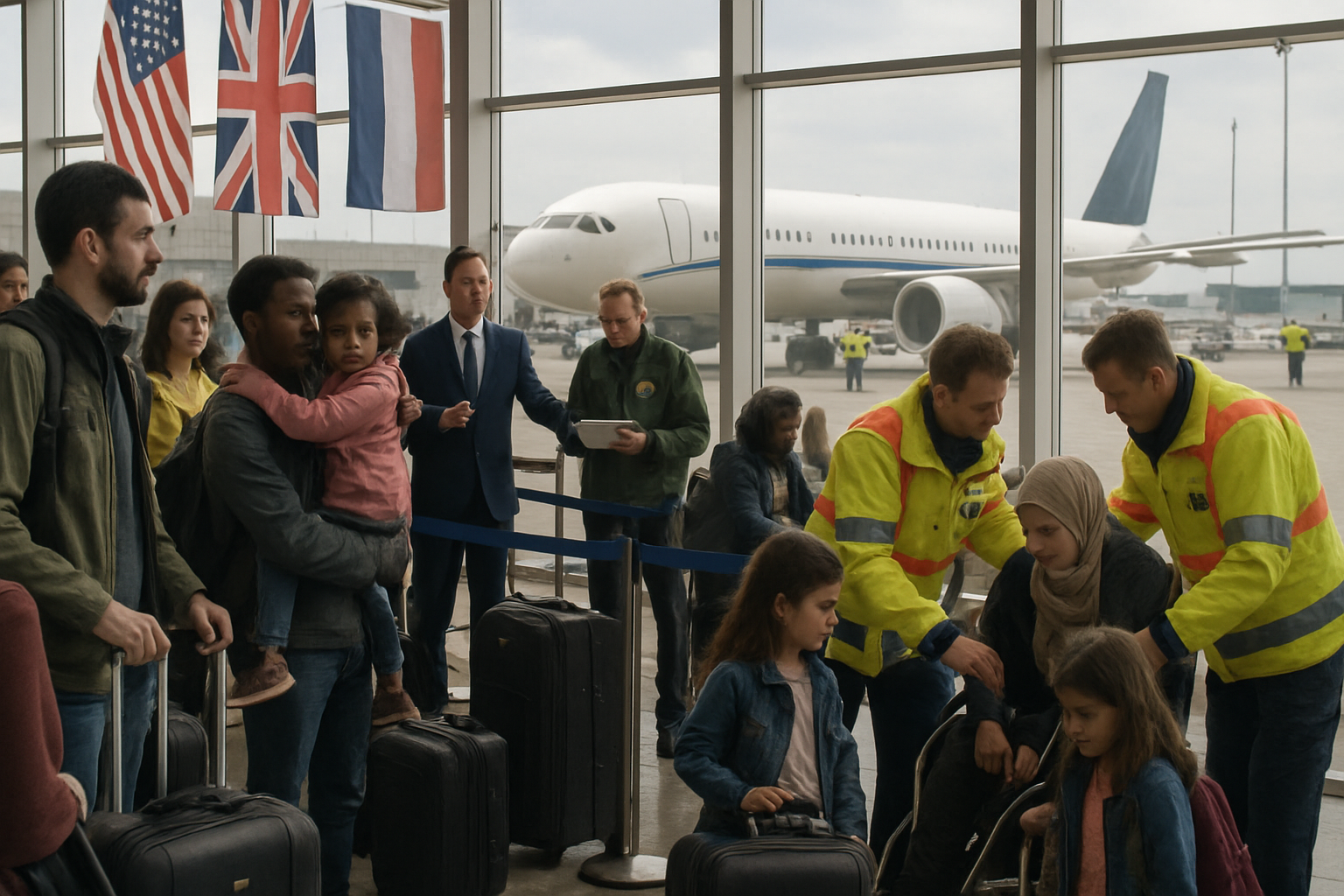
Nations across the globe are conducting the largest international evacuation operation since the Arab Spring of 2011, as governments race to extract hundreds of thousands of their citizens stranded across Middle Eastern countries following the escalation of regional conflict that began March 1, 2026.
The unprecedented evacuation effort spans multiple continents, with European Union members, Asian nations, and countries from Africa to the Americas coordinating emergency flights and alternative transport routes to bring their nationals home safely from Gulf states and the broader Middle East region.
Scale of the Crisis
The numbers reveal the staggering scope of the humanitarian challenge: Australia faces evacuating 115,000 nationals, Germany is working to extract 30,000 tourists, while Austria has registered 18,000 citizens requiring assistance. Kazakhstan has already successfully repatriated 2,111 citizens since March 3, with Air Astana and FlyDubai operating five emergency flights transporting 851 passengers in a single night.
Belgium's government confirmed it will commence repatriation operations starting Friday, with Defense Minister Theo Francken and Mobility Minister Jean-Luc Crucke coordinating the effort. Among those affected are over 40 West Flemish dairy farmers stranded in Dubai, who according to local reports have taken shelter in their hotel basement due to security concerns.
"But the West Flemish dairy farmers are not minded to panic," explains Steven Verhille from Poperinge, whose parents are among the group stranded in Dubai.
— Local Belgian Media Report
European Coordination Efforts
Cyprus has made history by activating its ESTIA evacuation plan for the first time since its implementation, coordinating the extraction of over 2,000 nationals from the UAE. This marks a watershed moment for European crisis management capabilities, demonstrating unprecedented multilateral coordination.
Croatia is overseeing the return of hundreds of nationals, while Denmark's emergency services have received over 1,500 calls from stranded citizens. Finnish authorities are organizing evacuation flights from the United Arab Emirates scheduled for Sunday, with citizens advised to contact their foreign ministry immediately.
Ireland has already begun evacuation operations, though some citizens report frustration with government response. Donal and Siobhan Dunn from Derry, who went to visit their daughter in Dubai, expressed concern about the lack of clear guidance and guaranteed flights home.
Global Aviation Crisis
The evacuation efforts are complicated by the most extensive aviation disruption since the COVID-19 pandemic, with over 18,000 flights cancelled worldwide. Eight Middle Eastern countries have simultaneously closed their airspace, including Iran, Iraq, Israel, UAE, Qatar, Syria, Kuwait, and Bahrain.
Dubai International Airport, the world's busiest with over 86 million passengers annually, remains completely shut down due to missile damage, creating cascading effects across global aviation networks. Emirates and other major carriers have suspended operations indefinitely, forcing complex rerouting through alternative hubs.

Asian Nations Response
South Korea has successfully evacuated 140 nationals from Iran and Israel, with President activating emergency response protocols. The government has imposed a complete travel ban on Iran citing escalating security concerns.
Singapore's Ministry of Foreign Affairs has begun repatriation flights this weekend, with plans to bring citizens home from Oman and the UAE, followed by assisted evacuations from Bahrain and Qatar in coming days.
In a more challenging situation, over 150 Russian tourists remain stuck on a cruise ship in Qatar, with passengers describing days of anxiety as they received little assistance from either the cruise operator or Russian diplomatic missions.
Individual Stories of Resilience
Personal accounts emerging from the crisis highlight both the human cost and remarkable resilience of those affected. A Danish family of eight, who were only supposed to have a two-hour layover in Dubai, found themselves stranded for a week amid explosions and emergency sirens.
Portuguese citizens in Qatar have expressed particular frustration, with their government's proposed solution involving only ground transport to Riyadh, Saudi Arabia - a route they describe as "completely impracticable."
Meanwhile, Maltese nationals are receiving full government support, with Prime Minister Robert Abela confirming that all evacuation costs will be covered by the state, ensuring affected families face no financial burden.
Logistical Challenges
The evacuation operation faces unprecedented logistical challenges. Slovakia's foreign ministry reports that a planned repatriation flight from Oman had to be cancelled because Muscat airport stopped accepting aircraft due to local restrictions.
Slovenia has managed to bring home 450 passengers on three flights from Oman and Dubai, with more flights scheduled in coming days. The government has earmarked €1.5 million for the repatriation operation, with an estimated 1,000 Slovenians initially stranded and about 500 still awaiting departure.
Ukraine faces particular challenges, with Ambassador reporting that approximately 800 Ukrainian nationals currently in Kuwait can only leave via land borders to Saudi Arabia due to aviation restrictions.
Energy Market Implications
The crisis has created severe disruptions to global energy markets, with oil prices surging 10% past $80 per barrel as Iran has effectively closed the Strait of Hormuz, which handles 40% of global oil transit. Major shipping companies including Maersk and MSC have suspended operations, leaving over 150 tankers stranded in the Persian Gulf.
Natural gas prices have skyrocketed by 24% in Europe and 78% in the United States, creating additional economic pressure on evacuation operations and raising concerns about winter energy supplies.
Historical Context and Precedent
The current evacuation operation represents the largest coordinated international effort since the Arab Spring of 2011, when similar mass evacuations were necessary across North Africa and the Middle East. However, the current crisis is unique in its simultaneous impact across multiple Gulf states and the involvement of critical global transportation hubs.
The crisis stems from the complete breakdown of nuclear diplomacy efforts that had shown promise in Geneva talks, achieving what officials called "broad agreement on guiding principles" - the most progress since the JCPOA collapse in 2018. However, fundamental disagreements over scope proved insurmountable.
International Cooperation Framework
The evacuation efforts have demonstrated both the strengths and limitations of international crisis management mechanisms. While individual nations have shown impressive rapid response capabilities, the crisis has also revealed gaps in unified coordination systems for mass civilian protection during regional conflicts.
European Union foreign ministers have held emergency sessions, with Cyprus's activation of the ESTIA plan serving as a template for future crisis responses. The coordination has involved sharing flight schedules, mutual assistance agreements, and joint diplomatic efforts to secure safe passage corridors.
"This is a historic moment that tests our collective ability to protect civilians in rapidly evolving international crises," noted one EU diplomatic source.
— European Diplomatic Official
Recovery Timeline Uncertain
Unlike natural disasters or technical failures that have predictable recovery timelines, the current situation depends entirely on the resolution of underlying political and military developments. Aviation industry analysts report that even when flights resume, clearing the backlog of cancelled flights and stranded passengers could take weeks.
The crisis has forced airlines to implement enhanced contingency planning, including complex rerouting strategies, alternative refueling arrangements, and dramatically increased operational costs. This has accelerated discussions about reducing over-dependence on Middle Eastern aviation hubs for global connectivity.
Looking Ahead
As evacuation efforts continue, governments are working around the clock to ensure the safe return of their citizens. The operation has become a template-setting moment for 21st-century crisis management, demonstrating how regional conflicts can instantly create global humanitarian challenges affecting hundreds of thousands of civilians worldwide.
The success of these coordinated evacuation efforts will likely influence future international crisis response frameworks, while the underlying regional tensions that triggered this massive operation remain unresolved. For now, the priority remains clear: bringing home the hundreds of thousands of people caught in an unprecedented international crisis.
The international community faces a critical test of its multilateral cooperation capabilities, with the outcome potentially reshaping diplomatic approaches to civilian protection in an increasingly interconnected but volatile world.