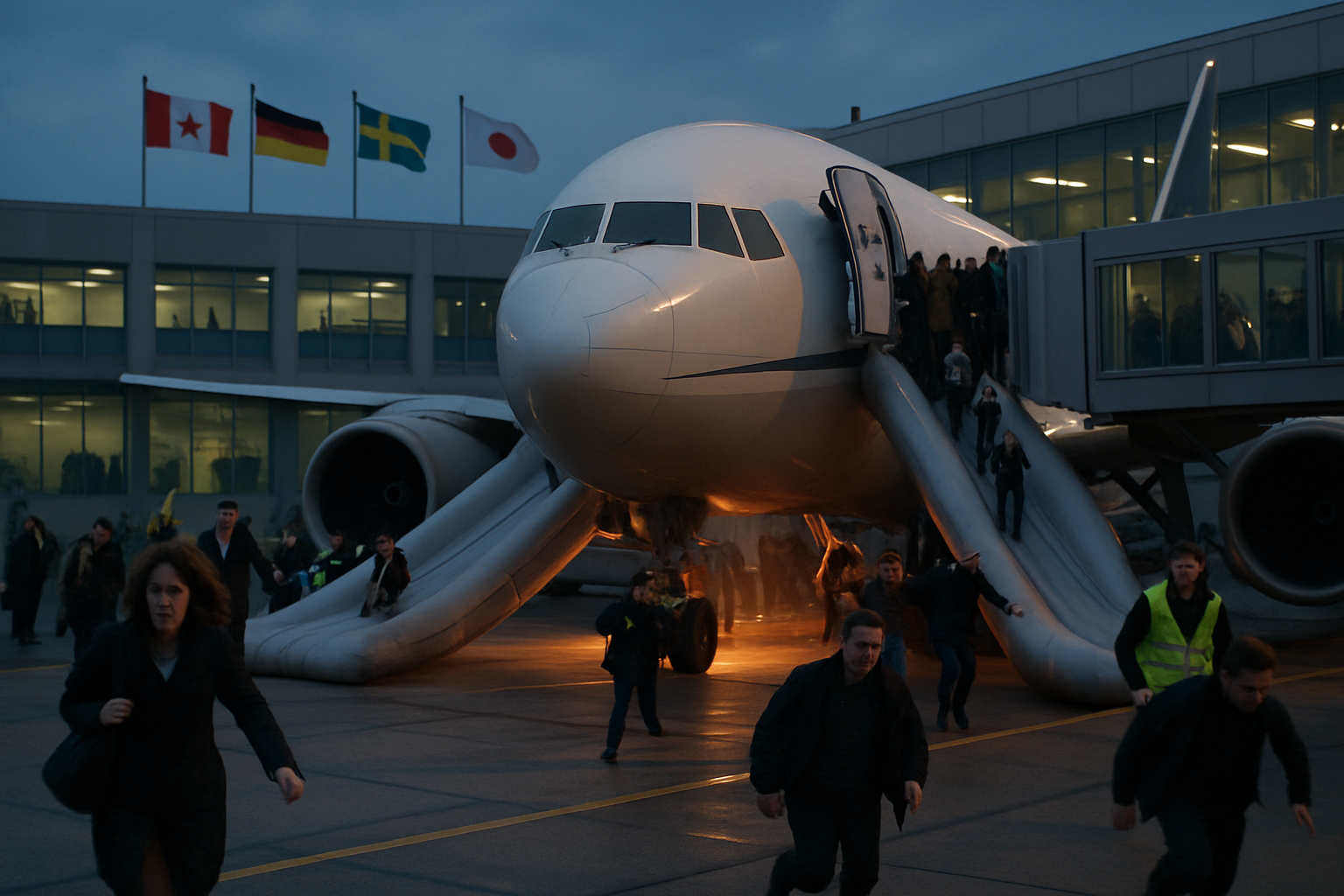
Nations across the globe are conducting the largest coordinated evacuation operations since the Arab Spring of 2011, working to extract over 500,000 citizens from Middle Eastern conflict zones as the region faces its most dangerous crisis since the Cold War.
The massive humanitarian operation spans continents, with countries from Canada to Japan mobilizing emergency resources to bring home nationals stranded across multiple Middle Eastern nations following the March 1 escalation of the Iran-Israel-United States conflict and the confirmed death of Iran's Supreme Leader Ali Khamenei.
Unprecedented Scale of Operations
The scope of the evacuations is staggering in its international breadth. Australia leads with 115,000 nationals requiring assistance, while Germany faces the challenge of repatriating 30,000 stranded tourists. Canada's Foreign Minister Anita Anand confirmed the government is working to evacuate over 2,000 citizens who remain scattered across the region.
The crisis has prompted Cyprus to activate its ESTIA national evacuation plan for the first time in history, coordinating the extraction of over 2,000 nationals and European Union citizens from the UAE. This marks a watershed moment for EU crisis management capabilities.
"We are witnessing the largest international evacuation effort in modern history," said a senior EU official. "The coordination required between nations demonstrates both our preparedness and the unprecedented nature of this crisis."
— European Union Crisis Management Official
The numbers continue to mount across nations: Japan announced charter aircraft operations to extract nationals from four Middle Eastern countries, while South Korea has already successfully evacuated 140 citizens from Iran and Israel. The Philippines reported that nearly 300 Filipino workers arrived home on Thursday after being repatriated from the region.
Aviation Crisis Compounds Challenges
The evacuation efforts are taking place against the backdrop of the most comprehensive aviation crisis since COVID-19, with over 18,000 flights cancelled worldwide. Eight Middle Eastern countries—Iran, Iraq, Israel, UAE, Qatar, Syria, Kuwait, and Bahrain—have simultaneously closed their airspace to civilian traffic.
Dubai International Airport, the world's busiest with over 86 million passengers annually, remains completely shut down after sustaining missile damage during Iranian retaliation strikes. This closure has eliminated the critical Europe-Asia transit hub, forcing airlines to implement complex alternative routing strategies.
Major carriers including Emirates, Air France-KLM, Wizz Air, and Bulgaria Air have suspended all Middle Eastern operations, affecting hundreds of thousands of passengers globally. The disruption extends far beyond the immediate region, with flight cancellations reported as far as Romania, which has cancelled 29 flights to various Middle Eastern destinations.
Individual Success Stories Emerge
Despite the massive logistical challenges, successful evacuations are providing hope for stranded citizens worldwide. Australia completed its first major repatriation with Emirates flight EK414, bringing over 200 citizens safely to Sydney Airport. Cyprus Airways successfully operated flight CYP107 from Dubai to Larnaca, evacuating 180 nationals.
Hong Kong managed to arrange safe air corridors through United Arab Emirates airspace, enabling the return of stranded residents. According to Captain Steven Dominique Cheung of the Hong Kong Professional Airline Pilots Association, pilots flying out of the region face significant challenges including GPS interference and false signals, making these successful operations even more remarkable.
Ireland has begun exploring alternative routes through Oman, with officials considering overland transport to bypass flight restrictions if necessary. The flexibility and creativity demonstrated by diplomatic missions worldwide highlight the unprecedented nature of the coordination required.
European Union Leadership
The European Union has demonstrated exceptional crisis management coordination, with multiple member states implementing synchronized evacuation protocols. Germany is arranging specialized charter flights for its 30,000 stranded tourists, while Sweden and Norway are coordinating the evacuation of thousands of citizens stranded in Dubai and Doha.
Latvia's Foreign Ministry has calculated the costs of repatriation flights, planning to utilize emergency contingency funds to ensure no citizen is left behind. Estonian authorities have advised approximately 3,000 nationals in the region to contact authorities for evacuation assistance.
The scale of European coordination extends to smaller nations as well. Luxembourg arranged evacuation flights from Muscat carrying 104 passengers via Egypt, while Malta is coordinating the evacuation of 1,619 nationals scattered across the region.
Energy Crisis Parallel
The evacuation operations are occurring alongside a parallel global energy crisis. Iran's closure of the Strait of Hormuz—through which 40% of global seaborne oil transit passes—has sent oil prices surging 10% to over $80 per barrel. Natural gas prices have increased 24% in Europe and 78% in the United States.
Major shipping companies Maersk and MSC have suspended operations in the Persian Gulf, leaving over 150 tankers anchored with billions of dollars worth of cargo stranded. Qatar has been forced to halt LNG production due to Iranian infrastructure strikes, affecting global energy supplies.
These energy disruptions are adding additional complexity to evacuation operations, as fuel costs and availability become critical factors in planning repatriation flights.
Diplomatic Breakdown Context
The current crisis stems from the complete collapse of US-Iran nuclear diplomacy despite achieving what negotiators called a "broad agreement on guiding principles"—the most progress made since the JCPOA collapse in 2018. The fundamental disagreement proved insurmountable: Iran insisted on excluding ballistic missiles and regional proxies as "red lines," while the US demanded a comprehensive agreement including missiles, armed groups, and human rights concerns.
This diplomatic breakdown led to Operation Epic Fury, described as the largest US-Israeli coordinated military operation since 2003, which resulted in the confirmed death of Iran's Supreme Leader Ali Khamenei on March 1, ending his 37-year rule. Iran's massive retaliation, dubbed "Operation True Promise 4," has caused casualties across multiple Gulf states and prompted the current evacuation crisis.
Historical Significance
Military and diplomatic experts are describing the current evacuation operations as template-setting for 21st-century crisis management. The rapid transition from diplomatic framework to military confrontation demonstrates what experts call the "fragility of modern crisis management in the multipolar era."
The crisis is occurring within a broader context of nuclear governance breakdown. The New START treaty between the US and Russia expired on February 5, marking the first time in over 50 years without bilateral nuclear constraints between the superpowers. UN Secretary-General António Guterres has warned that nuclear risks are at their "highest in decades."
Unlike weather-related disruptions that have predictable recovery timelines, the current crisis depends entirely on military operations resolution and diplomatic tensions normalization. Airlines are conducting daily operational reviews but cannot make long-term scheduling decisions, leaving hundreds of thousands of passengers in limbo.
Regional Coalition Under Strain
The evacuation crisis has severely strained an unprecedented regional coalition that had emerged to support diplomatic solutions. Saudi Arabia, the UAE, Qatar, and Egypt had formed an extraordinary Middle Eastern consensus backing negotiated resolution, but this coalition faces serious challenges as Iranian retaliation has targeted member territories directly.
UAE authorities reported one civilian killed in Abu Dhabi from missile debris, while Kuwait International Airport suffered drone strikes that injured employees. Qatar's air defense systems intercepted 65 missiles and 12 drones, with 8 people injured by falling fragments. Egyptian President Abdel Fattah el-Sisi condemned the attacks on "sisterly Arab countries," warning of "comprehensive chaos."
Recovery Timeline Uncertain
The timeline for recovery remains highly uncertain, with officials acknowledging that unlike natural disasters or technical failures, the current crisis depends on political and military developments beyond any single nation's control. Even when flight operations resume, clearing the backlog of cancelled flights and stranded passengers could take weeks.
Aviation industry experts are already discussing fundamental changes to route planning and risk assessment procedures. The crisis has exposed the vulnerability of modern transportation networks to geopolitical instability, particularly in strategically important regions that serve as critical transit hubs.
The interconnected nature of global travel has meant that a regional conflict has instantly become a worldwide civilian impact, affecting not just those in the immediate area but hundreds of thousands of travelers who depend on Middle Eastern hubs for connections between Europe, Asia, and other destinations.
International Cooperation Framework
Despite the unprecedented challenges, the evacuation operations are demonstrating remarkable international cooperation. Individual nations are sharing resources, coordinating flight schedules, and providing mutual assistance in ways that experts describe as a successful test of multilateral cooperation during crisis management.
The success of these coordinated efforts could provide a framework for future international crises, while failure to contain the broader regional conflict may fundamentally reshape international approaches to conflict resolution and civilian protection mechanisms.
As the situation continues to evolve, governments worldwide are maintaining emergency protocols and standing ready to adapt their evacuation strategies based on rapidly changing conditions on the ground. The coming days will be decisive in determining whether this remains a contained evacuation operation or expands into an even broader international crisis requiring unprecedented global coordination.