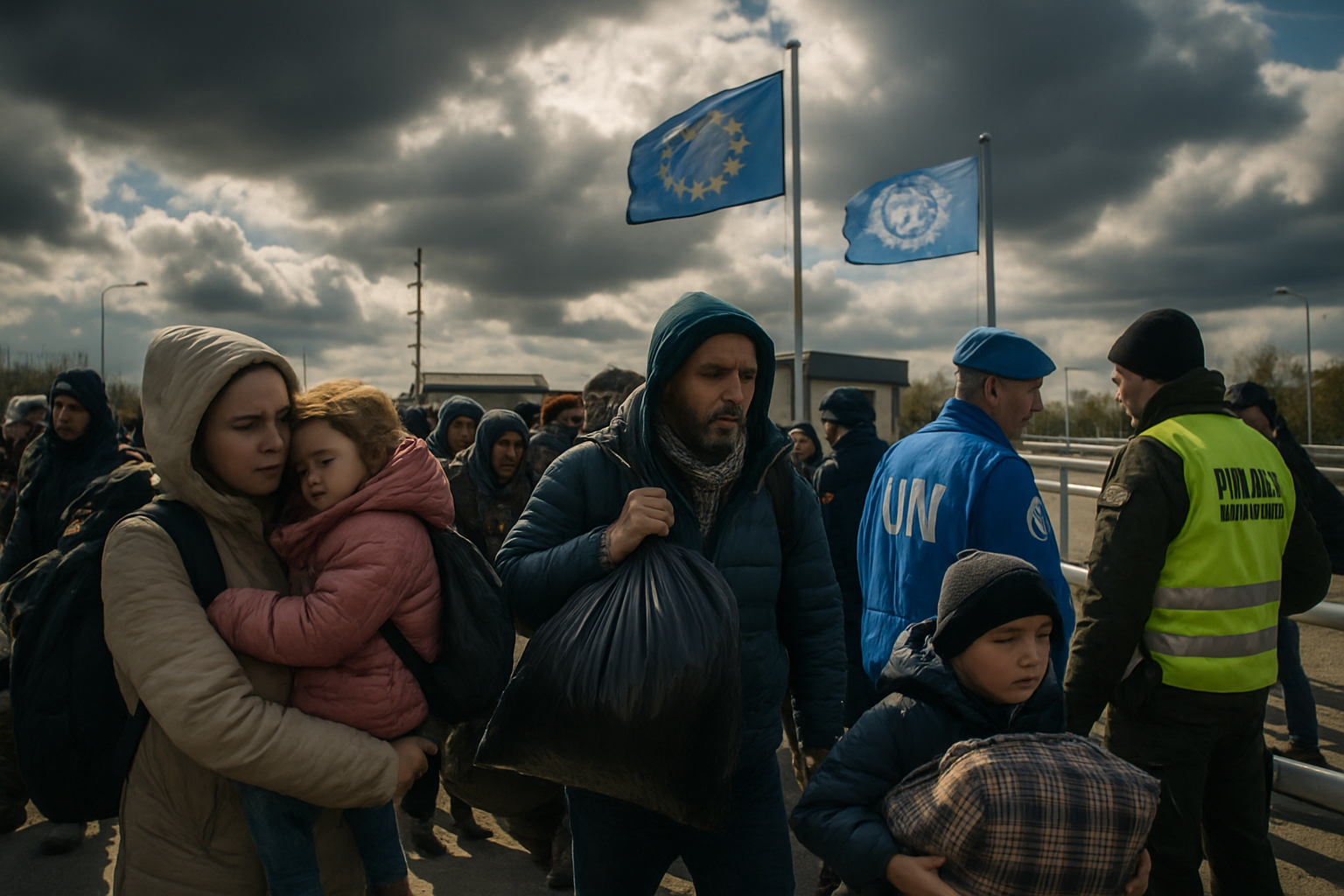
The year 2025 witnessed a stark contradiction in global migration patterns: while the Red Sea route claimed 922 lives—double the previous year's toll—European Union countries recorded their steepest decline in asylum applications since the 2015 refugee crisis, according to new UN and EU data released this week.
The International Organization for Migration (IOM) confirmed that deaths and disappearances on the Red Sea migrant route doubled in 2025, making it the deadliest year on record for this increasingly perilous passage between the Horn of Africa and Yemen. Meanwhile, Eurostat figures show first-time asylum applications across the EU plummeted to 669,400—a 27% decrease from the 912,400 applications recorded in 2024.
Red Sea Route: A Deadly Gateway
The Red Sea corridor has emerged as one of the world's most dangerous migration routes, with migrants primarily from Ethiopia, Somalia, and Eritrea attempting the hazardous sea crossing to reach Yemen and onward to Gulf states. The IOM's grim tally of 922 deaths and disappearances represents not just a statistical increase, but a human catastrophe of unprecedented scale on this route.
The doubling of casualties reflects both increased desperation among migrants fleeing conflict and economic hardship in the Horn of Africa, and the inherently dangerous nature of the journey. Small, overcrowded boats navigate treacherous waters, often without proper safety equipment or experienced operators.
"These numbers represent individual tragedies—families torn apart, dreams cut short, and communities left mourning," said a senior IOM official familiar with the data. The organization has been documenting migrant deaths and disappearances globally as part of its Missing Migrants Project, which tracks the human cost of irregular migration.
European Policy Transformation Drives Decline
The sharp 27% drop in EU asylum applications comes against the backdrop of sweeping policy changes across European migration systems. The decline represents the culmination of years of increasingly restrictive approaches that began transforming after the 2015-2016 refugee crisis.
Norway reported similar patterns, with asylum seeker numbers to EU countries falling dramatically over the past year. The trend reflects what migration experts describe as a fundamental shift from protection-based to deterrence-focused asylum policies across the continent.
Several factors have contributed to this decline, including enhanced cooperation mechanisms that allow smaller groups of EU member states to advance restrictive policies without requiring unanimous consent—effectively bypassing traditional humanitarian safeguards.
External Processing Centers Reshape Migration Landscape
A key development has been the establishment of external processing centers, with Italy's Albanian model serving as a template for broader European initiatives. Greece now leads a coalition with Germany, Netherlands, Austria, and Denmark to establish migrant deportation centers in Africa for rejected asylum seekers whose home countries refuse to readmit them.
These external processing arrangements represent the most significant transformation in European migration policy since the Dublin system's establishment, fundamentally altering how asylum claims are processed and where migrants await decisions on their cases.
Technology Enforcement and Border Controls
The EU's Entry/Exit System (EES) has proven effective in detecting violations, identifying over 4,000 overstayers in its first four months of operation—exceeding initial expectations. However, this technological success has created new challenges, with processing delays prompting warnings of four-hour queues during summer 2026, requiring potential partial suspension authorization from the European Commission.
Meanwhile, individual countries have implemented their own restrictive measures. The UK activated its first-ever "emergency brake" on visa restrictions, suspending study visas for nationals from Afghanistan, Cameroon, Myanmar, and Sudan due to a 470% surge in asylum applications from students between 2021-2025.
Regional Variations and Human Impact
Despite the overall EU decline, some countries experienced increases. Latvia saw asylum applications rise even as the broader European trend moved downward, highlighting the complex regional variations within the continental migration system.
The policy changes occur amid broader demographic challenges, with 89% of Europeans demanding greater EU unity while 72% express border security concerns, according to recent Eurobarometer polling. This tension between public demands for both unity and security has shaped the political landscape enabling these policy shifts.
Climate Displacement Pressures
The migration policy transformation unfolds against a backdrop of intensifying climate displacement pressures. March 2026 marks the 19th consecutive month of global temperatures exceeding 1.5°C above pre-industrial levels—the longest sustained warming streak in recorded history.
This unprecedented climate pattern is expected to generate new displacement pressures in coming years, potentially testing the sustainability of current restrictive approaches as climate-driven migration accelerates across traditional source regions.
Individual Stories Behind Statistics
Behind these policy shifts and statistics lie individual human stories of adaptation and hardship. In recent months, Iranian women soccer players granted asylum in Australia after being labeled "wartime traitors" by Iranian state television demonstrated how high-profile cases can influence broader humanitarian responses, even within restrictive policy frameworks.
Meanwhile, mass evacuations during the recent Middle East crisis—the largest coordinated international evacuation since the Arab Spring of 2011—showed both the capabilities and limitations of current international protection mechanisms when crises demand rapid humanitarian response.
Economic and Security Implications
The migration policy changes carry significant economic implications. The UK's student visa restrictions, for example, threaten billions in international education revenue and disrupt academic partnerships, highlighting the complex trade-offs between security measures and economic interests.
Labor shortages in agriculture, construction, and services across Europe create tension between migration restrictions and economic needs, particularly as aging populations increase dependency ratios across EU member states.
International Cooperation Challenges
The policy transformation reflects broader challenges in international cooperation on migration issues. Enhanced cooperation mechanisms enable smaller groups of EU countries to advance controversial policies, but they also risk fragmenting unified approaches to humanitarian protection.
Human rights organizations are preparing legal challenges over potential non-refoulement violations—the principle that prohibits returning people to territories where they face persecution. These challenges will test the legal boundaries of the new external processing arrangements.
Looking Forward: Template for Global Migration Management
The developments in European migration policy and Red Sea migration patterns represent template-setting moments that could influence international approaches to migration management for decades to come. The success or failure of external processing centers, technological enforcement systems, and deterrence-based policies will be closely monitored by other regions facing similar migration pressures.
As climate displacement intensifies and geopolitical instability continues to drive population movements, the balance between humanitarian obligations and security concerns will remain a defining challenge of 21st-century governance.
The stark contrast between rising death tolls on dangerous routes like the Red Sea and declining asylum applications in destination countries illustrates the complex dynamics of contemporary migration—where restrictive policies may redirect rather than reduce dangerous journeys.
Critical Juncture for Humanitarian Protection
March 2026 represents a critical juncture for international humanitarian protection principles. The European experience with external processing and deterrence-based policies will provide crucial data on whether democratic societies can maintain humanitarian commitments while managing complex migration flows driven by climate change, conflicts, and economic disparities.
The coming months will test whether current approaches can reduce dangerous journeys like those across the Red Sea, or whether restrictive destination policies simply shift risks to different routes and methods, potentially increasing rather than decreasing human casualties.
As the international community grapples with these challenges, the humanitarian cost of policy choices becomes increasingly apparent in statistics like the 922 lives lost on the Red Sea route in 2025—a sobering reminder that migration policy is ultimately about human lives, not just administrative procedures.