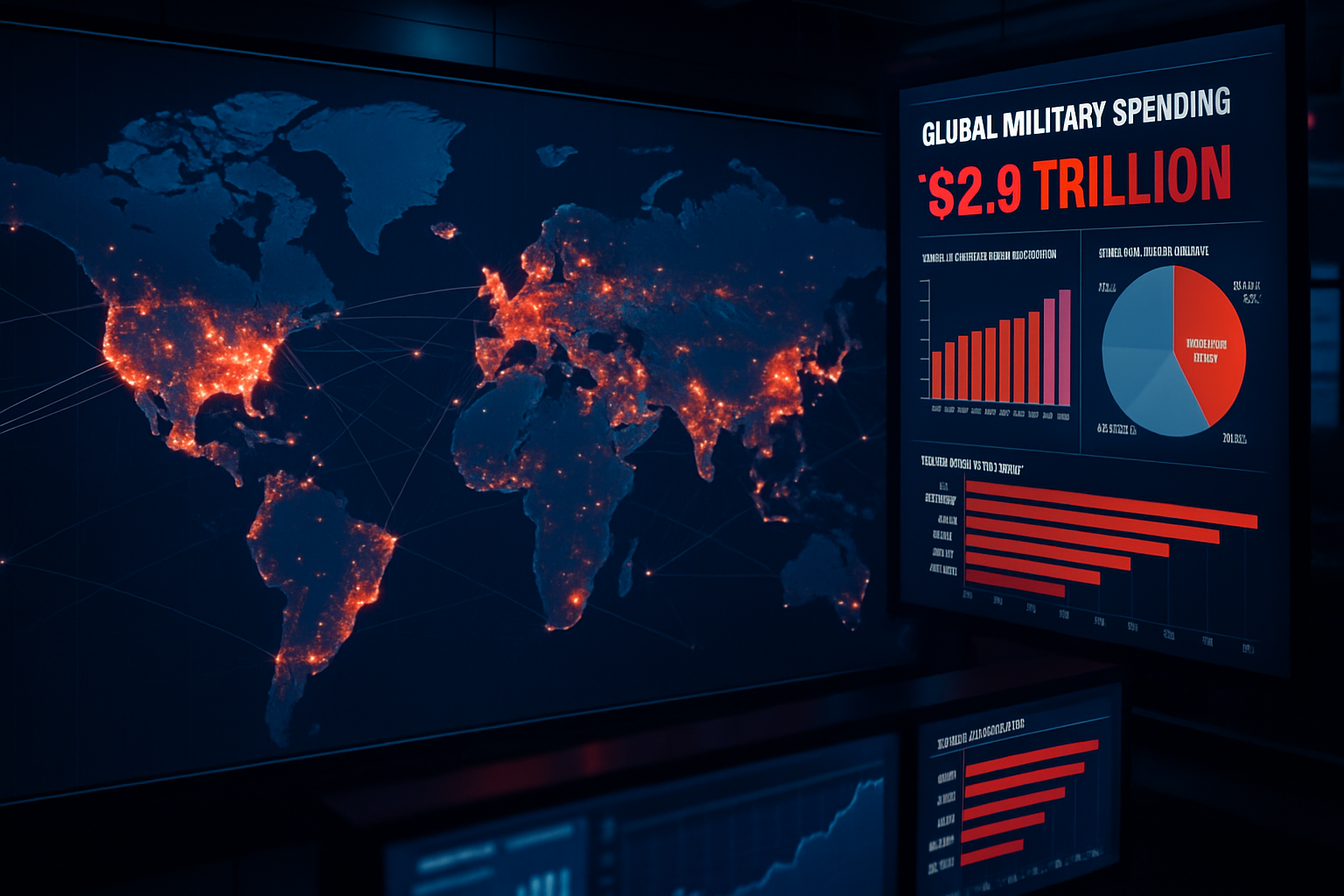
World military spending reached a record-breaking $2.9 trillion in 2025, marking the 11th consecutive year of increases as governments responded to war, strategic rivalry, and mounting uncertainty across Europe and Asia, according to the Stockholm International Peace Research Institute (SIPRI).
The unprecedented spending surge, representing a 2.9% increase from the previous year, reflects a fundamental shift in global security priorities as nations grapple with multiple concurrent conflicts and the breakdown of traditional arms control frameworks. Russia's military expenditures increased by nearly 6% as Moscow sustained its war efforts, while European nations tripled their arms imports since 2021 in response to regional security threats.
Europe and Asia Lead Global Rearmament
SIPRI's annual report, released Monday, identifies Europe and Asia as the primary drivers behind what researchers describe as the most significant global rearmament since the Cold War. The data reveals a complex web of interconnected security challenges that have fundamentally altered international military spending patterns.
"The world is witnessing an unprecedented convergence of regional conflicts, great power competition, and technological transformation," said a SIPRI researcher familiar with the data. "The $2.9 trillion figure represents not just increased spending, but a fundamental recalibration of how nations approach security in the 21st century."
European nations have demonstrated remarkable unity in meeting defense spending commitments, with all 32 NATO members achieving the historic 2% GDP defense spending target for the first time in the alliance's 75-year history. Combined NATO spending reached $1.4 trillion, representing a 6% increase from the previous year, with Poland leading at 4.3% of GDP.
Russia's War Economy Expansion
Russia's nearly 6% increase in military expenditures reflects the enormous financial burden of sustaining prolonged military operations. The Kremlin's spending surge comes despite growing economic pressures from international sanctions and the reallocation of resources from civilian sectors to military production.
Analysis from Russian sources indicates the country has fundamentally restructured its economy around defense production, with traditional agricultural and civilian manufacturing sectors experiencing reduced state support to fund military capabilities. This represents the most significant economic militarization since the Soviet era.
"Global military expenditures have increased for 11 consecutive years, with defense spending accelerating across multiple regions simultaneously."
— SIPRI Annual Report, 2026
The Russian military buildup has prompted corresponding increases across Eastern Europe, where nations directly bordering Russia have dramatically expanded their defense capabilities. The Baltic states, Poland, and Nordic countries have implemented comprehensive security upgrades, including advanced air defense systems and enhanced military infrastructure.
Nuclear Governance Crisis Drives Spending
The collapse of traditional arms control mechanisms has significantly contributed to rising military expenditures. The expiration of the New START treaty in February 2026 marked the first time in over 50 years that the United States and Russia operated without bilateral nuclear constraints, creating what UN Secretary-General António Guterres described as a "grave turning point" with nuclear risks at their highest levels in decades.
This nuclear governance vacuum has prompted unprecedented European discussions about alternative deterrent arrangements. Germany and France have initiated preliminary talks about expanding French nuclear deterrent capabilities beyond national scope—the first such discussions since the Cold War's end. Finland has announced plans to lift its comprehensive nuclear weapons ban, while Sweden has indicated willingness to host nuclear weapons during wartime conditions, breaking an 80-year Nordic nuclear-free tradition.
Technological Arms Race Acceleration
The spending surge reflects not only traditional military capabilities but also massive investments in emerging technologies that are reshaping warfare. Artificial intelligence integration has accelerated dramatically, with over 800 million users now accessing military-grade AI systems. China's recent breakthrough in hybrid propulsion drone technology and systematic AI integration throughout its military represents a fundamental technological competition.
European nations have responded with their own technological initiatives. Germany announced a historic €35 billion investment in military space defense systems, abandoning decades of restrictive space militarization policies. This represents a fundamental transformation from civilian-focused space approaches to comprehensive military space capabilities including advanced satellites, communications systems, and reconnaissance platforms.
Regional Security Transformations
The Arctic has emerged as a new frontline requiring substantial military investments. NATO's Arctic Sentry mission represents the most comprehensive northern defense initiative since the Cold War, with European leadership addressing a 23% increase in Russian military activity since Finland and Sweden joined the alliance.
Canada announced a $35 billion Arctic defense expansion—the most significant since the Cold War—while implementing a 5% GDP military spending target by 2035. The investment includes surveillance systems, climate-resilient infrastructure, and icebreaker capabilities designed to operate in temperatures reaching -70°C with winds exceeding 200 km/h.
In the Asia-Pacific region, military spending has surged in response to increasing tensions around Taiwan, where Chinese military activity increased 23% in 2025. Japan's recent constitutional reforms have enabled enhanced defense capabilities, while Australia's AUKUS nuclear submarine program represents a $30 billion commitment creating 10,000 jobs in Adelaide's manufacturing hub.
Economic Implications and Sustainability Concerns
The unprecedented spending levels raise significant questions about long-term economic sustainability and democratic oversight. Parliamentary bodies across multiple nations have demanded enhanced transparency mechanisms and detailed accounting of military expenditures that extend far beyond initial projections.
The climate implications of increased military spending have also drawn attention. Research indicates that the first 14 days of intensified military operations during recent conflicts generated 5 million tonnes of greenhouse gas emissions—equivalent to the combined annual carbon output of 84 countries. Military operations now represent one of the largest unregulated global emissions sources, creating tension between security requirements and climate commitments.
"The trajectory of global military spending suggests continued increases driven by regional conflicts, technological competition, and climate security impacts that will define international relations for decades ahead."
— Defense Policy Institute Analysis
Alliance Dynamics and Burden Sharing
The spending surge has fundamentally altered alliance relationships and burden-sharing arrangements. Spain's defense expenditures increased by 50% to $40.2 billion, representing the largest percentage increase among major powers and elevating the country into the top 15 global military spenders for the first time.
European strategic autonomy has evolved from aspiration to operational reality. The response to Iranian attacks on Cyprus—the first European territory attack since World War II—demonstrated unprecedented coordination as France repositioned the Charles de Gaulle aircraft carrier to the Mediterranean while Greece, Britain, and Spain provided naval and air defense assets within hours, operating independent of traditional NATO frameworks.
Looking Forward: Trajectory and Implications
The $2.9 trillion global military spending figure represents more than financial statistics—it reflects a fundamental paradigm shift in 21st-century security architecture. The combination of traditional state-to-state conflicts, technological competition, climate-related security challenges, and the breakdown of arms control frameworks has created an unprecedented security environment requiring coordinated international responses.
Success in managing this trajectory will depend on whether increased military investments enhance stability through deterrence or fuel competitive tensions that undermine diplomatic solutions. The stakes extend beyond defense budgets to fundamental questions about democratic governance, international cooperation, and sustainable development in an era of great power competition.
As nations continue navigating this complex security landscape, the effectiveness of their military investments in preventing conflicts while maintaining democratic values and international stability will determine the success of this unprecedented global rearmament effort. The $2.9 trillion spent in 2025 represents not just defense preparation, but a critical test of whether 21st-century institutions can manage multiple simultaneous challenges while preserving the foundations of international cooperation.