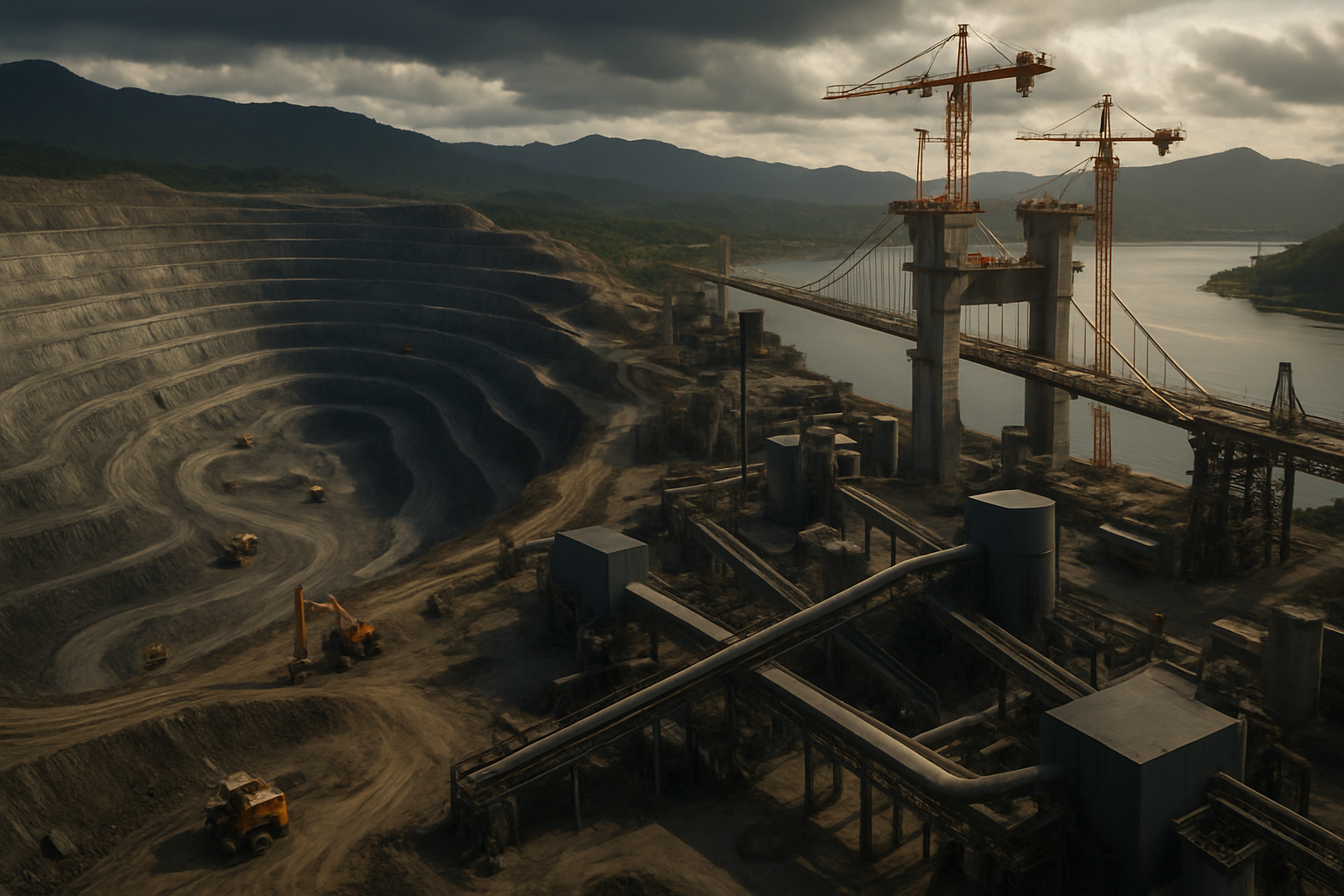
Major mining acquisitions and critical infrastructure projects are simultaneously advancing across four continents, signaling a new phase of global development as China expands its mineral footprint in Brazil while emergency bridge repairs and strategic construction projects reshape transportation networks from the Solomon Islands to Paraguay.
February 2026 has emerged as a watershed moment for both resource extraction and infrastructure development, with parallel developments highlighting the interconnected nature of global mineral security and strategic transportation networks.
China Expands Brazilian Aluminium Empire
China's state-owned aluminium giant Chalco and Anglo-Australian mining company Rio Tinto completed one of the year's most significant mining acquisitions on February 2, purchasing a controlling 68.6 percent stake in Brazil's Companhia Brasileira de Aluminio (CBA) for $886 million from Brazilian conglomerate Grupo Votorantim.
The transaction represents China's continued expansion into Brazil's strategic mineral assets, reinforcing Beijing's growing influence over critical raw material supply chains. This acquisition comes at a crucial time when the European Union has warned that China's control over 60 percent of global critical raw materials production and 90 percent of refining capacity poses serious risks to climate goals and strategic autonomy.
"This acquisition solidifies China's position in the global aluminium market while providing Rio Tinto with strategic access to one of South America's most significant processing facilities."
— Industry Analysis, Mining Sector Report
The CBA acquisition follows recent precedents in strategic mineral control, including Japan's successful deep-sea rare earth mining trial off Minamitorishima island, which extracted materials from 6,000 meters depth in an effort to reduce dependence on Chinese rare earth supplies.
Critical Bridge Infrastructure Under Emergency Repair
While major acquisitions reshape mineral markets, critical infrastructure projects across multiple regions face urgent challenges and significant progress milestones.
Solomon Islands Emergency Response
The Solomon Islands Ministry of Transport Infrastructure Management Services Division (TIMSD) launched emergency repair works for the Tanaeba (Kohi) Bridge and multi-cell culverts on Northwest Guadalcanal Road following catastrophic flooding that disrupted transportation for farmers, businesses, schools, and general road users.
The emergency response, coordinated with the Guadalcanal Provincial Disaster Operations Committee, addresses damage from persistent heavy rains and winds that affected multiple parts of the country. Contractors have been mobilized to reconnect the bridge and address compromised cell culverts identified during post-flood inspections.
Paraguay's Bioceanic Bridge Nears Completion
Meanwhile, Paraguay's Ministry of Public Works and Communications (MOPC) reported that the Bioceanic Bridge connecting Carmelo Peralta and Porto Murtinho, Brazil, is just 118 meters from completion in its central span. The Itaipú-financed project represents a strategic milestone for the Bioceanic Corridor.
Construction teams completed concrete work on Segment 13 on the Paraguayan side and Segment 15 on the Brazilian territory, bringing the 1,300-meter bridge structure significantly closer to final connection. The bridge will feature two traffic lanes and serve as a crucial link in regional economic development.
"The Bioceanic Bridge will consolidate as a strategic axis of the Bioceanic Corridor, fundamentally transforming regional connectivity and trade flows."
— Ministry of Public Works and Communications, Paraguay
Hungary's Massive Steel Bridge Installation
In Eastern Europe, Hungary is preparing to install a 1,400-ton steel railway bridge on Bartók Béla Road as part of the Southern Circular Railway development project. The massive steel structure is scheduled to reach its final position by Friday, representing a significant engineering achievement in urban railway infrastructure.
The bridge installation demonstrates the scale of infrastructure modernization occurring across multiple continents, with projects requiring precise coordination of heavy equipment and engineering expertise.
Historical Context and Strategic Implications
These developments occur against the backdrop of recent major infrastructure investments worldwide. Algeria recently launched its western mining railway connecting Gara Djebilet-Tindouf-Bechar to access the world's third-largest iron ore reserves, while Mexico completed its 58-kilometer Mexico-Toluca interurban train after 12 years of construction.
The simultaneous advancement of mining acquisitions and infrastructure projects reflects broader global trends toward resource security and strategic connectivity. China's expansion into Brazilian aluminium production capabilities occurs while European auditors warn of dangerous dependence on Chinese-controlled critical raw materials.
Regional infrastructure investments also demonstrate varied approaches to development challenges. Cameroon allocated $1.1 billion for major infrastructure projects in 2026 despite security challenges, while Oman doubled government tenders to $4.4 billion as part of Vision 2040 strategic initiatives.
Engineering and Logistical Challenges
The complexity of current projects highlights both technological capabilities and persistent challenges in major infrastructure development. The Solomon Islands emergency response required rapid mobilization following natural disaster impacts, while Paraguay's Bioceanic Bridge represents years of careful planning and international financing coordination.
Hungary's 1,400-ton bridge installation requires sophisticated heavy equipment and precise timing to minimize urban disruption, demonstrating the logistical expertise required for modern infrastructure projects in dense urban environments.
These projects collectively represent billions in investment and years of planning, execution, and coordination across multiple stakeholders including governments, international financing institutions, engineering firms, and construction companies.
Future Implications
The convergence of major mining acquisitions and infrastructure developments in February 2026 signals broader shifts in global economic geography. China's continued expansion into strategic mineral assets, combined with urgent infrastructure needs across developing regions, highlights the interconnected nature of resource security and connectivity infrastructure.
As these projects advance toward completion, they will reshape regional economic capabilities and global supply chain dynamics. The Bioceanic Bridge will enhance South American trade connectivity, Solomon Islands repairs will restore critical agricultural and educational access, and Hungary's railway infrastructure will modernize urban transportation networks.
The success of these diverse projects will provide important lessons for future infrastructure development and resource acquisition strategies, particularly as climate change and geopolitical tensions continue to influence global development priorities and investment patterns.