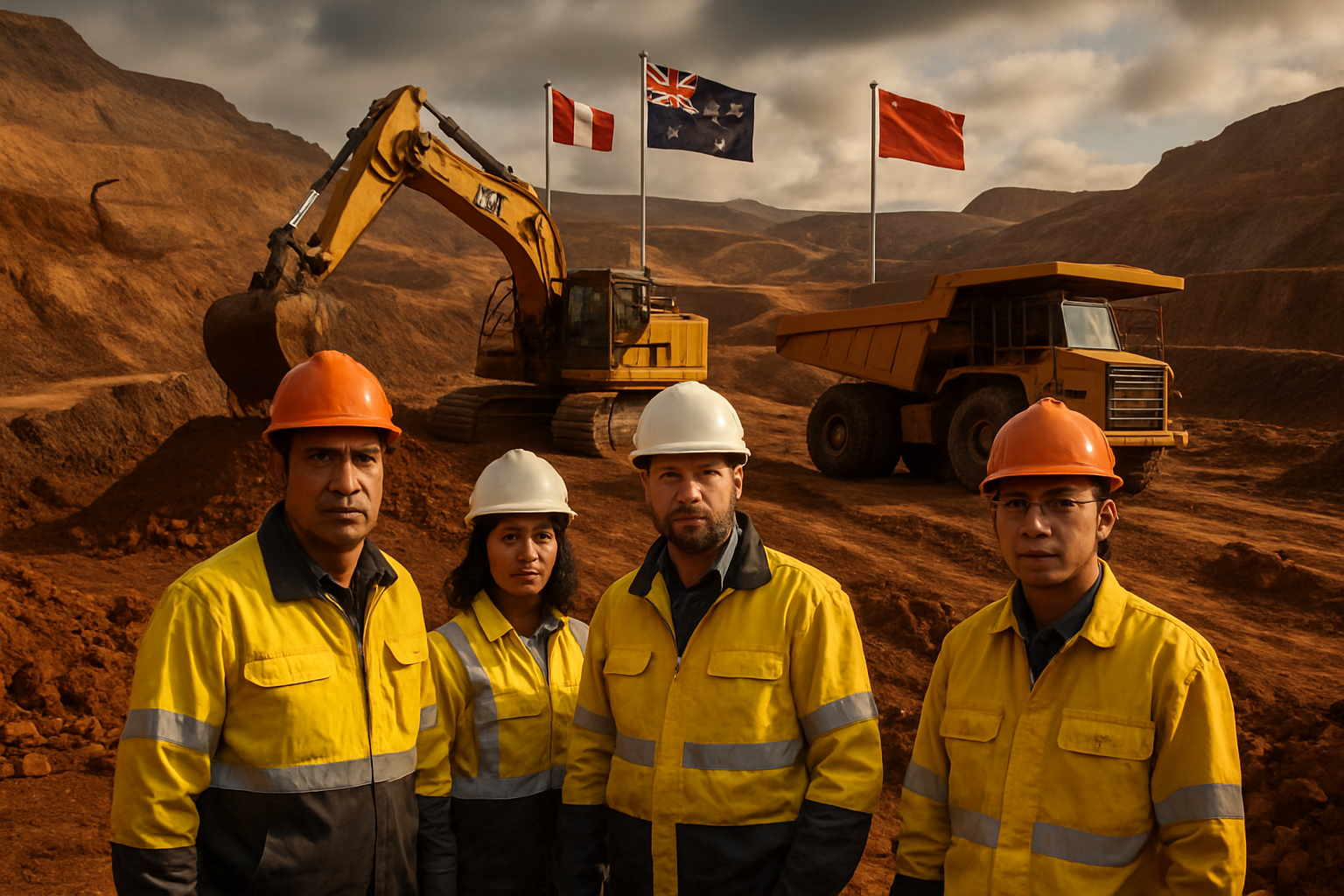
Global mining investment is experiencing an unprecedented surge as Peru leads with $398 million in January 2026 investments, up 8.9% from the previous year, while significant mineral discoveries in China and New Zealand's mining sector expansion to NYSE markets signal a fundamental transformation in the industry's geographic and financial landscape.
The dramatic growth in mining investment comes at a critical juncture when global supply chain security has become paramount. Peru's Ministry of Energy and Mines (Minem) reported that the $398 million January figure was driven by exceptional performance in Infrastructure development, which surged 83.3%, and Exploration activities, which increased by 32.9% compared to the same period in 2025.
Peru Emerges as Investment Powerhouse
Peru's mining sector has demonstrated remarkable resilience and growth potential, positioning itself as a key destination for international mining capital. The country's diverse geological profile and established mining infrastructure have attracted significant investment across multiple sectors, from traditional copper and gold operations to emerging critical minerals projects.
The infrastructure boom reflects Peru's strategic approach to modernizing its mining capabilities, with investments flowing into transportation networks, processing facilities, and technological upgrades that will support expanded production capacity. This foundation-building approach suggests sustained long-term commitment from both domestic and international investors.
"Peru's mining investment growth represents a fundamental shift in global capital allocation toward regions offering both geological potential and political stability."
— Industry Analyst, Latin American Mining Sector
China's Game-Changing Mineral Discoveries
Recent reports from Egyptian media sources highlight significant mineral discoveries in China that could potentially "change the global economic map." While specific details remain limited, the discoveries are described as involving critical raw materials essential for modern technology and renewable energy infrastructure.
These Chinese developments occur within the context of the country's existing dominance in critical minerals processing, controlling approximately 60% of global production and 90% of refining capacity for materials like lithium, cobalt, and rare earth elements. Any expansion of China's mineral resource base could further consolidate this strategic advantage.
The timing is particularly significant as the US-EU-Japan Critical Minerals Partnership, involving 55 countries including seven African suppliers, works to diversify supply chains away from Chinese dominance. New discoveries in China could complicate these diversification efforts and potentially strengthen Beijing's position in future trade negotiations.
New Zealand Mining Reaches Global Markets
In a historic development for New Zealand's mining sector, an Otago miner is preparing to witness a bell-ringing ceremony as his company prepares to list on the New York Stock Exchange. This milestone represents the international recognition of New Zealand's mining expertise and the global appetite for diversified mining investments.
The NYSE listing comes as international investors seek exposure to politically stable jurisdictions with strong environmental, social, and governance (ESG) standards. New Zealand's regulatory framework and commitment to sustainable mining practices make it an attractive destination for ESG-conscious investment funds.
This development also reflects the broader trend toward geographic diversification in mining portfolios, as investors seek to reduce concentration risk while accessing high-quality assets in stable political environments.
Geopolitical Drivers of Investment Transformation
The current mining investment surge is fundamentally driven by geopolitical considerations rather than purely market forces. The Russia-Ukraine conflict, tensions in the South China Sea, and ongoing trade disputes have highlighted the vulnerability of single-source supply chains for critical materials.
Countries rich in mineral resources are leveraging this new reality to attract investment and secure better terms from international partners. African nations, in particular, have seen unprecedented interest from competing global powers seeking to secure reliable access to critical minerals essential for renewable energy transitions and advanced manufacturing.
The African Finance Corporation has identified $29.5 trillion in mineral reserves across the continent, representing 20% of global totals, with $8.6 trillion remaining untapped. Recent major investments include Ivory Coast's $1.2 billion gold projects, South Africa's R325 million rare earth commitment, and infrastructure developments like Algeria's Gara Djebilet railway accessing the world's third-largest iron ore reserves.
Technology and Environmental Considerations
Modern mining operations are incorporating advanced technologies that promise both increased efficiency and reduced environmental impact. Digital monitoring systems, AI-powered equipment optimization, and renewable energy integration are becoming standard requirements rather than premium additions.
However, the industry faces significant challenges from supply chain constraints affecting technological infrastructure. Memory chip shortages have driven semiconductor prices up sixfold, affecting smart mining technologies until new fabrication facilities come online in 2027. This has forced mining companies to prioritize technology investments while managing substantially increased costs.
Environmental compliance has evolved from optional corporate responsibility to mandatory operational requirement. Recent regulatory actions, including Congo's suspension of mining operations for environmental violations, demonstrate that governments are asserting greater oversight while maintaining investment attractiveness through transparent, predictable frameworks.
Investment Patterns and Market Dynamics
Investment patterns are shifting toward localized strategies emphasizing clear regulatory frameworks and transparent governance over purely geographic diversification. Investors increasingly prioritize policy predictability and environmental compliance capabilities when traditional economic indicators may be insufficient.
The construction of supporting infrastructure has become as critical as the mining operations themselves. Projects like Angola's Lobito Corridor revival, connecting Atlantic ports to DRC copper regions, demonstrate how infrastructure investment creates multiplier effects supporting broader economic development beyond immediate mining activities.
Regional integration frameworks, particularly the African Continental Free Trade Agreement (AfCFTA), are enabling cross-border mining ventures and shared infrastructure development that maximizes investment impact across multiple jurisdictions.
Supply Chain Security and Strategic Partnerships
The formation of strategic partnerships has accelerated, with seven African countries (Angola, DRC, Guinea, Kenya, Morocco, Sierra Leone, Zambia) participating in the US-EU-Japan Critical Minerals Partnership. This represents a shift from market-driven to security-based supply chain coordination.
China's response includes announcing zero-tariff access for 53 African countries starting May 1, 2026 – the most comprehensive China-Africa trade expansion in history. This creates complex dynamics where African resource-rich nations balance competing international partnerships while maintaining strategic autonomy.
Brazil's experience illustrates both opportunities and challenges in this environment. Despite holding the world's second-largest rare earth reserves, internal divisions over foreign partnerships have limited near-term development potential. A government study showed Brazil's graphite output declined 8.4% annually, highlighting the gap between resource potential and actual production capacity.
Market Challenges and Risk Management
Despite robust investment growth, the mining sector faces significant operational challenges. Rising material costs are creating negative profit margins for some developers, while global supply chain disruptions affect equipment procurement and project timelines.
Security concerns have escalated in certain regions, with criminal organizations targeting mining operations and personnel. This has necessitated enhanced security protocols and international cooperation frameworks to protect industrial investments and personnel.
Currency volatility and changing commodity prices add additional complexity to investment decisions, requiring sophisticated risk management strategies that account for both market dynamics and geopolitical developments.
Future Outlook and Strategic Implications
The mining investment renaissance of 2026 represents a fundamental transformation toward strategic resource security rather than purely commercial considerations. Success in this environment requires enhanced security protocols, sophisticated environmental governance, technological innovation, and balanced international partnerships.
The industry's evolution from traditional extractive models toward comprehensive development strategies that benefit local populations while engaging global markets productively will determine long-term sustainability. Countries and companies that successfully navigate this transition will be positioned to lead the next phase of global mining development.
As climate change accelerates the demand for renewable energy materials while simultaneously making some mining operations more challenging, the industry faces the dual imperative of increasing production while improving environmental performance. The investments flowing into the sector in 2026 suggest confidence that this balance can be achieved through technological innovation and responsible development practices.
March 2026 may prove to be a decisive turning point that establishes mining development patterns influencing global competitiveness for decades ahead, positioning resource-rich nations as essential strategic partners in the global economy rather than simply commodity suppliers.