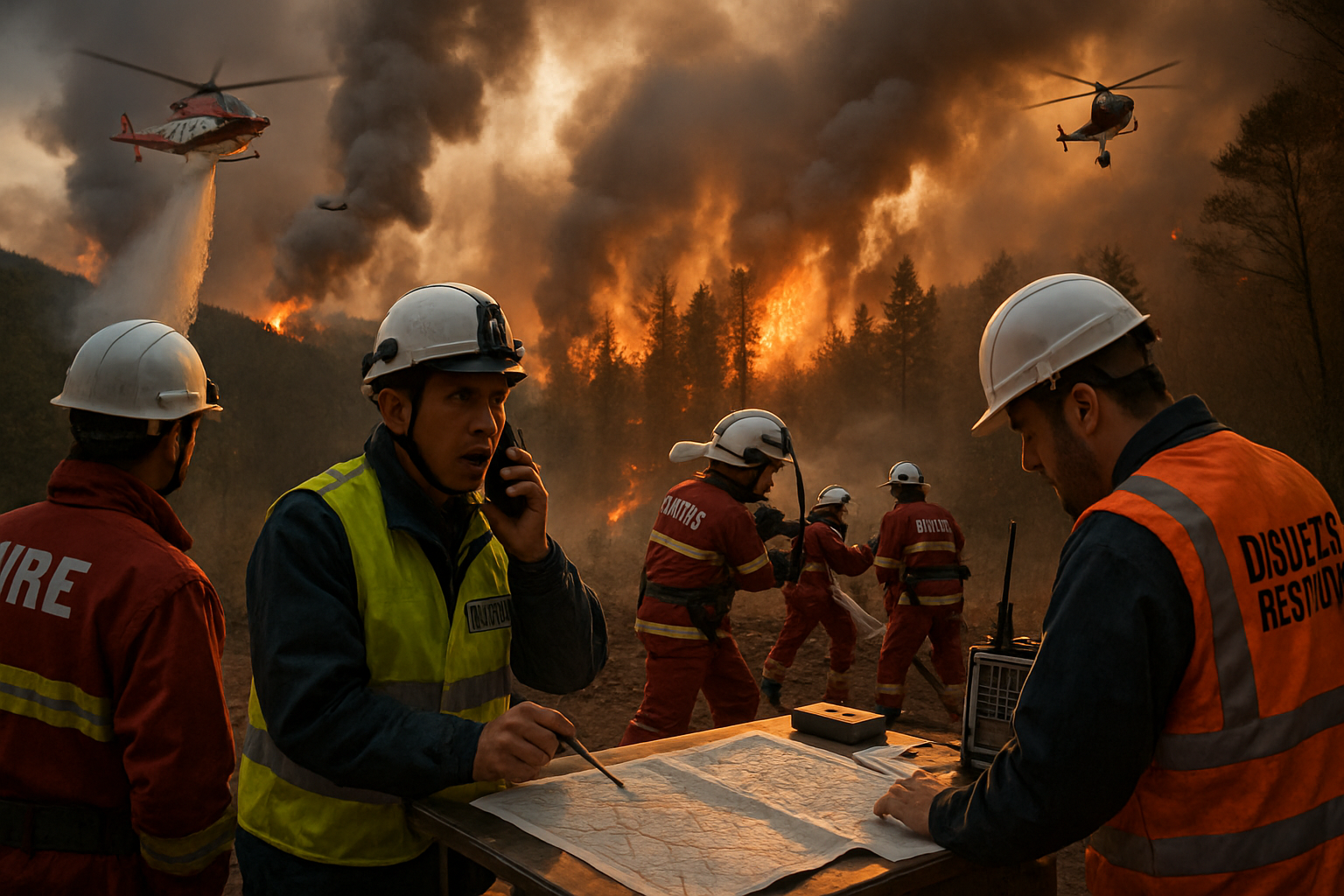
Emergency response systems across multiple continents are struggling to cope with an unprecedented convergence of natural disasters, as hundreds of firefighters battle raging wildfires in northern Japan while Pacific islands continue recovery efforts from devastating cyclones, highlighting the growing challenge of managing simultaneous global emergencies.
In northern Japan's Iwate region, over 700 hectares of mountainous forestland have burned since the fires erupted three days ago, forcing authorities to evacuate more than 3,200 residents from their homes. The massive blazes have generated columns of smoke so thick they can be detected 30 kilometers away, creating hazardous conditions across the region.
Hundreds of firefighters are deployed in what has become one of the largest wildfire response operations in northern Japan this year. The fires, burning through the mountainous terrain of Iwate Prefecture, represent a critical test of Japan's disaster response capabilities as the nation simultaneously monitors elevated seismic activity following recent earthquake alerts.
Pacific Islands Continue Cyclone Recovery Operations
Meanwhile, Pacific islands are still grappling with the aftermath of recent cyclone activity, with infrastructure damage and water supply issues persisting across multiple communities. Emergency management teams in Micronesia are working to restore essential services while addressing ongoing vulnerabilities exposed by the severe weather events.
The recovery operations highlight persistent challenges in rebuilding infrastructure capable of withstanding increasingly frequent extreme weather events. Water distribution networks, in particular, have shown significant vulnerabilities, with some areas experiencing complete service disruptions while others maintain partial connectivity.
Local authorities are implementing emergency protocols to ensure equitable water distribution across affected communities, while working to identify and repair damaged infrastructure. The uneven access to basic services has underscored the importance of building redundancy into critical systems.
Global Context of Climate Volatility
These simultaneous emergencies occur during what scientists describe as the 24th consecutive month of global temperatures exceeding 1.5°C above pre-industrial levels - the longest sustained extreme warming period in recorded human history. This unprecedented climate volatility is creating conditions where multiple regions face severe disasters simultaneously, straining international emergency response mechanisms designed for sequential rather than concurrent crises.
"We're seeing a fundamental shift in how disasters occur globally. Instead of isolated regional events, we now have compound disasters affecting multiple continents simultaneously, which challenges every aspect of our traditional emergency response frameworks."
— Climate Emergency Expert
The World Meteorological Organization projects a 50-60% probability of El Niño conditions developing between July and September 2026, which could potentially drive temperatures to unprecedented levels by combining baseline warming with natural climate cycle amplification.
Infrastructure Systems Beyond Design Parameters
Emergency management experts are identifying a paradigm shift toward "compound disasters" - multiple emergency types occurring concurrently across vast geographic areas, fundamentally challenging traditional resource allocation and mutual aid mechanisms that were designed for sequential, isolated emergencies.
Transportation networks, power grids, and communication systems originally designed for historical climate patterns are repeatedly failing as extreme weather events exceed their operational parameters. This infrastructure crisis is forcing a permanent shift in recovery timelines, from weeks to months or years, representing a fundamental change in disaster response approaches.
The concept of "building back better" has evolved from an optional enhancement strategy to an essential survival requirement in what experts term the "permanent climate volatility era." Traditional seasonal patterns that guided infrastructure design, agricultural planning, and emergency preparedness for centuries are no longer providing reliable frameworks for decision-making.
Emergency Services Overwhelmed Globally
Emergency services are operating at or beyond capacity limits globally, with traditional mutual aid mechanisms proving inadequate when multiple continents face disasters simultaneously. The European Union's Civil Protection Mechanism has been repeatedly activated, including a €246 million assistance package for Sweden and Denmark that represented the largest coordinated European weather response on record, yet it proved insufficient for the scale and simultaneity of current challenges.
In Japan, the wildfire response demonstrates both the capabilities and limitations of even well-prepared emergency systems. While hundreds of firefighters have been mobilized effectively, the scale of evacuation required - over 3,200 residents - illustrates how rapidly localized incidents can escalate to regional emergencies.
The Pacific island recovery operations reveal additional challenges in sustaining emergency response over extended periods. Communities that effectively managed initial cyclone impacts are now struggling with the prolonged infrastructure rebuilding required, particularly in water and power systems.
Innovation in Emergency Response
Despite the challenges, successful responses demonstrate sophisticated integration of cutting-edge technology with traditional knowledge and community-based management. Advanced monitoring systems using satellite imagery, environmental DNA sampling, and AI-powered analysis provide rapid threat assessment, but their effectiveness depends heavily on community engagement and local expertise.
Estonia's operation of continental Europe's largest battery storage system, serving 90,000 households with 88% renewable electricity, provides a model for resilient infrastructure design. Similarly, Finland's implementation of "transformative adaptation" - proactive systems designed for permanent volatility rather than reactive responses to exceptional events - offers templates for other regions.
International Cooperation Under Strain
Environmental challenges transcend political boundaries through atmospheric systems, ocean currents, and climate effects that ignore borders, making international cooperation essential. However, the simultaneity of disasters is testing cooperation mechanisms designed for stable regions to assist isolated emergencies.
The current crisis requires unprecedented coordination, enhanced multi-sector cooperation, and sustained financial commitments that recognize environmental protection as essential infrastructure for human prosperity and planetary sustainability. Traditional North-South aid frameworks are proving inadequate when multiple continents face emergencies simultaneously.
Economic and Social Impact
The economic devastation extends across multiple sectors, with agricultural operations experiencing billions in losses from extreme weather destroying crops and disrupting supply chains during critical growing seasons. Tourism industries face extended cancellations and infrastructure damage during peak revenue periods, while families risk losing generational properties and businesses face extinction threats from recurring disruptions.
Mental health services report increased demand related to climate anxiety and repeated trauma, with vulnerable populations including elderly individuals and those with respiratory conditions facing disproportionate impacts. The cumulative stress of repeated extreme weather events is creating long-term psychological and social challenges that extend far beyond immediate physical damage.
A Watershed Moment for Global Preparedness
April 2026 represents a critical watershed moment in global climate preparedness, forcing a choice between reactive crisis management and transformative infrastructure adaptation. Current conditions provide a preview of routine circumstances expected in the 2030s without comprehensive climate adaptation investment.
The climate action window is narrowing rapidly as ecological systems approach critical thresholds that could trigger irreversible changes to global food security, climate stability, and human settlements. Additional weather systems developing in Atlantic and Pacific regions suggest crisis conditions may persist for weeks or months, potentially establishing a "new normal" of extreme weather frequency and intensity that permanently challenges traditional emergency response frameworks.
The convergence of extreme weather events, infrastructure vulnerabilities, and emergency response limitations underscores the urgent need for coordinated international action. While the tools, knowledge, and cooperation frameworks exist for comprehensive environmental protection, success requires unprecedented speed in coordination and sustained international cooperation with political commitment to treating environmental protection as essential infrastructure rather than optional enhancement.
As Japan continues fighting its wildfires and Pacific communities rebuild from cyclone damage, the global community faces a decisive question: whether humanity can organize and implement solutions rapidly enough to maintain planetary habitability during Earth's most environmentally challenging period in recorded history.