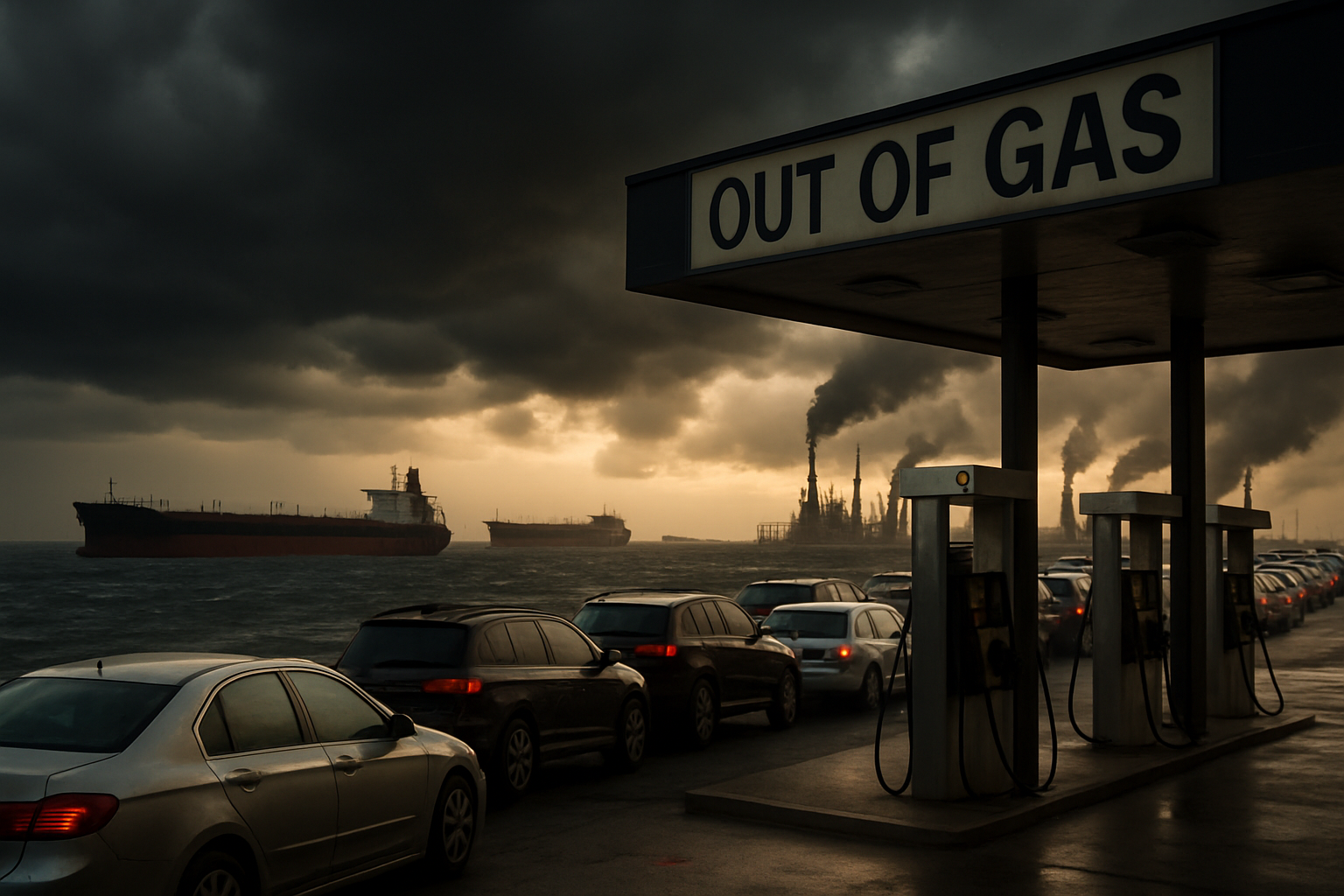
The global oil crisis that began in March 2026 continues to devastate energy markets worldwide, with governments across six continents implementing unprecedented emergency measures as fuel prices reach historic levels and supply chains collapse under the weight of the most severe energy disruption since the 1970s oil shocks.
The crisis, triggered by Iran's Revolutionary Guard closure of the Strait of Hormuz—a critical 21-mile waterway through which 40% of global seaborne oil transits—has forced oil prices above $100 per barrel for the first time since 2022, with Brent crude peaking at $119.50 and West Texas Intermediate reaching a record single-day jump of 18.98% to $108.15.
Unprecedented Government Interventions
Nations worldwide are abandoning traditional free-market principles to protect consumers from fuel price devastation. Australia's government has launched a $20 million fuel-saving campaign urging citizens to reduce driving and use public transport as prices surge past $2.50 per liter, approaching the $3 threshold in some regions.
In Europe, the response has been equally dramatic. Bosnia and Herzegovina reports fuel prices that have broken the 4 KM per liter barrier for diesel, while the United States faces gasoline prices exceeding $4 per gallon, with drivers in major cities paying $80 to fill their tanks.

Pakistan has received a crucial $5 billion financial lifeline from Saudi Arabia and Qatar, specifically aimed at easing pressure on foreign exchange reserves as the country prepares to repay $3.5 billion to the UAE this month while facing extreme fuel cost pressures.
Philippines Declares Energy Emergency
The Philippines has taken the extraordinary step of declaring a year-long "national energy emergency," implementing the UPLIFT program as diesel prices approach P100 per liter. President Ferdinand Marcos Jr.'s administration faces mounting pressure as the country receives emergency fuel shipments, including 329,000 barrels of diesel from Malaysia—part of efforts by the Philippine National Oil Company to secure supplies from non-Middle Eastern sources.
"The Philippines remains more vulnerable to oil shocks than many Southeast Asian neighbors."
— Industry Analysis Report
This vulnerability has become starkly apparent as the crisis unfolds, with the Philippines serving as a case study of how oil-dependent economies struggle when global supply chains fracture.
Aviation Industry in Crisis
The aviation sector faces its worst crisis since COVID-19, with over 18,000 flights cancelled worldwide—the most extensive disruption since the pandemic. Caribbean Airlines has introduced fuel surcharges ranging from US$15 to US$25 on all regional and international tickets, a direct response to jet fuel prices surging 122% from $85-90 to $150-200 per barrel.
Eight Middle Eastern countries have imposed simultaneous airspace closures (Iran, Iraq, Israel, UAE, Qatar, Syria, Kuwait, and Bahrain), creating an "aviation black hole" affecting Europe-Asia corridors. Dubai International Airport, the world's busiest with 86 million annual passengers, remains shut due to missile damage.
IEA's Historic Response
The International Energy Agency has deployed the largest strategic petroleum reserve release in its 50-year history—400 million barrels from 32 member countries, more than double the 182.7 million barrels released during the 2022 Ukraine crisis. Japan is releasing 80 million barrels, marking the first such deployment since the 2011 Fukushima disaster, despite the country's 95% dependence on Middle Eastern oil, with 70% transiting through the Strait of Hormuz.
Regional Impacts and Responses
Papua New Guinea's government has warned fuel suppliers against unauthorized price increases, while the Caribbean region experiences jet fuel shortages that threaten summer travel seasons. The crisis has exposed dangerous vulnerabilities in global energy architecture, with the 21-mile Strait of Hormuz proving to be a catastrophic single-point failure in modern logistics systems.
European nations have implemented emergency measures not seen since the 1970s. Hungary has imposed immediate price caps on gasoline and diesel to counter "war-driven price explosions," while France has deployed 500 fuel station inspectors to prevent price manipulation. Romania has developed five emergency scenarios to prevent diesel from exceeding 10 lei per liter.

Financial Market Turmoil
Global financial markets have crashed under the pressure, with Pakistan's KSE-100 recording an 8.97% decline—the largest single-day drop in the exchange's history. South Korea's KOSPI fell 12%, triggering circuit breakers as the Korean won hit a 17-year low. Central banks worldwide, including the European Central Bank and Bank of Japan, are coordinating emergency liquidity provisions as traditional monetary policy proves limited against structural geopolitical disruptions.
Supply Chain Collapse
Major shipping companies Maersk and MSC have suspended all Persian Gulf operations, leaving over 150 oil and LNG tankers stranded with billions of dollars worth of cargo. The Persian Gulf, serving as a critical trade hub beyond energy, affects consumer goods, industrial materials, and food distribution worldwide. Qatar has halted LNG production at its Ras Laffan and Mesaid facilities, impacting approximately 20% of global exports.
Long-term Energy Security Implications
Energy security experts warn of fundamental vulnerabilities exposed by the crisis. Samuel Ciszuk, a leading energy analyst, describes this as "the most severe energy security crisis in decades, with single-chokepoint vulnerabilities exposed." The crisis has demonstrated how over-dependence on strategic chokepoints requires fundamental restructuring to reduce geopolitical volatility.
"This situation is going on longer than initially thought, with financial markets becoming the ultimate constraint on prolonged conflict."
— Damien Boey, Financial Market Analyst
Qatar's Energy Minister Saad Al Kaabi has warned that Gulf states may declare force majeure "within weeks" if oil approaches $150 per barrel, threatening to "bring down economies of the world."
Nuclear Diplomacy Concerns
The crisis stems from the complete collapse of US-Iran nuclear talks despite a Geneva breakthrough that represented the most progress since the 2018 JCPOA framework collapse. The situation has been compounded by the expiration of the New START treaty in February 2026, marking the first time in over 50 years without US-Russia nuclear constraints. Iran continues 60% uranium enrichment with over 400kg of weapons-grade material, approaching multiple weapons capability.
Consumer Impact Worldwide
The human cost of the crisis is staggering. Bangladesh has implemented fuel rationing for 170 million people, while Pakistan maintains wartime austerity measures including four-day government work weeks with fuel prices at Rs321.17 per liter—the highest in South Asia. Bosnia and Herzegovina has been reduced to two-day gas reserves, and Malta faces prices 45% higher without government subsidies.
Sweden reports electricity price increases of 10-20 öre with gasoline up 1-2 kronor, with Malmö being the most exposed due to continental integration. Ireland faces "brazen rip-offs" with heating oil approaching €2 per liter, prompting government intervention discussions.
Path Forward
UN Secretary-General António Guterres has called the situation the "greatest test of multilateral cooperation in the modern era," as nuclear risks reach their "highest levels in decades." The crisis represents a watershed moment for 21st-century energy security planning, requiring fundamental transformation to reduce dependence on strategic chokepoints.
Recovery timelines remain uncertain, dependent on military and diplomatic resolution rather than predictable economic factors. Unlike weather-related disruptions, aviation cannot maintain scheduling with closed airspace, and energy markets remain volatile with blocked transit routes.
The April 2026 crisis has established new paradigms for international energy cooperation, with success potentially providing a nuclear crisis resolution framework while failure could accelerate military solutions, reshaping Middle Eastern geopolitics for decades and encouraging global nuclear proliferation while undermining diplomatic credibility worldwide.
As governments worldwide continue implementing emergency measures unprecedented since the 1970s oil shocks, the crisis serves as a stark reminder of the interconnected nature of global energy systems and the urgent need for diversified, resilient energy architecture in an increasingly volatile geopolitical landscape.