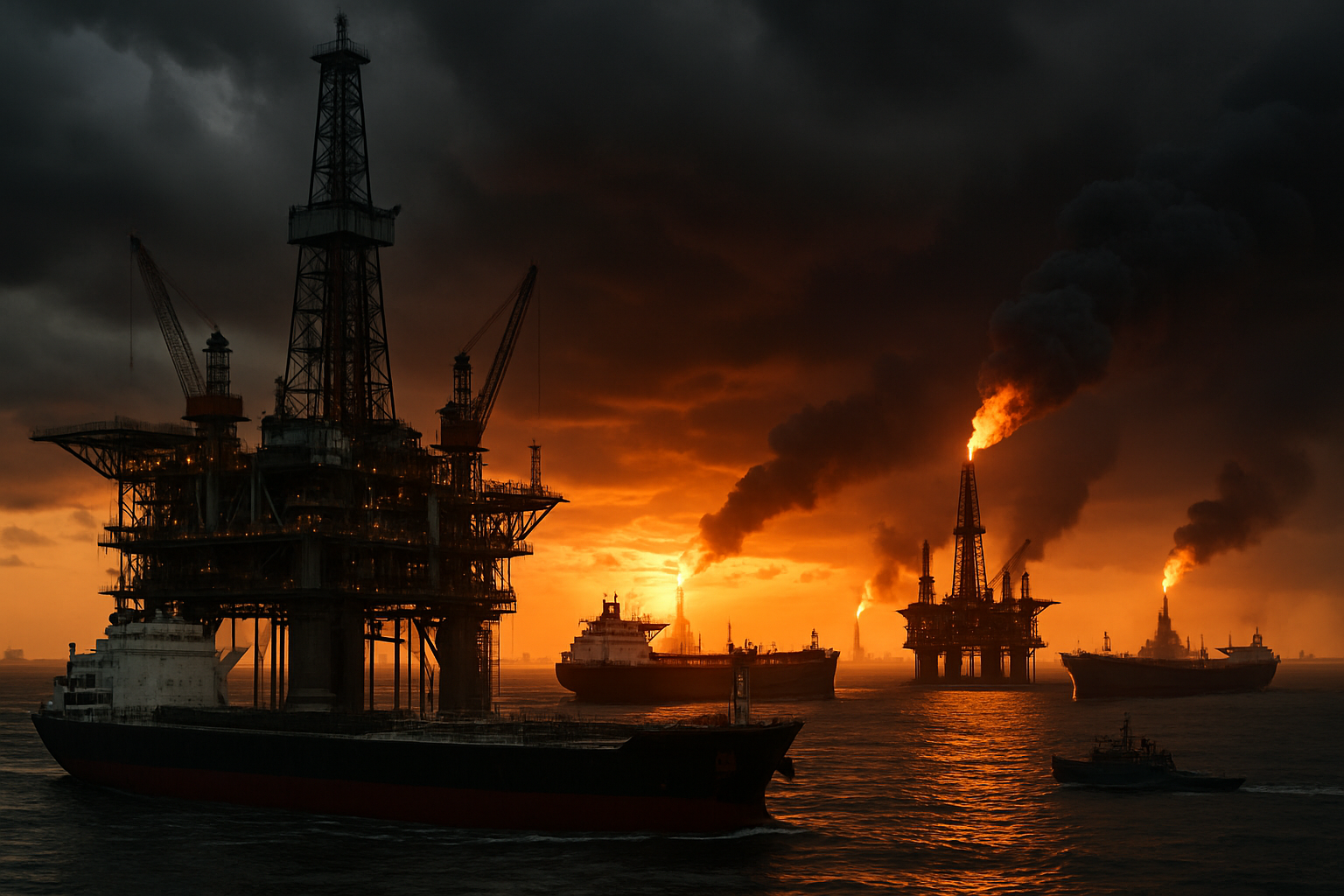
Global oil markets face their most severe crisis in decades as Azerbaijani crude soars past $125 per barrel while Iran's blockade of the Strait of Hormuz enters its second month, creating unprecedented supply disruptions that have triggered strategic reserve releases and emergency government interventions worldwide.
The crisis has reached critical proportions following coordinated attacks on Saudi Arabian oil infrastructure, including damage to the critical East-West pipeline that has reduced the kingdom's oil production capacity by approximately 600,000 barrels per day. According to Saudi energy ministry sources, the pipeline's throughput has been slashed by an additional 700,000 barrels daily, representing a devastating blow to global energy security.
Strait of Hormuz: The World's Energy Chokepoint Under Siege
The strategic waterway, which typically handles 40% of global oil transit, remains effectively closed due to Iranian naval mining operations that began in early March. Intelligence reports indicate Iran has deployed between 2,000 and 6,000 naval mines throughout the 21-mile strait, forcing over 150 oil and LNG tankers carrying billions of dollars in cargo to remain stranded in Persian Gulf waters.
U.S. naval forces have destroyed more than 28 Iranian mine-laying vessels in recent weeks, but the waterway remains too dangerous for commercial shipping operations. Major shipping companies Maersk and MSC have suspended all operations in the region, creating a supply chain crisis that extends far beyond energy markets.
"The Strait of Hormuz has become the single-point failure of the modern global economy. There simply are no realistic alternatives to handle this volume of energy transit."
— Samuel Ciszuk, Energy Security Analyst
Strategic Reserve Releases Provide Temporary Relief
The International Energy Agency has coordinated the largest strategic petroleum reserve release in its 50-year history, deploying 400 million barrels from 32 member countries—more than double the amount released during the 2022 Ukraine crisis. Japan alone is releasing 80 million barrels, marking its first such action since the 2011 Fukushima disaster.
Despite these unprecedented measures, oil prices continue their relentless climb. Brent crude peaked at $119.50 per barrel in March, while WTI futures reached $108.15—the highest levels since 2022. Analysts warn that without resolution to the Middle East conflict, prices could approach $150-200 per barrel.
Aviation Industry in Crisis Mode
The energy crisis has created a parallel aviation emergency, with more than 18,000 flights cancelled worldwide—the most extensive disruption since COVID-19. Eight Middle Eastern countries have closed their airspace simultaneously, creating what industry experts describe as an "aviation black hole" that has severed critical Europe-Asia corridors.
Dubai International Airport, the world's busiest with 86 million passengers annually, remains completely shut down due to missile damage. Major carriers including Emirates, Air France-KLM, and Wizz Air have suspended indefinitely all Middle East operations, affecting hundreds of thousands of travelers globally.
Jet fuel prices have surged 122% from $85-90 per barrel to $150-200, forcing airlines to implement emergency fare increases and route cancellations. Caribbean Airlines has added fuel surcharges of $15-25 to regional and international tickets, while other carriers are implementing similar emergency measures.
Japan Mobilizes Strategic Reserves
In an unprecedented move, Japanese Minister Sanae Takaichi has confirmed plans to release additional oil reserves next month, building on the country's initial deployment that began in March. Japan's action is particularly significant given its 95% dependence on Middle Eastern oil, with 70% of imports typically transiting through the now-blocked Strait of Hormuz.
The country began tapping its strategic stockpiles—the world's largest—in March as the government sought to moderate price spikes. This marks Japan's first strategic reserve release since the 2011 Fukushima nuclear disaster, underlining the severity of the current crisis.
European Energy Security Under Threat
European markets have experienced dramatic price volatility, with natural gas prices surging 24% across the continent. The crisis has exposed dangerous over-dependence on Middle Eastern energy supplies, with Qatar's LNG production—representing roughly 20% of global exports—severely disrupted by the ongoing conflict.
Greece has confirmed significant damage to critical pipeline infrastructure, while Bulgaria reports that strikes on Saudi energy facilities have created regional supply concerns. European governments are implementing emergency measures, with several countries considering fuel price caps and enhanced strategic reserve deployments.
Global Consumer Impact Intensifies
The energy crisis has triggered dramatic price increases worldwide, affecting consumers from Norway to Trinidad and Tobago. Norway's statistics bureau reports record jumps in fuel prices following the Middle East energy shock, while Romania has seen significant increases in gasoline and diesel costs despite government intervention efforts.
In Asia, Singapore has experienced 30% increases in logistics costs due to Persian Gulf shipping disruptions. China has been forced to suspend refined fuel export contracts, cancelling committed shipments to prioritize domestic supply security.
"This is the most severe energy security crisis in decades. The single-chokepoint vulnerabilities of our global system have been catastrophically exposed."
— Dr. Maria Santos, International Energy Expert
Diplomatic Breakdown Fuels Crisis
The current energy emergency stems from the complete collapse of U.S.-Iran nuclear negotiations in February, despite achieving what negotiators described as "broad agreement on guiding principles"—the most significant diplomatic progress since the 2018 JCPOA collapse.
The breakdown led to Operation Epic Fury, the largest coordinated U.S.-Israeli military operation since 2003, which prompted massive Iranian retaliation under "Operation True Promise 4." Iran's Revolutionary Guard declared "no red lines remain," systematically targeting energy infrastructure across the Gulf region.
Financial Markets in Turmoil
Global financial markets have experienced severe disruptions, with Pakistan's KSE-100 index posting its largest single-day decline in history at -8.97%. South Korea's KOSPI index fell 12%, triggering circuit breakers, while the Korean won hit 17-year lows as foreign capital fled emerging markets.
Central banks including the European Central Bank and Bank of Japan are coordinating emergency liquidity measures, though traditional monetary policy tools have limited effectiveness against structural geopolitical disruptions of this magnitude.
Energy Architecture Requires Fundamental Transformation
The crisis has exposed the dangerous vulnerability of modern energy systems to single-point failures. The 21-mile Strait of Hormuz, with no realistic alternatives for energy transit, has become a chokepoint that can effectively shut down global commerce.
Energy experts argue that the current crisis demands fundamental restructuring of international energy architecture, requiring years or decades of supply diversification and renewable energy transitions. However, the urgency has been dramatically accelerated by recent events.
Manufacturing sectors dependent on Gulf logistics networks—including automotive, electronics, and textiles—have experienced severe supply chain disruptions extending far beyond energy markets. The Persian Gulf's role as a critical Asia-Europe trade hub means the crisis affects consumer goods and industrial materials worldwide.
Government Emergency Responses Worldwide
Governments across multiple continents have implemented emergency measures to protect consumers from the energy crisis. Hungary has imposed immediate gasoline and diesel price caps in response to what officials describe as "war-driven explosions" in fuel costs.
France has deployed 500 fuel station inspectors to prevent price manipulation, while Romania has prepared five emergency scenarios to prevent diesel prices from exceeding critical thresholds. Slovakia has activated strategic petroleum reserves for the first time under established protocols.
In Asia-Pacific, Australia's New South Wales is considering "Muldoon-era" interventions including car-free days and petrol limits—measures not seen since the 1970s energy crisis. The scale of government intervention reflects the unprecedented nature of the current emergency.
Looking Ahead: Uncertain Recovery Timeline
Unlike weather-related disruptions with predictable timelines, recovery from the current crisis depends entirely on military and diplomatic developments in the Middle East. The fragile ceasefire between major powers represents a crucial window, but structural vulnerabilities persist even after immediate crisis resolution.
UN Secretary-General António Guterres has described the situation as "the greatest test of multilateral cooperation and crisis management in the modern era." The nuclear governance crisis, with the New START treaty having expired in February—the first time in 50+ years without U.S.-Russia nuclear constraints—adds another layer of complexity.
"The stakes could not be higher. Success in containing this crisis provides a framework for nuclear crisis resolution, but failure could accelerate military solutions for decades, encouraging proliferation globally and undermining diplomatic credibility worldwide."
— Ambassador Patricia Chen, Crisis Management Specialist
As oil prices continue their upward trajectory and strategic reserves provide only temporary relief, the international community faces a template-setting moment that will determine approaches to energy security, diplomatic crisis resolution, and international cooperation for decades to come. The coming weeks will prove crucial in determining whether multilateral mechanisms can manage 21st-century security challenges or if the world faces a fundamental shift toward military confrontation as the primary dispute resolution mechanism.
With global supply chains under unprecedented stress and consumer prices rising across all sectors, the current energy crisis represents not just an economic emergency, but a test of the post-Cold War international order's ability to prevent regional conflicts from devastating global stability.