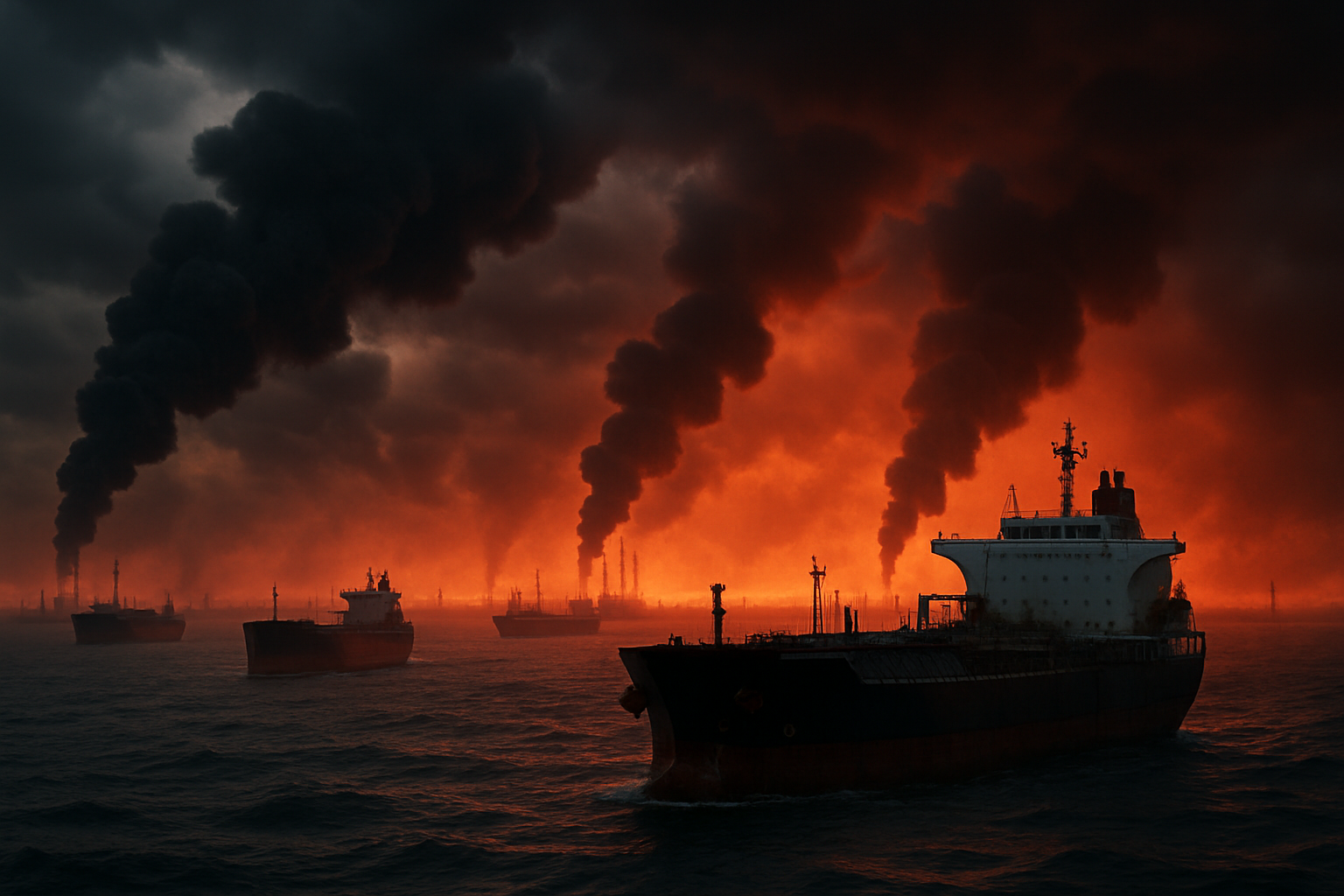
Oil markets remain volatile as Middle East tensions continue to disrupt global energy supply chains, with aviation fuel shortages threatening summer travel and governments scrambling to implement emergency measures to protect consumers from soaring prices.
As of late April 2026, the global energy crisis that began in February continues to send shockwaves through international markets. Oil prices have breached the $100 per barrel threshold repeatedly, with Brent crude reaching peaks of $119.50 and West Texas Intermediate jumping to $108.15 in what marked the first time prices exceeded $100 since 2022.
Strait of Hormuz Remains Critical Chokepoint
The crisis stems from Iran's Revolutionary Guard maintaining effective control over the Strait of Hormuz, a 21-mile waterway that handles approximately 40% of the world's seaborne oil transit. This critical chokepoint has become the epicenter of a global supply chain nightmare, with over 150 oil and LNG tankers stranded in the Persian Gulf representing billions of dollars in cargo value.
Major shipping companies including Maersk and MSC have suspended operations in the Persian Gulf region indefinitely, creating a domino effect that has disrupted not just energy supplies but also consumer goods and industrial materials that typically flow through this vital trade hub.
Aviation Industry Faces Unprecedented Crisis
The aviation sector has been particularly hard hit, with more than 18,000 flights cancelled worldwide—the most severe disruption since the COVID-19 pandemic. Eight Middle Eastern countries have simultaneously closed their airspace, creating what industry experts describe as an "aviation black hole" that has severed critical Europe-Asia corridors.
"Europe has perhaps six weeks of jet fuel remaining before systematic flight cancellations become inevitable by early June."
— Fatih Birol, International Energy Agency Director
Jet fuel costs have surged 122% from their pre-crisis levels of $85-90 per barrel to $150-200 per barrel, forcing airlines to implement emergency surcharges. Major carriers including Emirates, Air France-KLM, and Wizz Air have suspended operations indefinitely, while others like Lufthansa have announced the cancellation of 20,000 short-haul flights through October 2026.
Government Emergency Responses Intensify
Governments worldwide have abandoned traditional free-market principles to protect consumers from the energy crisis. Hungary has implemented immediate price caps for gasoline and diesel to combat what officials term "war-driven price explosions." France has deployed 500 fuel station inspectors to prevent price manipulation, while Romania has activated five emergency scenarios to prevent diesel prices from exceeding 10 lei per liter.
The International Energy Agency has coordinated the largest strategic petroleum reserve release in its 50-year history, deploying 400 million barrels from 32 countries—double the amount released during the 2022 Ukraine crisis. Japan is leading the effort with an 80 million barrel release, marking the first such deployment since the 2011 Fukushima disaster.
Consumer Impact Reaches Crisis Levels
The energy crisis has created severe hardships for consumers globally. Bangladesh has implemented fuel rationing for 170 million people, while Pakistan has instituted wartime austerity measures including four-day government work weeks. In Australia, petrol prices are approaching the $3 per liter threshold, prompting emergency government talks.
European consumers are experiencing particular strain, with heating oil in Ireland approaching €2 per liter in what officials have called "brazen rip-offs." Sweden faces electricity increases of 10-20 öre and gasoline price rises of 1-2 kronor per liter, with the southern Malmö region most exposed due to continental European market integration.
Financial Markets Under Extreme Stress
Global financial markets have experienced historic volatility, with Pakistan's KSE-100 recording its largest single-day decline in history at -8.97%. South Korea's KOSPI fell 12%, triggering circuit breakers as the Korean won hit 17-year lows. The European Central Bank and Bank of Japan have coordinated emergency liquidity measures, though traditional monetary policy has proven limited in addressing structural geopolitical disruptions.
Supply Chain Vulnerabilities Exposed
The crisis has exposed dangerous vulnerabilities in global energy architecture. The Persian Gulf serves as a critical trade hub extending far beyond energy, affecting everything from automotive and electronics manufacturing to textile production. China has suspended refined fuel exports, while Singapore reports 30% increases in logistics costs.
Qatar's LNG facilities at Ras Laffan and Mesaid, which handle approximately 20% of global exports, remain shuttered following infrastructure damage. Qatar's Energy Minister Saad Al Kaabi has warned that Gulf states may be forced to declare force majeure "within weeks" if oil approaches $150 per barrel, potentially "bringing down economies of the world."
Long-term Energy Security Implications
Energy experts warn that the crisis represents more than a temporary supply disruption. Samuel Ciszuk, a leading energy analyst, describes it as "the most severe energy security crisis in decades, exposing single-chokepoint vulnerabilities in our global systems."
The current situation has accelerated discussions about fundamental energy architecture transformation to reduce dependence on volatile geopolitical regions and strategic chokepoints. However, supply diversification and renewable energy transitions require years or decades to implement, leaving current vulnerabilities exposed in the interim.
Recovery Timeline Remains Uncertain
Unlike weather-related disruptions, the recovery timeline for this crisis depends entirely on military operations and diplomatic resolution in the Middle East. Airlines cannot make long-term scheduling decisions with multiple airspaces closed, while energy markets remain volatile with critical transit routes blocked.
The crisis has become what UN Secretary-General António Guterres calls "the greatest test of multilateral cooperation in crisis management in the modern era," with nuclear risks at their "highest levels in decades."
As the situation continues to evolve, the global community faces critical decisions about immediate supply needs versus long-term energy security architecture. The outcome will likely establish new paradigms for 21st-century energy security planning and international crisis management, with implications extending far beyond current events.