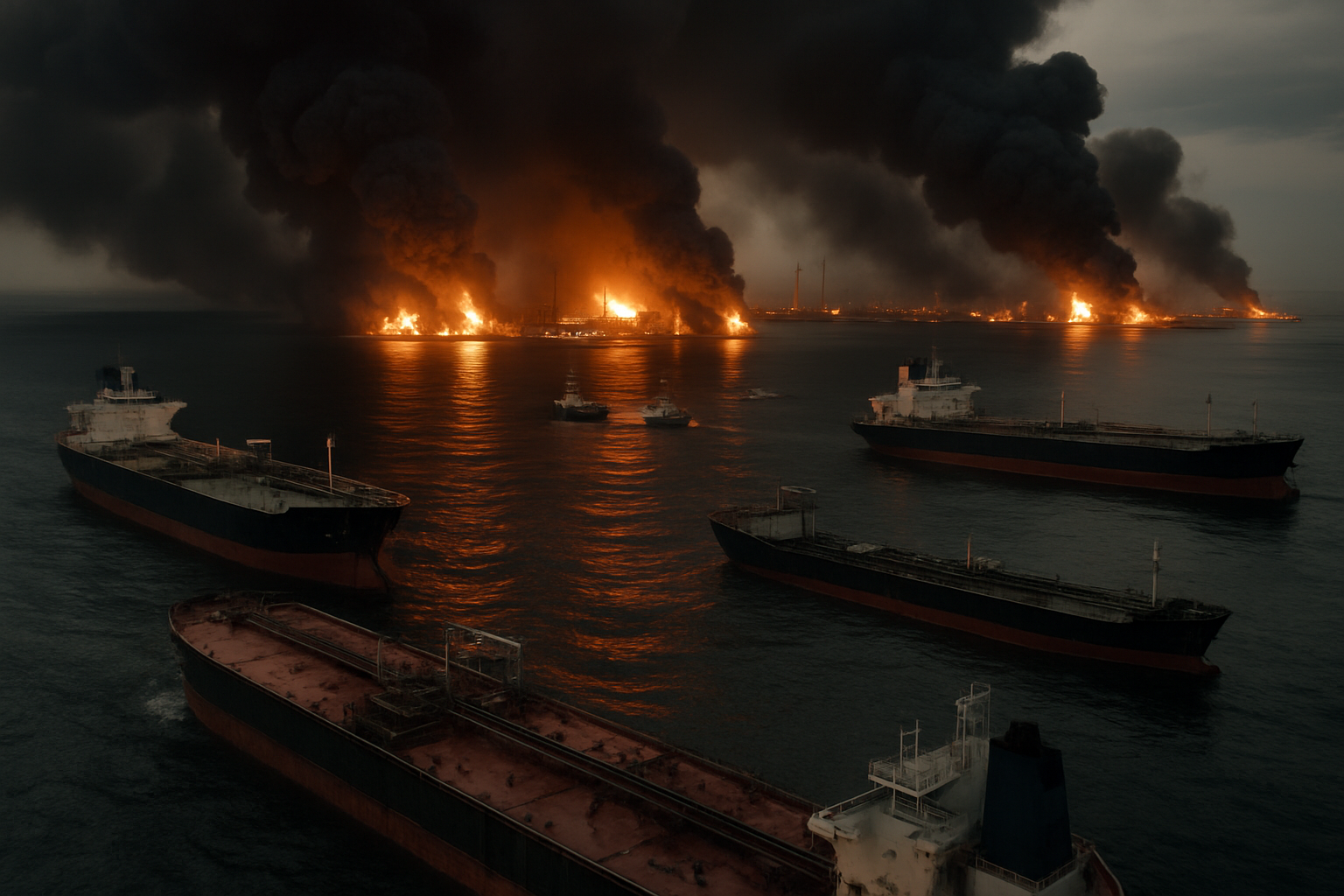
Oil prices have surged past $80 per barrel—a 10% increase—as Iran's Revolutionary Guard declared the Strait of Hormuz "unsafe," effectively closing the world's most critical energy chokepoint that handles 40% of global seaborne oil transit.
The closure, announced March 4, 2026, follows the ongoing US-Israeli "Operation Epic Fury" and Iran's massive retaliation campaign dubbed "Operation True Promise 4." With over 150 oil and LNG tankers now stranded in the Persian Gulf representing billions in cargo value, major shipping companies Maersk and MSC have suspended operations entirely.
Strait of Hormuz: The World's Energy Lifeline Severed
The 21-mile-wide Strait of Hormuz has long been recognized as one of the world's most strategically vulnerable chokepoints. Iran's declaration that the waterway is "unsafe" has created an unprecedented energy crisis that extends far beyond the Middle East.
"The Strait of Hormuz closure threatens not just oil but LNG exports, manufacturing supply chains, and shipping routes connecting Asia-Europe trade," according to energy analysts monitoring the crisis.
Qatar's massive LNG production facilities at Ras Laffan and Mesaid have been forced to halt operations following Iranian drone attacks, affecting approximately 20% of global LNG exports. A force majeure declaration is expected imminently.
Natural Gas Markets in Turmoil
Natural gas prices have experienced even more dramatic increases, surging 24% in Europe and a staggering 78% in the United States. European gas prices rocketed nearly 50% to €47.32 per megawatt-hour—the highest level since February 2025.
The crisis has exposed Europe's continued vulnerability to energy supply disruptions, despite efforts to diversify sources following the Russia-Ukraine conflict. With Qatar's LNG facilities offline, European nations are scrambling to secure alternative supplies.
Aviation Industry Faces Unprecedented Disruption
The energy crisis coincides with the most extensive aviation disruption since COVID-19, with over 18,000 flights cancelled worldwide. Eight Middle Eastern countries—Iran, Iraq, Israel, UAE, Qatar, Syria, Kuwait, and Bahrain—have simultaneously closed their airspace.
Dubai International Airport, the world's busiest with over 86 million passengers annually, remains completely shut down following missile damage. Emirates and Air France-KLM, along with Wizz Air and Bulgaria Air, have suspended Middle East operations indefinitely, affecting hundreds of thousands of passengers globally.
OPEC's Emergency Response Falls Short
The Organization of the Petroleum Exporting Countries (OPEC) convened an emergency meeting and approved a production increase of 206,000 barrels per day for April. However, analysts confirm this increase is insufficient to offset the shipping disruption caused by the Strait of Hormuz closure.
"Increased production is meaningless if tankers cannot transit safely through the Persian Gulf."
— OPEC Energy Analyst
The organization faces an unprecedented challenge: even maximum production cannot compensate for the loss of the geographically irreplaceable transit route. Alternative routes through the Arabian Peninsula lack adequate capacity and impose significant time and cost penalties.
Global Financial Markets in Freefall
Financial markets worldwide have responded with panic selling. Pakistan's KSE-100 index crashed 8.97% in its largest single-day decline in history. South Korea's KOSPI plummeted 12%, triggering circuit breakers and a 20-minute trading halt. Dow futures dropped between 400-570 points as the crisis deepened.
The technology sector has been particularly hard hit, with PayPay's $1.1 billion IPO postponed indefinitely and major tech companies reassessing expansion plans. Central banks, including the Bank of Japan and European Central Bank, are coordinating emergency liquidity provision to prevent financial contagion.
Consumer Impact: From Scandinavia to Australia
The energy crisis is already translating into higher costs for consumers worldwide. Sweden is predicting electricity price increases of 10-20 öre and gasoline price rises of 1-2 kronor per liter. Southern Sweden, particularly the Malmö zone 4, faces the highest exposure due to its integration with continental European energy markets.
Australia has issued fuel price warnings, while Mexico faces concerns about a "gasolinazo"—a sharp increase in gasoline prices that could trigger social unrest. The global nature of the crisis means that even countries far from the Middle East are feeling immediate impacts on energy costs.
Supply Chain Vulnerabilities Exposed
The crisis has starkly exposed the vulnerabilities of modern global supply chains' over-dependence on strategic chokepoints. The Persian Gulf serves as a critical global trade hub that extends far beyond energy, affecting everything from consumer goods to industrial materials worldwide.
Manufacturing sectors dependent on Gulf logistics networks—including automotive, electronics, and textiles—are facing severe disruptions. Strategic petroleum reserves can only provide temporary buffering against sustained disruptions of this magnitude.
Diplomatic Collapse Triggers Military Escalation
The current crisis stems from the complete breakdown of US-Iran nuclear diplomacy despite achieving what experts called "broad agreement on guiding principles"—the most significant progress since the JCPOA collapse in 2018.
Iran maintained that ballistic missiles and regional proxies were "red lines" to be excluded from nuclear-only talks, while the US demanded a comprehensive agreement including missiles, armed groups, and human rights issues. This fundamental scope disagreement proved insurmountable.
The diplomatic failure led to "Operation Epic Fury," the largest coordinated US-Israeli military operation since the 2003 Iraq invasion, utilizing an unprecedented dual-carrier deployment of the USS Gerald R. Ford and USS Abraham Lincoln.
Regional Coalition Under Severe Strain
An unprecedented coalition of Saudi Arabia, UAE, Qatar, and Egypt that had been supporting the diplomatic process is now severely strained as Iranian retaliatory strikes have targeted member territories directly.
Egyptian President Sisi condemned attacks on "sisterly Arab countries," warning of "comprehensive chaos." The UAE suffered one civilian death in Abu Dhabi from missile debris, while Kuwait's airport was struck by drones, injuring 32 foreign nationals. Qatar intercepted 65 missiles and 12 drones, with 8 people injured by fragments despite Patriot system protection.
Nuclear Governance Crisis Context
The energy crisis unfolds against the backdrop of a broader nuclear governance crisis. The New START Treaty between the US and Russia expired on February 5, 2026—marking the first time in over 50 years without US-Russia nuclear constraints. Combined with China's nuclear expansion, UN Secretary-General António Guterres has warned that nuclear risks are at their "highest in decades."
Iran continues to enrich uranium at 60% purity—approaching the 90% weapons-grade threshold—with over 400 kilograms of material that experts say makes nuclear weapons capability "easily achievable."
Recovery Timeline Remains Uncertain
Unlike weather-related or technical disruptions, the recovery timeline for this crisis depends entirely on military operations resolution and diplomatic normalization. Aviation industry officials report they cannot engage in long-term scheduling while conducting daily reviews of the volatile situation.
Energy markets remain highly volatile with critical transit routes blocked. Traditional monetary policy tools have limited effectiveness against structural infrastructure and geopolitical disruptions of this magnitude.
Template-Setting Crisis for the 21st Century
March 2026 represents a watershed moment for global energy security, exposing strategic chokepoint vulnerabilities and interconnected supply chain fragility. This crisis serves as the most dangerous international confrontation since the end of the Cold War, with stakes that include regional war prevention, energy market stability, nuclear governance credibility, and international law enforcement.
The rapid transition from diplomatic framework to military escalation demonstrates the fragility of modern crisis management mechanisms in a multipolar era. Success in containing the escalation could provide a framework for future nuclear crisis resolution and strengthen diplomatic precedents. Failure may accelerate military solutions over diplomatic engagement, reshaping Middle Eastern geopolitics for decades while encouraging nuclear proliferation globally and undermining diplomatic credibility worldwide.
Long-term Implications for Energy Architecture
The crisis has accelerated discussions about supply chain diversification and alternative energy sources, but such transitions require years or decades for implementation. The vulnerability of the 21-mile Strait of Hormuz demonstrates the single-point failure risks inherent in modern logistics systems and may necessitate fundamental restructuring of global energy security architecture.
As the situation continues to evolve, the international community faces decisions between addressing immediate supply needs and undertaking the long-term energy security architecture restructuring that this crisis has shown to be urgently necessary.
The coming phase will be decisive: success in containing the escalation provides a framework for future crisis resolution, while failure may fundamentally reshape international approaches to conflict resolution and energy security for the 21st century.