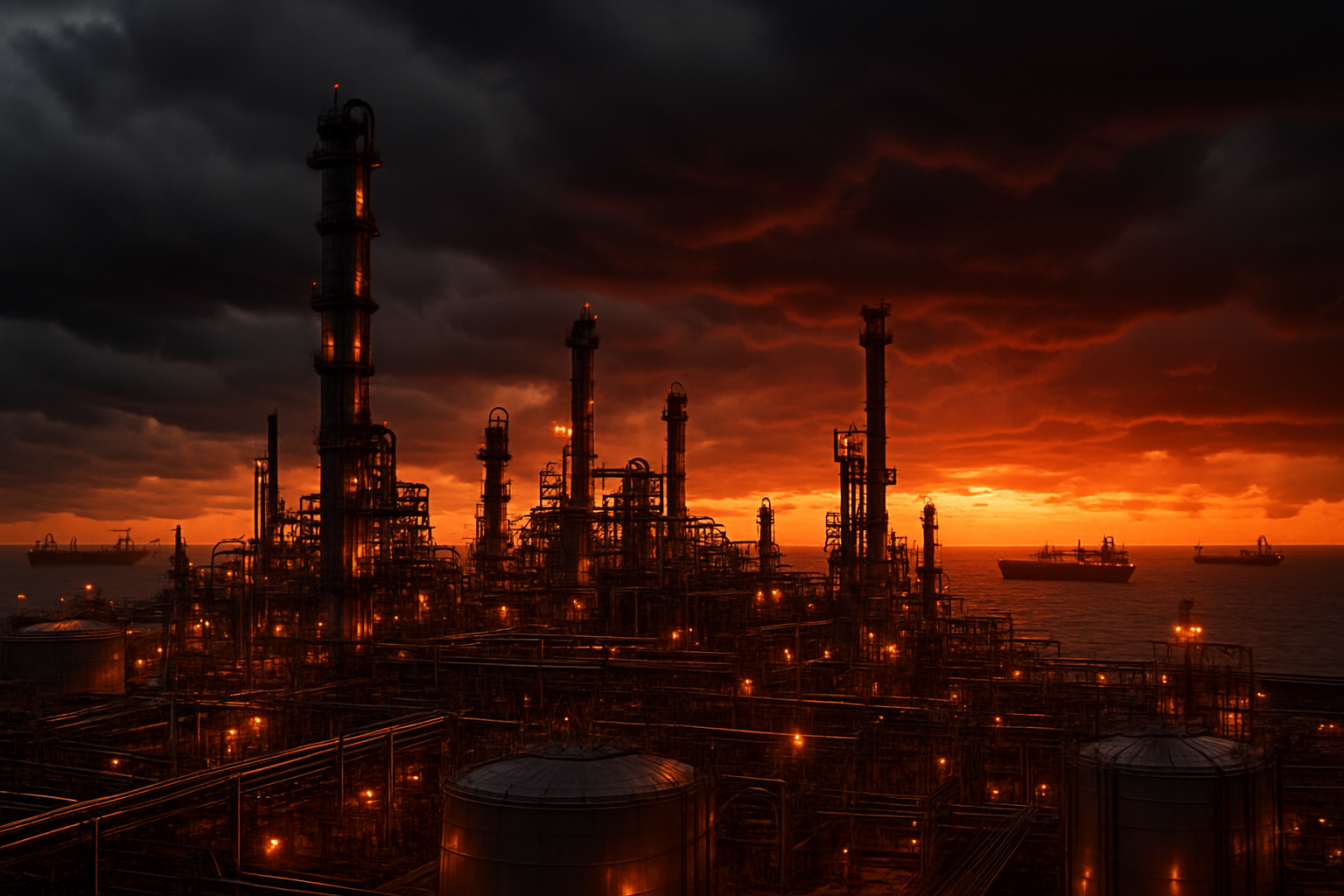
Global oil prices have surged 10% past $80 per barrel as Iran effectively closed the Strait of Hormuz, the world's most critical energy chokepoint handling 40% of global seaborne oil transit, in the most severe energy security crisis in decades.
The dramatic price spike, from approximately $73 to over $80 per barrel for Brent crude, follows Iran's Revolutionary Guard declaring the 21-mile-wide waterway "unsafe" amid escalating Middle East conflicts. Major shipping companies Maersk and MSC have suspended operations, leaving more than 150 oil and LNG tankers stranded in the Persian Gulf representing billions of dollars in cargo value.
Strait of Hormuz Closure Creates Global Disruption
The closure of this geographically irreplaceable chokepoint has created unprecedented disruption across global energy markets. Natural gas prices have exploded 24% in Europe and 78% in the United States, while European gas prices rocketed nearly 50% to €47.32 per MWh - the highest level since February 2025.
Qatar has halted LNG production at its Ras Laffan and Mesaid facilities following Iranian attacks, affecting approximately 20% of global LNG exports with a force majeure declaration expected. The disruption extends far beyond the Middle East, affecting energy supplies from Europe to Asia and triggering emergency responses from governments worldwide.
"This represents the most serious threat to global energy security in decades. The Strait of Hormuz simply cannot be replaced - there are no alternative routes that can handle this volume of traffic without significant time and cost penalties."
— Energy Market Analyst
OPEC Response Proves Insufficient
The Organization of the Petroleum Exporting Countries held an emergency meeting, approving a production increase of 206,000 barrels per day for April. However, analysts confirm this increase is insufficient to offset the shipping disruption caused by the Strait of Hormuz closure.
"The challenge OPEC faces is that increased production is meaningless if tankers cannot transit safely through the world's most important oil chokepoint," explained one industry expert. Strategic petroleum reserves can only provide a temporary buffer during sustained disruptions of this magnitude.
Aviation Industry in Crisis
The energy crisis has coincided with an unprecedented aviation disruption, with over 18,000 flights cancelled worldwide - the most extensive disruption since the COVID-19 pandemic. Eight Middle Eastern countries including Iran, Iraq, Israel, UAE, Qatar, Syria, Kuwait, and Bahrain have simultaneously closed their airspace.
Dubai International Airport, the world's busiest with over 86 million passengers annually, remains completely shut down due to missile damage. Major carriers including Emirates, Air France-KLM, Wizz Air, and Bulgaria Air have suspended Middle East operations, affecting hundreds of thousands of passengers globally.
Global Economic Impact Spreads
Financial markets worldwide have crashed in response to the crisis. Pakistan's KSE-100 index plummeted 8.97% in its largest single-day decline in history, while Dow futures dropped 400-570 points. The South Korean won hit a 17-year low as investors fled to safe-haven assets.
Consumer impacts are being felt globally. Sweden is predicting electricity price increases of 10-20 öre and gasoline price rises of 1-2 kronor per liter, with southern Sweden's Malmö zone particularly exposed due to continental European market integration. Australia has issued fuel price warnings, while Mexico faces concerns about "gasolinazo" fuel price spikes.
Government Emergency Responses
Governments worldwide are activating emergency protocols. French finance officials moved to calm fears of sharp fuel price rises, while Greek Development Minister Takis Theodorikakos announced intervention plans if the Middle East crisis intensifies. Romania's government is maintaining gas price caps for consumers through March 2027 to avoid price increases during global market uncertainties.
The UK government is discussing potential interventions to protect households from soaring energy bills, as the crisis threatens household energy costs with a potential £160 rise. Cyprus activated its ESTIA national evacuation plan for the first time, while multiple nations coordinate the largest evacuation effort since the Arab Spring of 2011.
Supply Chain Vulnerabilities Exposed
The crisis has starkly exposed global supply chain vulnerabilities and over-dependence on strategic chokepoints with limited alternatives. The Persian Gulf serves as a critical global trade hub extending far beyond energy, affecting consumer goods and industrial materials worldwide.
China has asked companies to suspend new contracts for refined fuel exports and attempt to cancel committed shipments as the widening Middle East conflict curtails refinery output. This move underscores how regional conflicts can rapidly become global economic disruptions in an interconnected world.
Nuclear Diplomacy Breakdown Context
The energy crisis follows the complete collapse of US-Iran nuclear diplomacy despite achieving a "broad agreement on guiding principles" breakthrough - the most progress since the JCPOA collapse in 2018. The fundamental disagreement proved insurmountable: Iran excluded ballistic missiles and regional proxies as "red lines," demanding nuclear-only talks, while the US insisted on comprehensive agreements addressing missiles, armed groups, and human rights.
Iran continues uranium enrichment at 60% purity, approaching weapons-grade levels with over 400kg of enriched material sufficient for multiple weapons if weaponized. The diplomatic breakdown led to "Operation Epic Fury," described as the largest US-Israeli military operation since 2003.
Regional Coalition Under Strain
An unprecedented coalition of Saudi Arabia, UAE, Qatar, and Egypt that had been supporting diplomatic solutions now faces severe strain as Iranian retaliation has targeted member territories. Egyptian President Sisi condemned attacks on "sisterly Arab countries," warning of "comprehensive chaos."
Regional casualties include one civilian killed in Abu Dhabi, 32 foreign nationals injured at Kuwait Airport from drone strikes, and eight people injured in Qatar despite Patriot missile interceptions of 65 missiles and 12 drones.
Nuclear Governance Crisis Context
The crisis unfolds against a broader nuclear governance breakdown. The New START treaty expired on February 5, marking the first time in over 50 years without US-Russia nuclear constraints. Combined with China's nuclear expansion, UN Secretary-General Guterres warns that nuclear risks are at their "highest in decades."
This represents a template-setting moment for 21st-century crisis management in a multipolar era, testing whether diplomatic solutions can prevail over military confrontation with global implications extending decades beyond current events.
Recovery Timeline Uncertain
Unlike weather-related or technical disruptions, recovery from this crisis depends entirely on military operations resolution and diplomatic normalization. The aviation industry cannot make long-term scheduling decisions with critical airspace closed, while energy markets remain volatile with transit routes blocked.
Traditional monetary policy tools have limited effectiveness against structural infrastructure and geopolitical disruptions of this magnitude. Central banks including the European Central Bank and Bank of Japan are coordinating emergency liquidity provision to prevent broader financial contagion.
Template-Setting Implications
This crisis represents the most consequential energy, aviation, and supply chain disruption affecting civilian populations globally. It serves as the greatest test of multilateral cooperation and crisis management in the modern era, determining whether regional conflicts can be prevented from escalating into broader implications.
Success in containing the escalation could provide a framework for future nuclear crisis resolution and strengthen diplomatic precedents. Failure may accelerate military solutions over diplomatic engagement, potentially reshaping Middle Eastern geopolitics for decades, encouraging nuclear proliferation globally, and undermining diplomatic credibility worldwide.
The stakes could not be higher: regional war prevention, global energy security, nuclear governance credibility, and international law enforcement mechanisms are all being tested simultaneously. The coming phase will be decisive in determining whether this remains a contained regional confrontation or expands into a broader Middle Eastern conflict with worldwide implications affecting energy markets, supply chains, and fundamental principles of international stability that have governed the post-WWII order.
As governments worldwide prepare emergency measures and markets brace for continued volatility, the March 2026 energy crisis has already established itself as a watershed moment in global energy security, exposing strategic chokepoint vulnerabilities and the fragility of interconnected supply chains in an increasingly unstable geopolitical environment.