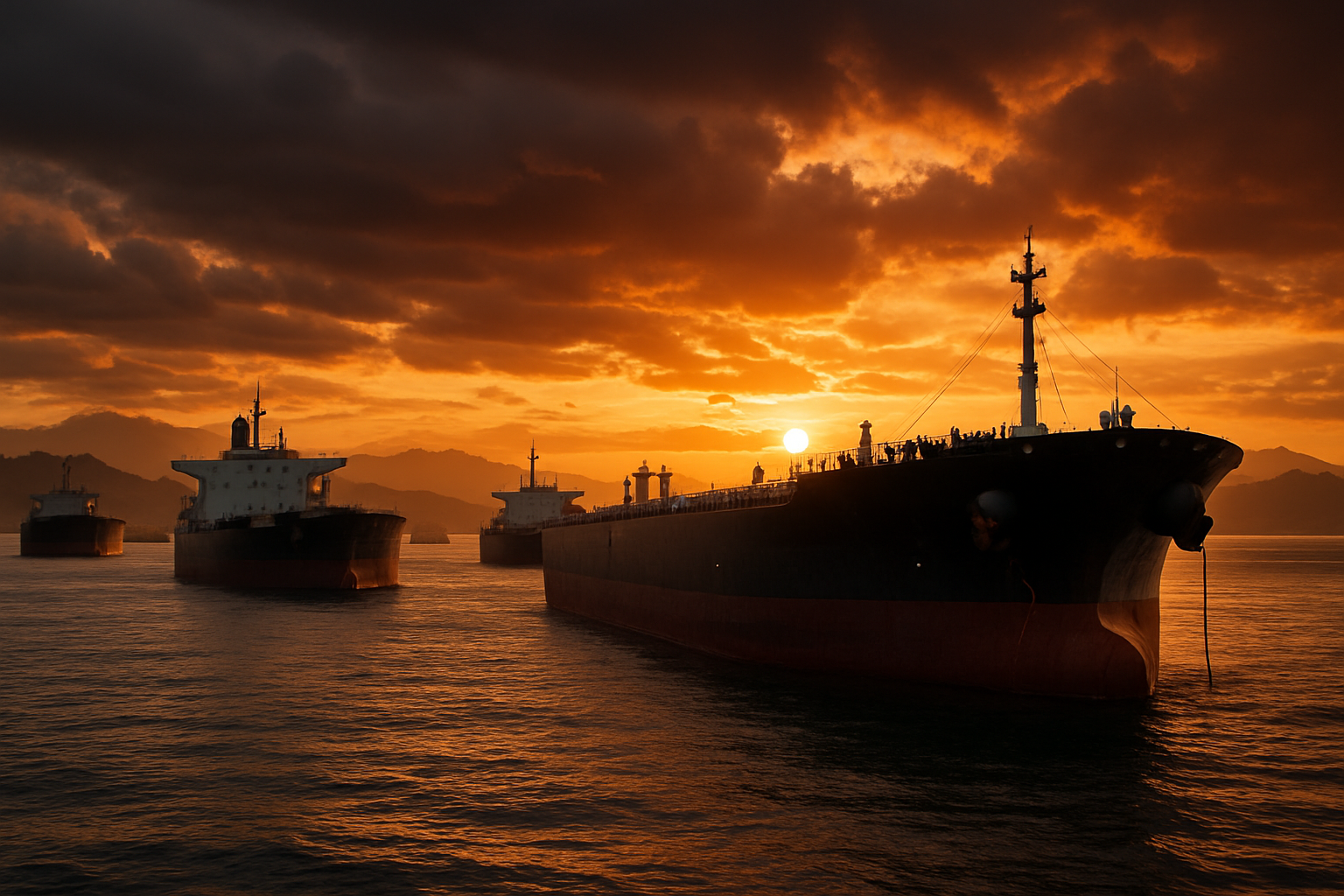
Oil prices have surged past $80 per barrel, marking a dramatic 10% increase as Iran's Revolutionary Guard declared the Strait of Hormuz "unsafe," effectively closing the critical waterway that handles 40% of global seaborne oil transit. The crisis follows the escalation of the Middle East conflict to unprecedented levels, with major shipping companies suspending operations and over 150 oil tankers stranded in Persian Gulf waters.
The energy crisis has reached catastrophic proportions as the ongoing US-Israeli "Operation Epic Fury" and Iran's massive retaliation "Operation True Promise 4" have created the most dangerous international crisis since the Cold War ended. Natural gas prices have exploded by 24% in Europe and 78% in the United States, while European gas prices have rocketed nearly 50% to €47.32/MWh—the highest levels since February 2025.
Strait of Hormuz: The World's Most Critical Energy Chokepoint
The 21-mile-wide Strait of Hormuz has become the epicenter of a global energy security nightmare. Iran's Revolutionary Guard Corps (IRGC) declared "no red lines remain" as they effectively blockaded the strategic waterway through which approximately 20 million barrels of oil pass daily—roughly one-fifth of global petroleum production.
Major shipping conglomerates Maersk and MSC have suspended all operations in the Persian Gulf, leaving more than 150 oil and LNG tankers anchored in Gulf waters, representing billions of dollars in stranded cargo. The geographically irreplaceable chokepoint has no adequate alternatives, with backup routes around the Arabian Peninsula adding significant time and costs that cannot match current capacity needs.
"Every day, two giant tankers carrying 2 million barrels remain docked due to security risks and prohibitive marine insurance costs,"
— Energy Expert, TVMonaco
Global Supply Chains Under Siege
The crisis extends far beyond energy markets, exposing critical vulnerabilities in global supply chains. Qatar has halted LNG production at its Ras Laffan and Mesaid facilities following Iranian drone attacks, affecting approximately 20% of global LNG exports. A force majeure declaration is expected, which will severely impact European energy supplies already strained by the conflict.
Sweden's energy economists predict electricity price increases of 10-20 öre and gasoline price rises of 1-2 kronor per liter, with the southern Malmö zone most exposed due to continental European market integration. Estonia's SEB Chief Economist Mihkel Nestor noted that while prices have surged, they remain roughly at the same levels as this time last year, providing some historical context to the current spike.
In Latvia, the Passenger Transport Association has urgently called on Transport Minister Atis Švinķis to find rapid solutions for fuel price increases caused by the Middle Eastern conflict. The association warns that without swift action, the transportation sector faces unprecedented challenges that could disrupt essential services.
Aviation Industry in Crisis
The energy crisis has paralleled an unprecedented aviation disaster, with over 18,000 flights cancelled worldwide—the most extensive disruption since the COVID-19 pandemic. Eight countries have simultaneously closed their airspace: Iran, Iraq, Israel, UAE, Qatar, Syria, Kuwait, and Bahrain. Dubai International Airport, the world's busiest with over 86 million passengers annually, remains completely shut down due to missile damage.
Major carriers including Emirates, Air France-KLM, Wizz Air, and Bulgaria Air have suspended Middle East operations indefinitely, affecting hundreds of thousands of passengers globally and severing critical Europe-Asia hub connections.
OPEC's Emergency Response Falls Short
The Organization of Petroleum Exporting Countries (OPEC) held an emergency meeting and approved a production increase of 206,000 barrels per day for April. However, energy analysts confirm this increase is insufficient to offset the shipping disruption caused by the Strait of Hormuz closure.
The fundamental challenge facing OPEC is that increased production becomes meaningless if tankers cannot transit safely through the world's most critical energy chokepoint. Alternative routes exist but cannot handle the volume and add substantial time and cost penalties that make them economically unfeasible for current global energy demands.
Asian Nations Implement Emergency Measures
Asian countries, heavily dependent on Middle Eastern oil, have begun implementing extraordinary measures to restrict petroleum consumption. India, Pakistan, Indonesia, Bangladesh, and especially the Philippines are adopting restriction measures on "black gold" consumption as the energy shock manifests across the region.
Indonesia faces particular vulnerability, with analysts warning of a sharp fiscal squeeze if the US-Israel-Iran conflict pushes oil prices higher. The country's fuel subsidy bill could inflate dramatically at a time when global ratings agencies and investors are already scrutinizing Jakarta's monetary discipline, potentially forcing policymakers into difficult choices between maintaining subsidies and breaching legal deficit ceilings.
The Diplomatic Collapse That Triggered Crisis
The current crisis represents the complete breakdown of nuclear diplomacy despite achieving what Abbas Araghchi called "broad agreement on guiding principles"—the most significant progress since the JCPOA collapse in 2018. The fundamental scope disagreement proved insurmountable: Iran excluded ballistic missiles and regional proxies as "red lines," demanding nuclear-only talks, while the US insisted on comprehensive agreements addressing missiles, armed groups, and human rights.
This diplomatic failure led to "Operation Epic Fury," the largest US-Israeli coordinated military operation since 2003, which has now escalated into Iran's massive retaliation campaign that threatens the entire global energy architecture.
Nuclear Governance Crisis Context
The crisis unfolds against the backdrop of a broader nuclear governance breakdown. The New START treaty expired on February 5, marking the first time in over 50 years without US-Russia nuclear constraints. Combined with China's nuclear expansion and Iran's uranium enrichment at 60% purity (approaching the 90% weapons-grade threshold), UN Secretary-General António Guterres has warned that nuclear risks are at their "highest in decades."
"This is a template-setting moment for 21st-century crisis management in a multipolar era. The rapid transition from diplomatic breakthrough to military escalation demonstrates the fragility of modern crisis management mechanisms."
— International Relations Expert
Financial Markets in Freefall
Global financial markets have crashed in response to the crisis. Pakistan's KSE-100 index plummeted 8.97% in the largest single-day decline in the exchange's history. The Dow futures dropped 400-570 points, while European markets suffered severe losses. PayPay's $1.1 billion IPO has been postponed indefinitely due to market volatility.
Central banks, including the European Central Bank and Bank of Japan, are coordinating emergency liquidity provisions to prevent broader financial contagion. The crisis demonstrates how quickly regional conflicts can become global economic disruptions in an interconnected world.
Government Emergency Responses
Governments worldwide have activated unprecedented emergency response protocols. Cyprus has activated its ESTIA evacuation plan for the first time, while multiple European nations have ordered immediate evacuations from Iran due to "extremely uncertain" security conditions.
The scale of coordinated evacuations rivals those seen during the Arab Spring in 2011, with Australia reporting 115,000 nationals trapped, Germany 30,000 stranded, and multiple other nations implementing emergency repatriation procedures across 15 Middle Eastern countries.
Long-term Implications for Energy Security
The crisis has exposed critical vulnerabilities in global energy security architecture, highlighting dangerous over-dependence on strategic chokepoints with limited alternatives. The 21-mile Strait of Hormuz demonstrates how single-point failures can paralyze modern logistics and energy systems that depend on stable geopolitical conditions.
While the crisis accelerates discussions about supply diversification and alternative energy sources, such transitions require years or decades to implement effectively. Strategic petroleum reserves provide only temporary buffers for sustained disruptions of this magnitude.
Traditional monetary policy has limited effectiveness against structural geopolitical disruptions, forcing policymakers to consider fundamental restructuring of energy security planning to reduce dependence on volatile geopolitical regions.
Template-Setting Crisis for the 21st Century
March 2026 marks a watershed moment in global energy security, representing the most dangerous international crisis since the Cold War ended. The stakes extend far beyond immediate supply disruptions, affecting regional war prevention, nuclear governance credibility, international law enforcement, and post-WWII order principles simultaneously.
Success in containing the escalation could provide a framework for future nuclear crisis resolution and strengthen non-proliferation norms globally. However, failure may accelerate military solutions over diplomatic engagement, potentially reshaping Middle Eastern geopolitics for decades while encouraging nuclear proliferation elsewhere and undermining diplomatic credibility worldwide.
The crisis demonstrates that in an interconnected world, regional conflicts instantly affect hundreds of thousands of civilians globally through energy markets, supply chains, and transportation networks. Recovery timelines remain uncertain, unlike weather disruptions, as they depend on military operations resolution and diplomatic normalization rather than predictable natural patterns.
As the situation continues to evolve, the international community faces its greatest test of multilateral cooperation and crisis management in the modern era, with decisions made in the coming days and weeks likely to reverberate through international relations for decades to come.