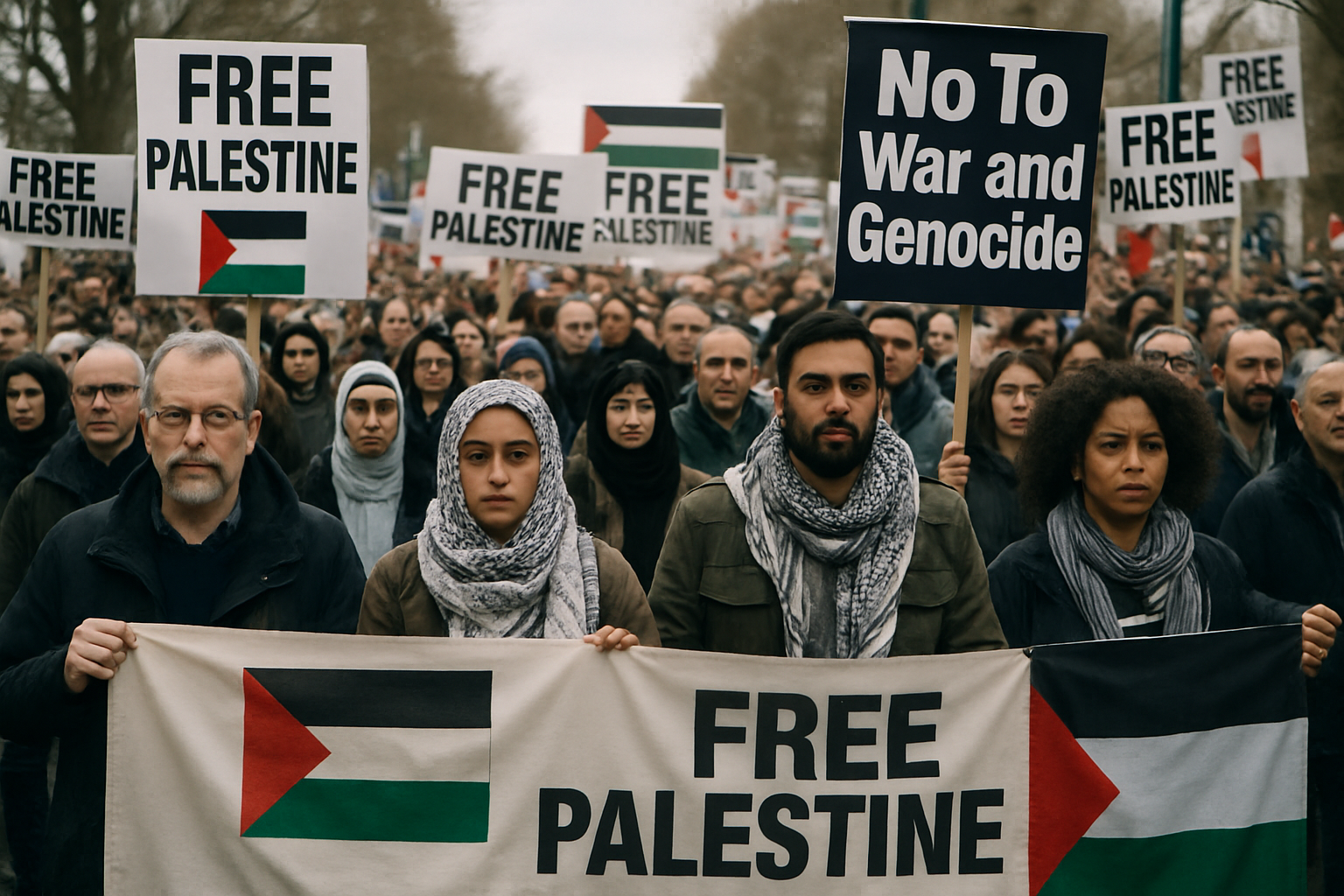
A surge of Palestinian solidarity demonstrations across Australia, Bosnia and Herzegovina, and Ireland has marked a new phase in global human rights advocacy, as protesters face unprecedented legal restrictions while maintaining unwavering support for Palestinian causes.
In Queensland, Australia, twenty protesters were arrested for violating the state's controversial ban on pro-Palestinian phrases, according to reports from SBS News. Those who recite or display "from the river to the sea" or "globalise the intifada" now face up to two years in jail under legislation that has drawn sharp criticism from civil liberties advocates.
International Solidarity Demonstrations
The arrests in Australia came as hundreds of people participated in a "No to War and Genocide" demonstration in Dublin city center, demonstrating the global reach of Palestinian solidarity movements. Video footage from the Irish Times captured the scale of the peaceful protest, which reflected growing international concern over the ongoing conflict.
Meanwhile, in Sarajevo, Bosnia and Herzegovina, the Palestinian community organized a solidarity gathering for Palestinian prisoners. The event, held by the Palestinian community in Bosnia and Herzegovina, highlighted the plight of more than 9,600 Palestinian prisoners, including women and children, according to local media reports from TVSA.BA.
"The gathering comes as a reaction to the adoption of laws that allow the death penalty for Palestinian prisoners in Israeli prisons. We emphasize that this is the institutionalization of violence through legislative frameworks."
— Palestinian Community Representative, Bosnia and Herzegovina
Legal Restrictions and Crackdowns
The Australian arrests represent a concerning escalation in government restrictions on protest expression. Legal experts have raised questions about the compatibility of such laws with international human rights standards, particularly regarding freedom of expression and peaceful assembly.
According to historical context from our archives, this crackdown occurs amid what civil rights organizations describe as a "coordinated assault on civil liberties" affecting multiple countries. The March 2026 Global Social Activism Crisis Investigation revealed sophisticated extremist coordination targeting activists and minority communities across Australia, Ireland, the UK, and Bosnia.
Pattern of International Suppression
The current wave of restrictions follows documented patterns of democratic regression. Our analysis shows that in March 2026, Pakistani authorities detained dozens of women's rights activists, including Dr. Farzana Bari, ahead of International Women's Day rallies. Similar restrictions have been reported across multiple continents.
In London, Palestine Action protesters have faced mass arrests despite High Court rulings in February 2026 that found government terrorism designations "unlawful" and "disproportionate," violating freedom of expression and assembly rights.
Evolving Advocacy Strategies
Despite increasing restrictions, human rights advocacy movements have evolved sophisticated strategies for maintaining momentum. The shift from reactive protest to proactive policy engagement has become a defining characteristic of contemporary social justice movements.
The Bosnian solidarity gathering exemplified this evolution, combining commemoration with practical policy discussions. Participants received certificates and merit awards during the event, which coincided with March women's rights month programming.
The gathering featured speakers including:
- Avdo Hebib, President of the Bosnia and Herzegovina-Palestine Friendship Association
- Hala Hamad, representing Palestinian journalists
- Aldiana Neiroukh, representative of the Palestinian Community in Bosnia and Herzegovina
- Sara Shehada, representing the children of the Palestinian Community
- Sylvia Abu Laban, Ambassador of the State of Palestine to Bosnia and Herzegovina
Global Context and Historical Precedents
The current protests occur against a backdrop of extensive historical precedent. The March 2026 UN Resolution on the Transatlantic Slave Trade, which designated slavery as the "gravest crime against humanity," demonstrated how sustained advocacy and strategic coalitions can achieve breakthrough moments in international recognition.
Ghana's President John Dramani Mahama championed that resolution, stating: "Let it be recorded that when history beckoned, we did what was right for the memory of millions who suffered the indignity of slavery." The resolution passed with 123 countries supporting, despite opposition from the United States, Israel, and Argentina.
International Cooperation and Challenges
The Palestinian solidarity movement demonstrates both the potential and limitations of international cooperation. While protests span multiple continents, activists face varying degrees of restriction depending on their local political contexts.
In Egypt, parliamentary meetings have addressed child marriage prevention, showing how human rights advocacy continues through institutional channels. The Democratic Republic of Congo has seen women's rights organizations conducting prison reform awareness sessions, indicating the diverse approaches being employed globally.
Economic and Political Implications
The restrictions on Palestinian solidarity protests have broader implications for democratic governance and economic development. Research consistently shows that countries with stronger human rights protections demonstrate more robust and sustainable economic growth.
The economic dimensions of human rights advocacy have become increasingly apparent, with discrimination reducing productivity, innovation, and social stability. Business communities in various countries have begun recognizing that comprehensive human rights protections generate economic returns through reduced healthcare costs and enhanced community resilience.
Technology and Modern Advocacy
Modern advocacy movements have successfully integrated technology while maintaining human-centered approaches. Digital platforms enable global diaspora participation and virtual services that connect separated families, while mobile applications provide coordination tools for peaceful demonstrations.
However, activists also face new challenges from digital surveillance and social media monitoring. The Austrian case involving work permit cancellations affecting skilled workers demonstrates how enforcement mechanisms now extend beyond traditional protest spaces into digital realms.
Looking Forward: Sustained Commitment
The current wave of Palestinian solidarity protests reflects a broader evolution in human rights advocacy toward sustained daily commitment rather than periodic symbolic gestures. This shift, observed across multiple social justice movements in 2026, emphasizes long-term institutional change over episodic mobilization.
The success of these movements will likely depend on several factors identified by analysts:
- Sustained political commitment beyond electoral cycles
- Comprehensive stakeholder engagement across communities
- Authentic community leadership respecting cultural diversity
- Maintenance of universal human rights principles while adapting to local contexts
As the international community continues to grapple with questions of sovereignty, human rights, and democratic governance, the Palestinian solidarity movement represents a critical test case for how civil society can maintain pressure for justice while navigating increasingly restrictive political environments.
The protests in Australia, Bosnia and Herzegovina, and Ireland demonstrate that despite varying levels of government restriction, the fundamental human impulse toward solidarity and justice remains a powerful force for social change. Whether this momentum can translate into meaningful policy changes and improved conditions for Palestinian communities remains to be seen, but the global scope and sustained nature of these movements suggests they will continue to shape international discourse on human rights and social justice for years to come.