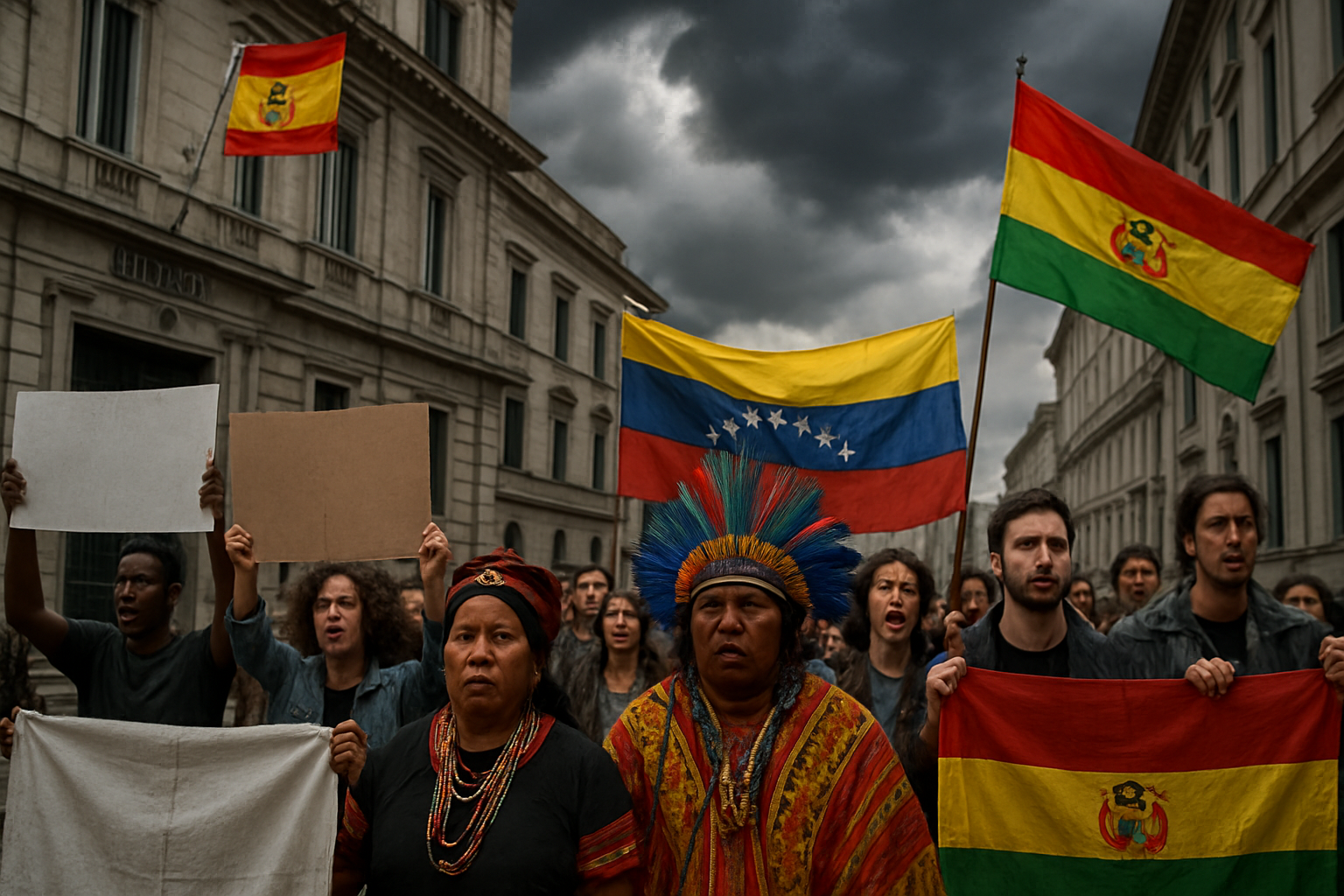
Political tensions are reaching critical levels across multiple continents as indigenous communities in Bolivia launch major protests against controversial land legislation, while diplomatic relations between Spain and Israel deteriorate to unprecedented lows, creating a complex web of international disputes.
The convergence of these political controversies—spanning from South American indigenous rights to Middle Eastern diplomatic crises and Venezuelan governmental transitions—illustrates the interconnected nature of contemporary global governance challenges and the mounting pressures on democratic institutions worldwide.
Bolivia: Indigenous March Against Land Rights Law
Indigenous communities and rural sectors from Bolivia's Pando department have launched a significant march toward La Paz, expressing strong opposition to Law 157, which they view as a direct threat to territorial control and collective property rights in their ancestral regions.
The protest movement, initially starting with a small group of participants mid-week, has grown substantially as additional rural and indigenous organizations have joined the mobilization. According to reports from Erbol, the march has strengthened progressively with the incorporation of agricultural union structures and original representations from Bolivia's northern Amazonian region.
"The norm establishes changes in the categorization of rural properties that could fundamentally alter our territorial rights and collective ownership structures."
— Indigenous community representatives, as reported by La Razón
Law 157, promulgated by President Rodrigo Paz, introduces modifications to rural property categorization that indigenous leaders argue threatens their constitutional rights to collective land ownership and self-determination. The legislation represents a broader challenge facing indigenous communities across Latin America as governments seek to modernize land use policies while maintaining respect for ancestral territorial rights.
Spain-Israel Diplomatic Crisis Deepens
Tensions between Spain and Israel have escalated dramatically following incidents involving Spanish diplomatic personnel and controversial symbolic protests. Israel has formally reprimanded Spain's top diplomat in Tel Aviv over the detonation of an effigy representing Israeli Prime Minister Benjamin Netanyahu, marking one of the most serious diplomatic incidents between the two nations in recent memory.
The controversy reflects broader European frustration with Israeli policies, as Spain joined 85 UN member states in condemning Israeli West Bank policies earlier this year. The diplomatic crisis has been exacerbated by what Spanish officials describe as "systematic violations of international law and human rights" in the region.
Hamas has welcomed the Spanish diplomatic stance as a "continuation of honorable positions rejecting the Gaza situation," while Yemen's Sanaa government praised the move, commending "Spain's solidarity with the Islamic Republic of Iran" against what they termed "US-Israeli aggression."
Venezuelan Political Transition Continues
Venezuela continues its complex political transition under Acting President Delcy Rodríguez, with recent developments including a call for a pilgrimage scheduled for April 19th demanding the lifting of international sanctions. The announcement was made during a visit to the María Matilde Liendo commune in San José de Cotiza.
Simultaneously, protests in Valencia highlight ongoing infrastructure challenges, as residents denounce constant blackouts and electrical failures. Despite government officials from Corpoelec claiming power cuts last only four hours, local residents report experiencing outages lasting up to 12 hours, demonstrating the gap between official statements and lived reality.
"The electrical crisis affects all aspects of daily life, from businesses to healthcare facilities, creating humanitarian concerns beyond mere inconvenience."
— Valencia protest organizers
These developments occur against the backdrop of Venezuela's ongoing democratic transition, with over 750 political prisoners released under a comprehensive amnesty program since January 2026, representing the most extensive Latin American reconciliation effort in recent history.
Qatar Reports Israeli Diplomatic Pressure
Adding to the regional diplomatic tensions, Qatar has reported that Israel reprimanded Spanish diplomatic officials over the Netanyahu effigy incident, indicating the broader Middle Eastern implications of European diplomatic positions regarding Israeli policies.
This incident reflects the growing international pressure on Israel's government as diplomatic relationships with traditional European allies become increasingly strained over policies in the occupied territories and regional security matters.
Historical Context and Pattern Analysis
The current wave of political controversies fits within a broader pattern of global political tensions observed throughout 2026. From indigenous rights movements in Latin America to diplomatic crises in Europe and the Middle East, these incidents reflect several common themes:
- Tension between national sovereignty and international law
- Indigenous and marginalized communities asserting traditional rights against modernization policies
- Deteriorating diplomatic relationships amid polarized international politics
- The intersection of domestic politics with international relations
The Venezuelan case, in particular, demonstrates how political transitions can create both opportunities for reconciliation and new sources of conflict, as different political actors compete for influence during periods of institutional change.
Regional and International Implications
These political controversies carry significant implications for regional stability and international governance. The Bolivian indigenous march highlights ongoing challenges in Latin American democracies to balance development policies with constitutional protections for indigenous rights.
The Spain-Israel diplomatic crisis reflects broader European concerns about Middle Eastern policies and the limits of diplomatic protest in international relations. The incident demonstrates how symbolic actions can quickly escalate into serious diplomatic incidents with lasting consequences for bilateral relationships.
Venezuela's complex transition continues to serve as a template for post-authoritarian democratic development, with the international community closely monitoring whether genuine democratic reforms will emerge or whether cosmetic changes will maintain existing power structures.
Democratic Governance Under Pressure
The convergence of these political controversies illustrates the mounting pressures on democratic institutions worldwide. From indigenous communities asserting constitutional rights in Bolivia to diplomatic crises between democratic allies, the current moment represents a significant test of institutional resilience.
The effectiveness of democratic governance mechanisms in addressing these diverse challenges will influence not only the immediate political outcomes but also the broader credibility of democratic systems in managing complex social, economic, and international pressures.
International observers emphasize that the coming weeks will be crucial in determining whether these controversies can be resolved through established diplomatic and political channels or whether they will escalate into more serious conflicts with lasting regional and international consequences.
Looking Forward
As these political controversies continue to develop, their resolution will require sustained engagement from all parties involved. The Bolivian government must address indigenous concerns about Law 157 while maintaining its broader development agenda. Spain and Israel need to find mechanisms to restore diplomatic cooperation despite fundamental disagreements about Middle Eastern policies.
Venezuela's transition remains a critical test case for democratic development in Latin America, with the success or failure of its reconciliation process likely to influence similar efforts across the region.
The interconnected nature of these political challenges underscores the complexity of contemporary governance and the need for innovative approaches to managing political tensions in an increasingly interconnected world.