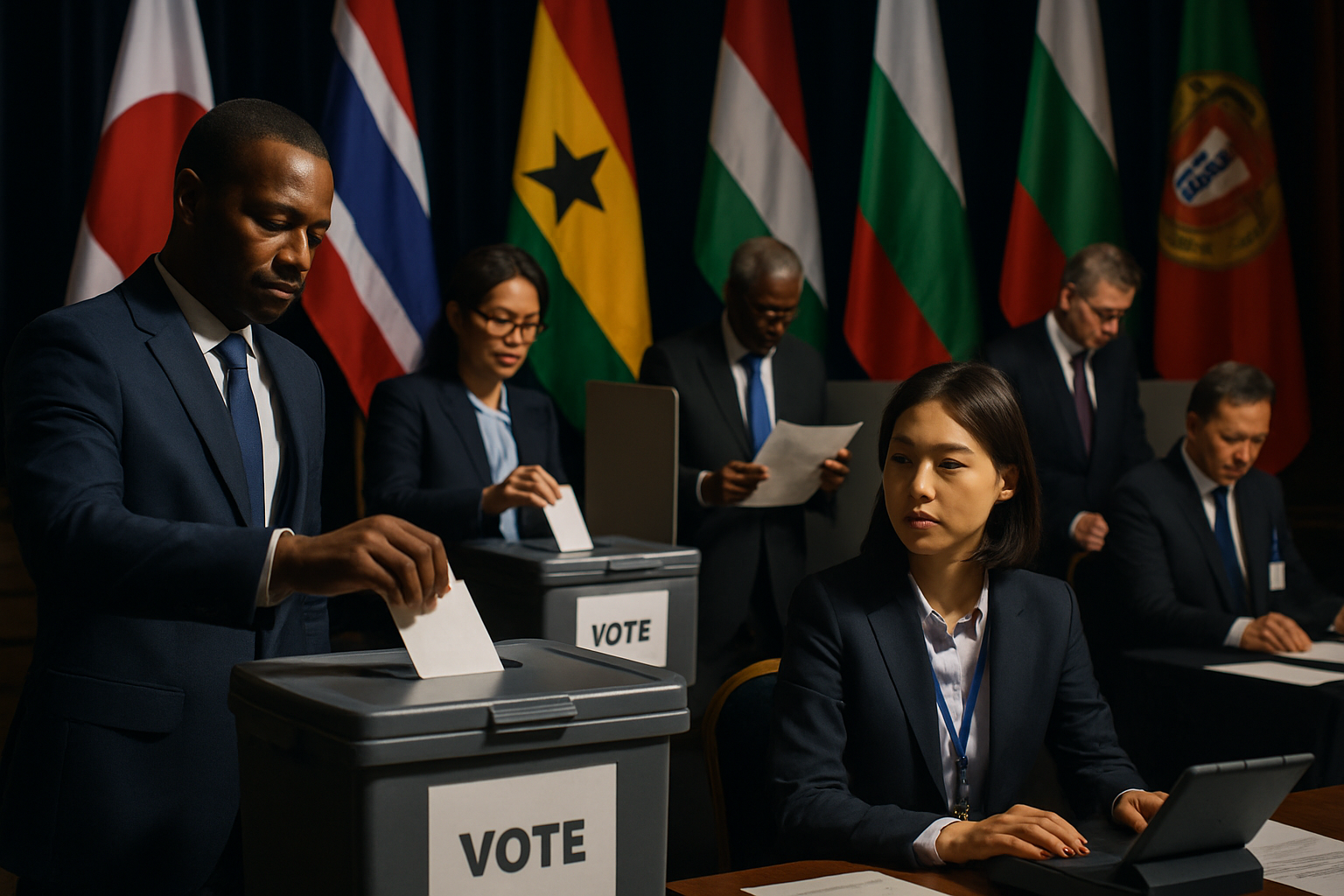
February 2026 has emerged as a defining moment in global politics, with multiple nations experiencing simultaneous electoral challenges, leadership transitions, and constitutional crises that are reshaping power dynamics across continents and testing the resilience of democratic institutions worldwide.
Japan's Historic Electoral Gambit
Japan stands at the center of this global political transformation, where Prime Minister Sanae Takaichi—the nation's first female premier—has staked her political future on snap elections scheduled for Sunday, February 9th. The election represents a critical test for Japan's Liberal Democratic Party (LDP) as it seeks to reclaim parliamentary dominance following recent electoral setbacks.
Takaichi's campaign has focused heavily on immigration policy, with her final appeal to voters emphasizing plans to make Japan "more prosperous and safer" through tougher immigration screening measures. This nationalist approach reflects broader regional security concerns and demographic challenges facing the archipelago nation.
Portuguese media analysis suggests that after consecutive electoral losses, the LDP views Takaichi's popularity as key to regaining a comfortable parliamentary majority. The election comes amid heightened regional tensions and represents a potential shift toward more conservative policies in one of Asia's most stable democracies.
Thailand's Democratic Struggles
Thailand continues to grapple with persistent political instability that has hindered meaningful reform for over two decades. According to a Bloomberg analysis published February 6, political reform efforts have consistently failed to gain traction as the country faces entrenched economic power structures and weak growth.
The analysis, titled "Why Struggling Thailand Keeps Voting for Change That Never Comes," highlights how persistent political instability has prevented Thailand from achieving the economic progress once expected of the Southeast Asian nation. Once viewed as following the development paths of South Korea and Singapore, Thailand now trails regional peers with sluggish growth, rising debt, and widening inequality.
Adding to electoral complications, Thailand's Election Commission issued urgent warnings to voters about carefully checking ballots after the Supreme Court ordered the removal of 49 disqualified candidates—18 constituency candidates and 31 party-list candidates—ahead of upcoming elections. Votes cast for these disqualified candidates will be counted as spoiled ballots, creating potential confusion at polling stations.
Ghana's Political Succession
In West Africa, Ghana is conducting a crucial by-election in the Ayawaso East constituency following the death of MP Naser Toure. The contest, featuring five candidates vying for the National Democratic Congress (NDC) ticket, is seen as particularly significant given the party's traditional dominance in the constituency.
Frontrunners include Hajia Amina Adam, widow of the late MP, who is expected to benefit from sympathy votes, alongside Baba Jamal Mohammed Ahmed and Dr. Yakubu Azindow. The Ghana Police Service is handling security while the Electoral Commission supervises the polls in what observers view as a test of the country's democratic institutions.
Bulgaria's Political Fragmentation
Bulgaria faces a deepening political crisis as the Bulgarian Socialist Party (BSP) navigates internal leadership struggles. Key figures Dragimir Stoinev, chairman of BSP's parliamentary group, and Kalyan Pargov, a member of the party's Executive Bureau, have both withdrawn from the leadership race, creating uncertainty about the party's future direction.
The developments come as Ivan Takov, chairman of BSP-Sofia's city council, has characterized former President Rumen Radev's resignation as a potential opportunity for the socialist party. Radev's departure from the presidential post has created a political vacuum that various parties are attempting to fill, highlighting the country's ongoing institutional challenges.
Hungary's Historical Reflection
Hungary continues to confront its complex political legacy, with recent discussions about Count Mihály Károlyi (1875-1955), former prime minister and president of the Hungarian Republic. According to Count György Károlyi, a former Hungarian ambassador to Paris, Mihály Károlyi was "not a traitor, but he was unsuited to the role that history had assigned him."
This historical reflection comes as Hungary faces contemporary political pressures, including ongoing tensions with EU institutions and questions about democratic governance under the current administration.
Regional Patterns and Global Implications
These simultaneous political developments reveal several critical patterns shaping global democracy in 2026. First, traditional political establishments across multiple regions are facing unprecedented challenges from both internal fragmentation and external pressures.
Second, the role of female leadership is becoming increasingly prominent, with Japan's historic female premiership potentially setting precedents for political representation across Asia. Takaichi's nationalist approach also reflects broader global trends toward sovereignty-focused governance in response to international pressures.
Third, electoral integrity has become a central concern, as seen in Thailand's candidate disqualification issues and various nations' struggles with ensuring fair and transparent democratic processes.
Institutional Stress Tests
The convergence of these political transitions represents a stress test for democratic institutions worldwide. From Japan's constitutional democracy navigating security challenges to Thailand's persistent reform failures, the events of February 2026 highlight the fragility of democratic governance in an era of rapid global change.
Bulgaria's political fragmentation demonstrates how post-communist democracies continue to struggle with institutional stability, while Ghana's by-election shows the importance of peaceful democratic succession in regions where such processes cannot be taken for granted.
These developments occur against a backdrop of broader global challenges, including climate change, migration pressures, economic inequality, and technological disruption—all of which are placing unprecedented demands on political systems worldwide.
The Path Forward
As February 2026 unfolds, the outcomes of these various political transitions will likely influence democratic development far beyond their immediate national contexts. Japan's election results could affect regional security arrangements and economic policies across Asia. Thailand's ongoing struggles may serve as a cautionary tale for other developing democracies. Ghana's by-election demonstrates the possibility of peaceful democratic processes in regions often marked by political instability.
The international community watches these developments with particular interest, as they occur during a period when democratic institutions face challenges from authoritarian alternatives and internal polarization. Success in navigating these transitions could strengthen global confidence in democratic governance, while failures might accelerate trends toward alternative political models.
The coming weeks will prove crucial in determining whether these nations can successfully manage their political transitions while maintaining democratic norms and institutional integrity. The stakes extend far beyond individual countries, as the global community seeks evidence that democratic systems can adapt and thrive in an increasingly complex world.