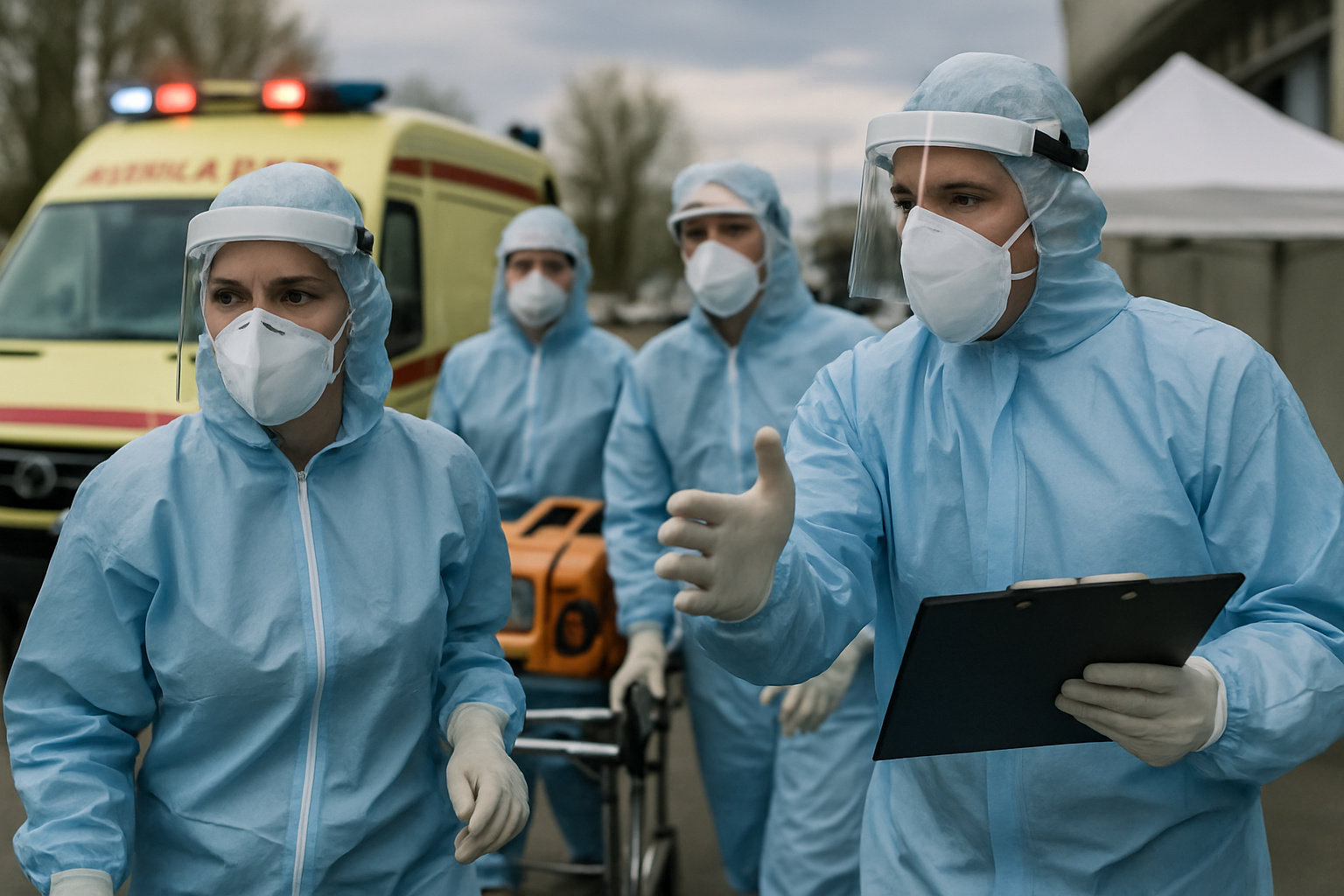
Health authorities across three continents are implementing coordinated emergency responses to combat multiple disease outbreaks, while Cyprus marks a significant victory in its battle against foot-and-mouth disease, demonstrating the effectiveness of international cooperation in modern public health crisis management.
The convergence of health emergencies spanning from Eastern Europe to Central Africa highlights both the challenges and successes of contemporary global health security systems, as nations grapple with evolving disease patterns amid unprecedented climate conditions.
Cyprus Achieves Landmark Recovery in Agricultural Disease Crisis
Cyprus health and agricultural authorities have successfully contained what was once described as the island's most severe agricultural crisis in decades, with the foot-and-mouth disease outbreak now showing clear signs of resolution. The latest vaccination data reveals remarkable progress: 98% cattle coverage and 76% sheep and goat first-dose vaccination rates, while 28,516 sheep and goats and 1,910 cattle have been culled as part of the comprehensive containment strategy.
Critically, no new cases have been reported, indicating successful containment of the outbreak that began in February 2026 in Oroklini and subsequently spread to Livadia and parts of the Nicosia district. The crisis had threatened Cyprus's disease-free status, crucial for the island's €250 million halloumi export market, which depends on 80% of the nation's milk production.
"The coordinated response demonstrates what can be achieved through sustained political commitment and international cooperation," said Agricultural Ministry officials, confirming that all animals at affected Livadia farms testing positive have been successfully culled according to EU protocols.
The outbreak's resolution represents a template for agricultural disease response, combining technical measures including comprehensive vaccination campaigns, strict culling protocols, enhanced biosecurity measures, and robust EU cooperation under President Nikos Christodoulides' coordinating body involving multiple agencies.
Russian-Chinese Border Region Faces Livestock Disease Surge
Meanwhile, concerning developments emerge along the Russian-Chinese border as China reports new outbreaks of foot-and-mouth disease in regions previously affected by months of mass cattle culling in Russia. The outbreak of livestock disease near Russian regions that have experienced extensive cattle culling raises serious concerns about possible cross-border transmission patterns.
The geographic proximity of these outbreaks to areas that have undergone massive livestock culling operations suggests potential linkages in disease transmission networks that could challenge containment efforts across national boundaries. Health authorities are monitoring the situation closely as the disease appears to be spreading through interconnected livestock trade and movement patterns.
This development comes amid growing international concern about the ability of national borders to effectively contain rapidly spreading livestock diseases, particularly in regions with significant agricultural trade relationships.
Democratic Republic of Congo Declares End to Devastating Mpox Outbreak
In a major public health victory, the Democratic Republic of Congo has officially announced the end of a catastrophic two-year mpox outbreak that infected thousands and claimed more than 2,200 lives. The declaration marks the conclusion of one of the most severe mpox outbreaks in recent history, representing both a humanitarian milestone and a testament to sustained international health cooperation.
The outbreak, which began in early 2024, had overwhelmed healthcare systems across multiple provinces and required extensive international support including medical supplies, technical expertise, and vaccination campaigns. Health officials confirmed that the declaration followed weeks of surveillance showing no new cases meeting the criteria for outbreak continuation.
"This represents a significant achievement for our healthcare system and international partners who supported our response efforts," stated DRC health authorities in announcing the end of the outbreak that had affected vulnerable populations across multiple regions.
The successful containment demonstrates the effectiveness of coordinated international health responses, combining traditional public health measures with modern surveillance technology and community engagement strategies. The outbreak's resolution provides crucial lessons for managing similar health emergencies in resource-constrained settings.
Integration of Climate Change and Disease Response
These multiple health crises occur during the 20th consecutive month of global temperatures exceeding 1.5°C above pre-industrial levels, creating what experts describe as a "threat multiplier" effect on disease transmission and containment efforts. Climate change is fundamentally altering traditional disease patterns, allowing pathogens that typically peak during different seasons to co-circulate simultaneously.
The sustained warming has disrupted veterinary and public health systems designed for sequential rather than simultaneous challenges, requiring rapid adaptation of emergency response protocols. Agricultural systems face particular pressure as optimal pathogen conditions coincide with supply chain disruptions and changing precipitation patterns affecting livestock and crop production.
Healthcare experts note that prevention-first approaches, as demonstrated in Cyprus's successful containment strategy, prove more cost-effective than reactive crisis management when dealing with climate-amplified disease challenges.
International Cooperation Models Evolution
The diverse responses to current health emergencies showcase the evolution of international health cooperation beyond traditional multilateral frameworks. Cyprus's success relied heavily on EU emergency protocols and bilateral partnerships with member states, while the DRC's mpox containment benefited from direct technical assistance and resource sharing among African health networks.
Despite ongoing challenges facing traditional international health institutions, including WHO funding constraints from major contributor reductions, bilateral partnerships and regional cooperation networks continue driving effective emergency responses through peer-to-peer knowledge sharing and flexible, culturally responsive approaches.
The success factors identified across these varied responses include sustained political commitment, adequate resource allocation, comprehensive professional training, and continued international cooperation that maintains evidence-based medical standards while adapting to local contexts.
Economic Implications and Prevention-First Strategies
The economic implications of these health emergencies extend far beyond immediate medical costs. Cyprus's successful containment protected not only its crucial halloumi industry but also maintained tourism confidence ahead of the peak season. The DRC's mpox outbreak resolution removes significant barriers to regional trade and economic development that had persisted throughout the two-year crisis.
Economic analyses consistently demonstrate that prevention-focused strategies, as evidenced in the Cyprus response, offer substantial cost reductions through decreased crisis interventions while achieving superior population health outcomes. Countries implementing comprehensive prevention programs report enhanced community resilience, reduced emergency care demands, and improved international competitiveness.
The contrast between successful preventive interventions and reactive crisis management becomes particularly stark when examining the broader economic multiplier effects, including reduced infrastructure damage, maintained export markets, and preserved public confidence in health systems.
Technology-Traditional Knowledge Integration
The successful health responses demonstrate sophisticated integration of cutting-edge technology with traditional public health approaches. Cyprus's containment strategy combined advanced molecular testing and satellite-monitored quarantine zones with traditional veterinary practices and community engagement.
Similarly, the DRC's mpox response utilized digital surveillance systems and modern vaccine delivery methods alongside community health worker networks and culturally appropriate education campaigns. This balanced approach avoids the "wellness paradox" where technological solutions create healthcare inequality rather than improving access and outcomes for diverse populations.
The goal remains technology enhancing rather than replacing clinical judgment and personal medical relationships, ensuring that advanced capabilities serve public health rather than creating new barriers to essential care.
Future Preparedness and Global Health Security
These concurrent health challenges provide crucial insights for future global health security preparedness. The success of Cyprus's comprehensive response model, combining vaccination campaigns with strict biosecurity measures and international cooperation, offers a template for addressing similar agricultural health emergencies.
The DRC's mpox containment demonstrates that sustained international engagement, adequate funding, and community-centered implementation can achieve transformative improvements even in resource-constrained settings. These successes occur within the broader context of the "Therapeutic Revolution of 2026," characterized by prevention-first healthcare strategies and enhanced international cooperation.
Moving forward, the window for building resilient, equitable health systems capable of addressing climate-amplified health challenges continues to narrow. Environmental pressures are accelerating while ecological systems approach critical thresholds that could create potentially irreversible changes affecting global food security, climate stability, and human settlements.
The tools, knowledge, and cooperation frameworks exist for comprehensive health protection, but success requires sufficient speed, coordination, and sustained international cooperation during this critical climate action decade. The diverse responses examined here provide hope that coordinated action can achieve transformative health improvements even under significant resource and environmental constraints.
As health authorities continue monitoring these evolving situations, the lessons learned from both successful containments and ongoing challenges will prove essential for developing more resilient global health security systems capable of addressing the complex, interconnected health threats of the 21st century.