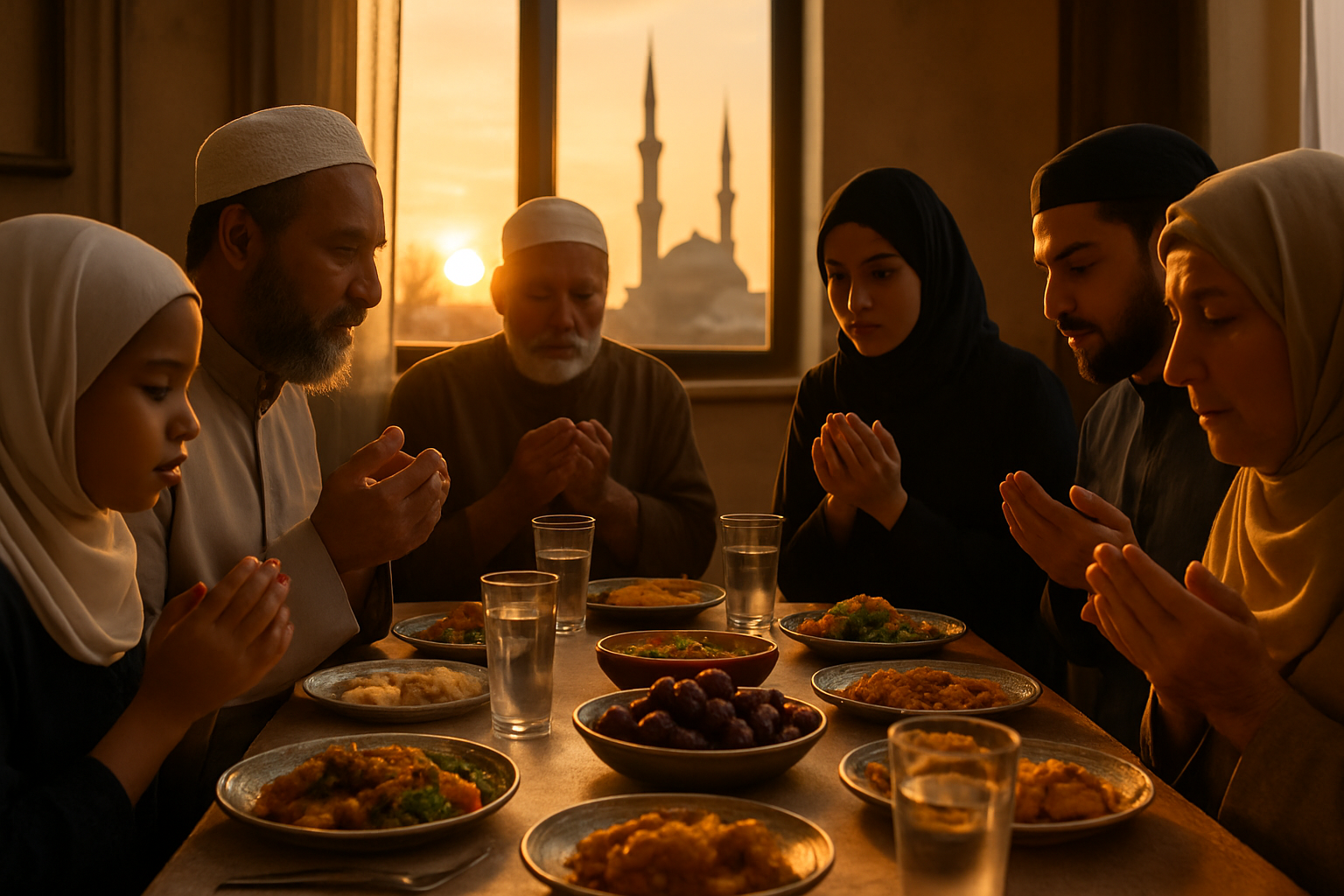
Nearly 2 billion Muslims worldwide began observing Ramadan 1447 AH on February 18-19, 2026, marking the commencement of the holy month with unprecedented global coordination and comprehensive governmental support across multiple continents.
The sacred month officially commenced following successful crescent moon sighting confirmations across numerous Islamic nations on Tuesday evening, February 18, 2026. Pakistan's Central Ruet-i-Hilal Committee Chairman Maulana Abdul Khabir Azad announced the moon sighting from Peshawar, confirming eyewitness reports from Dir, Sawabi, Mohmand, and Karachi, with the Meteorological Department confirming the moon's visibility until 7:03 PM.
Global Moon Sighting Confirmations
Saudi Arabia's Supreme Court confirmed crescent moon sightings at Hawtat Sudair and Tumair observatories in Al-Majma'ah Governorate, using traditional visual confirmation enhanced by modern astronomical support. The Kingdom's announcement influenced neighboring Gulf states and global Muslim communities, establishing February 18 as the predominant start date.
Algeria's National Committee for Crescents and Sharia Times announced successful moon sighting observations, while Azerbaijan First Vice-President Mehriban Aliyeva shared commemorative posts marking the sacred month's beginning. The unified timing across most Islamic nations reinforced global Muslim ummah unity despite geographical and cultural differences.
Governmental Arrangements and Support
Multiple governments implemented comprehensive arrangements to facilitate religious observance. Saudi Arabia's Ministry of Commerce conducted over 37,000 inspection and supply monitoring visits across the Kingdom over the past two months to ensure availability of essential goods for Ramadan, targeting retail outlets, central markets, and gas stations along routes to Makkah and Madinah.
"The Ministry has deployed specialized teams to maintain a steady supply of Ramadan-related products and protect consumer interests throughout the holy month."
— Saudi Ministry of Commerce Official
Pakistan's State Bank revealed modified banking hours for commercial banks during Ramadan, with operations running Monday through Thursday from 9:00 AM to 2:00 PM, and Friday hours from 9:00 AM to 12:30 PM. The central bank issued the directive immediately, ensuring uninterrupted banking services throughout the fasting period.
In Oman, Muscat Municipality announced revised operating hours for slaughterhouses in Seeb and Amerat, with slaughtering services for companies and meat shops available daily from 6 AM to 9 AM, while individual customers will be served from 4 PM to 9 PM. Friday operations will run in two shifts to provide greater flexibility for customers.
Religious Leadership and Spiritual Messages
Religious and political leaders across the Islamic world extended heartfelt congratulations to Muslim communities. Albanian Prime Minister Edi Rama wished Muslim believers "Easy and accepted fasting" through social media posts, while President of Uzbekistan Shavkat Mirziyoyev addressed the nation with congratulations emphasizing the month's profound spiritual and moral significance.
In Bosnia and Herzegovina, the beginning of Ramadan was officially marked by the traditional cannon firing from Žuta Tabija (Yellow Fortress) in Sarajevo. Reisu-l-ulema of the Islamic Community Husein ef. Kavazović delivered a special Ramadan message to Muslims, calling for spiritual awakening and dedication to faith values during these sacred thirty days.
Nigeria's political leaders joined the congratulatory messages, with Lagos State Governor Babajide Sanwo-Olu urging both Christians and Muslims to use this year's Lenten and Ramadan fasting season to seek advancement of shared peace and prosperity for Nigeria.
International Support and Recognition
The global nature of Ramadan observance was highlighted by interfaith support initiatives. In Nigeria, a Christian church distributed Ramadan food to Tsangaya schools in Kaduna, with church officials stating they had supported underprivileged Muslims and Tsangaya schools across five northern states with food items for approximately 20 years.
Kuwait experienced significant livestock price increases ahead of Ramadan, with the "Ramadan rush" sending prices to record highs as demand surged for traditional holiday meals. This economic phenomenon demonstrates the month's substantial impact on regional markets and consumption patterns.
Infrastructure and Security Preparations
Advanced technological preparations supported the holy month observance. Saudi Arabia's Communications, Space and Technology Commission (CST) completed comprehensive operational plans to serve guests of the Two Holy Mosques during Ramadan 1447 AH, including expanded deployment of 5G technology in and around the Grand Mosque in Makkah and the Prophet's Mosque in Madinah.
Algeria's security authorities implemented special safety measures for Ramadan, with security services planning comprehensive coverage of markets, mosques, public spaces, entertainment venues, and transportation stations that experience continuous movement throughout the holy month.
In Uzbekistan, authorities introduced temporary traffic restrictions on streets adjacent to mosques in Tashkent where Tarawih prayers are performed, demonstrating systematic urban planning for increased religious activity.
Cultural and Historical Traditions
The rich cultural heritage surrounding Ramadan observance was exemplified in Saudi Arabia's Maysan Governorate, where elderly residents recalled memories of Ramadan in the 1930s when the holy month's start was confirmed solely by naked-eye moon sighting. Nearly century-old resident Sharifah bint Atiyah Al-Thaqafi recounted how men and children would climb nearby elevations to scan the horizon for the first glimpse of the crescent moon.
In Saudi Arabia's historic Jeddah, Al-Balad district was illuminated with traditional Ramadan decorations, creating an atmosphere of celebration as visitors gathered in the historic area during the holy month's opening days.
Spiritual Observance and Prayer
The first night of Ramadan witnessed hundreds of thousands of worshippers performing Isha and Tarawih special prayers at the Grand Mosque in Makkah and the Prophet's Mosque in Madinah. The General Authority for the Care of the Affairs of the Grand Mosque and the Prophet's Mosque completed comprehensive operational preparations to receive worshippers, providing optimal services to enable comfortable and tranquil ritual performance.
Senegal's religious authorities addressed questions about moon sighting methodology, with meteorologist Riad Kawar providing technical explanations for why the crescent lunar observation was challenging on Tuesday, contributing to informed religious discourse about traditional lunar calendar determination.
Global Impact and Significance
The simultaneous beginning of Ramadan across most of the Islamic world demonstrates sophisticated international coordination in religious observance. This year's commencement builds upon previous years' successes in global Muslim cooperation, with countries coordinating prayer times, charitable initiatives, and cultural exchanges throughout the sacred month.
The month emphasizes spiritual purification, increased charitable giving (zakat), enhanced community bonds, and special Tarawih prayers, while triggering altered consumption patterns, evening economic activity increases, and strengthened social solidarity across Muslim communities worldwide.
As nearly 2 billion Muslims enter this period of fasting, prayer, and reflection, Ramadan 2026 represents not only a personal spiritual journey for individual believers but also a testament to the enduring power of shared religious traditions to unite diverse communities across geographical, cultural, and political boundaries in common purpose and devotion.