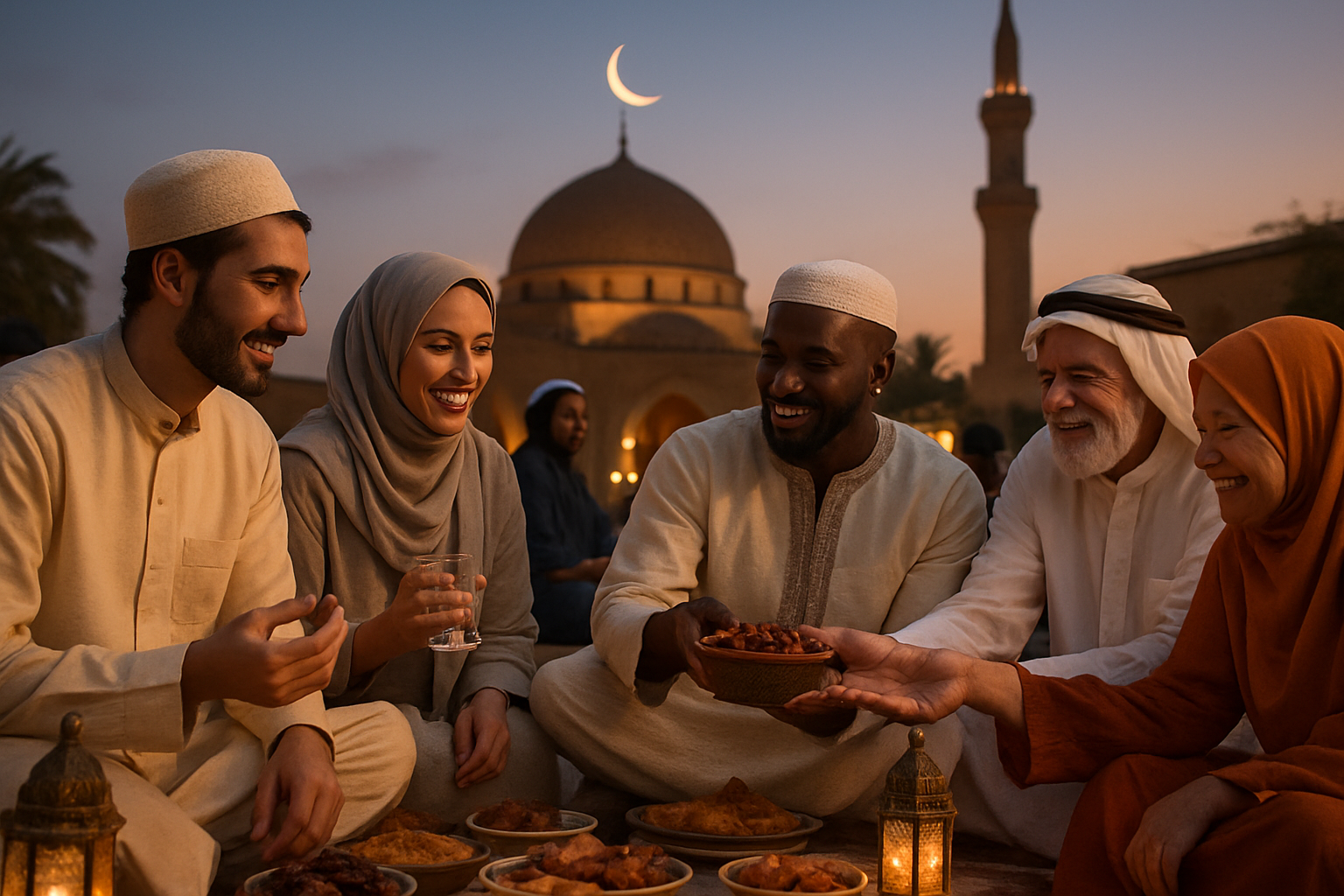
Muslim communities across the globe began observing Ramadan 1447 AH with Thursday, February 19, 2026, marking the first day of the holy month following successful crescent moon sightings and astronomical confirmations from multiple countries.
The commencement of Ramadan demonstrates the remarkable diversity and unity within the global Muslim ummah, with governments, religious authorities, and communities implementing various cultural and religious activities while making special arrangements to accommodate the spiritual needs of nearly 2 billion Muslims worldwide.
Crescent Moon Confirmations and Scientific Validation
The determination of Ramadan's start date showcased both traditional Islamic practices and modern astronomical technology. Jordan's Astronomical Society provided precise documentation of the crescent moon sighting ceremony, confirming the lunar observation that officially marked the beginning of the holy month.
"The Jordanian Astronomical Society confirmed that the crescent moon for Ramadan was thin but visible after reaching over 24 hours of age, providing both scientific and religious confirmation for the start of the holy month."
— Jordan Astronomical Society Statement
This scientific validation occurred simultaneously across multiple Islamic nations, with various countries conducting their own moon-sighting ceremonies. However, the process was not without controversy, as some experts questioned certain sightings, with reports suggesting that in some cases, observers may have mistaken the planet Venus for the lunar crescent.
Government Accommodations and Public Support
Across the Muslim world, governments implemented comprehensive support measures to facilitate Ramadan observance. In Kuwait, multiple government ministries issued formal congratulations and implemented practical accommodations for the holy month.
Kuwait's Ministry of Interior announced adjusted working hours for various government departments during Ramadan, with identity centers operating in two shifts: morning sessions from 10:00 AM to 2:30 PM and evening sessions from 7:00 PM to 11:30 PM. The Ministry of Health, Higher Education, and Social Affairs all issued formal statements extending greetings to the nation's leadership and citizens.
In a remarkable display of inclusive governance, Kuwait's Amir Sheikh Mishal Al-Ahmad Al-Jaber Al-Sabah and Crown Prince Sheikh Sabah Khaled Al-Hamad Al-Sabah received well-wishers—both citizens and residents—at the Al-Sabah family diwan at Bayan Palace, reflecting the unity that characterizes Kuwaiti society during the holy month.
Cultural and Regional Variations
The observance of Ramadan across different regions demonstrated rich cultural diversity while maintaining spiritual unity. In Algeria, high-ranking officials including the Communication Minister Zahir Bouamama and National People's Assembly President Ibrahim Boughali extended congratulations to the Algerian people, emphasizing the month's significance for spiritual renewal and community solidarity.
Algeria's military leadership also participated in the observances, with Army Chief of Staff General Said Chanegriha extending greetings to all military personnel and their families, highlighting the month's importance for personal reflection and spiritual growth.
West African Observances and Market Preparations
In West Africa, various governments took proactive steps to ensure smooth Ramadan observances. In Niger, the municipality of Dosso implemented price controls and market monitoring to preserve citizens' purchasing power during the holy month, demonstrating how local authorities adapt to meet community needs during Ramadan.
Mauritania's National Committee for Crescents confirmed the sighting of the Ramadan crescent on Wednesday evening, February 18, announcing Thursday, February 19 as the first day of fasting. This coordination across Islamic institutions ensures unified observance within national boundaries.
Comprehensive Religious Programming
The scope of religious activities planned for Ramadan 2026 demonstrates unprecedented organization and community engagement. In Oman, the Department of Endowments and Religious Affairs in South Batinah announced plans for more than 2,000 religious, outreach, and awareness activities during the holy month.
"This year's plans include hundreds of sermons, lectures, lessons and religious talks to be held in mosques, schools and community centres, featuring specialized outreach initiatives and translated lectures for non-Arabic speakers."
— Dr. Abdulrahman bin Mohammed Al Siyabi, Director, Department of Endowments and Religious Affairs
These comprehensive programs target various segments of society while promoting ethical and faith-based values, representing a sophisticated approach to community engagement during the holy month.
Economic and Social Adaptations
The beginning of Ramadan triggered significant economic and social adaptations across Muslim-majority societies. In Oman, government and private sector institutions adopted revised schedules to accommodate fasting and support employee well-being, while commercial activity adapted to different tempo patterns with increased evening economic activity.
Citizens reported positive responses to these accommodations. "Shorter working hours during Ramadan reduce physical strain and allow us to focus better on both work and worship," said Salem bin Rashid from Suhar, who works in the private sector.
Global Diaspora Participation
The global nature of Ramadan observance was particularly evident in countries with significant Muslim populations. In Norway, media coverage highlighted how Muslims worldwide enter the month-long period of dawn-to-sunset fasting, though noting that not all communities agree on exact start dates due to varying lunar calculation methods.
Interfaith Recognition and Community Solidarity
The commencement of Ramadan 2026 also demonstrated significant interfaith recognition and community solidarity. In Nigeria, the National Chairman of the All Progressives Congress (APC), Professor Nentawe Goshwe Yilwatda, extended greetings to both Muslims beginning Ramadan and Christians starting Lent, describing the dual observance as "a significant moment for spiritual renewal and national unity."
This convergence of religious observances created unique opportunities for interfaith dialogue and mutual understanding, with religious leaders across different faith traditions emphasizing shared values of fasting, reflection, and charitable giving.
Traditional Practices and Modern Integration
The beginning of Ramadan showcased how traditional Islamic practices continue to find meaningful expression in contemporary contexts. In Senegal, religious communities engaged in traditional practices including special night prayers (Nafila) specific to the first night of Ramadan, following teachings from Islamic scholars and maintained through generations.
These practices demonstrate the continuity of Islamic spiritual traditions while adapting to modern circumstances, with communities using both traditional methods and modern communication technologies to coordinate observances and share religious guidance.
Challenges and Adaptations
Despite the celebratory nature of Ramadan's commencement, some regions faced unique challenges. The month began amid varying degrees of difficulty across different communities, requiring adaptive approaches to ensure meaningful observance while addressing practical concerns.
The diversity of approaches—from high-tech astronomical calculations to traditional visual confirmations, from government-supported accommodations to grassroots community organization—reflects the remarkable adaptability and resilience of Muslim communities worldwide.
Global Unity and Local Diversity
The commencement of Ramadan 2026 exemplifies how a global religious observance can simultaneously maintain spiritual unity while celebrating cultural diversity. From the formal protocols of Gulf state governments to the community-centered approaches of West African nations, the holy month's beginning demonstrates Islam's capacity to unite believers across geographical, cultural, and political boundaries.
As nearly 2 billion Muslims worldwide begin this period of spiritual reflection, increased charitable giving, and enhanced community bonds, Ramadan 2026 represents both continuity with centuries-old traditions and adaptation to contemporary global realities.
The successful coordination of Ramadan's commencement across multiple countries and cultures provides a template for international religious cooperation, demonstrating how ancient spiritual practices can find meaningful expression in the modern world while serving fundamental human needs for spiritual meaning and community connection.