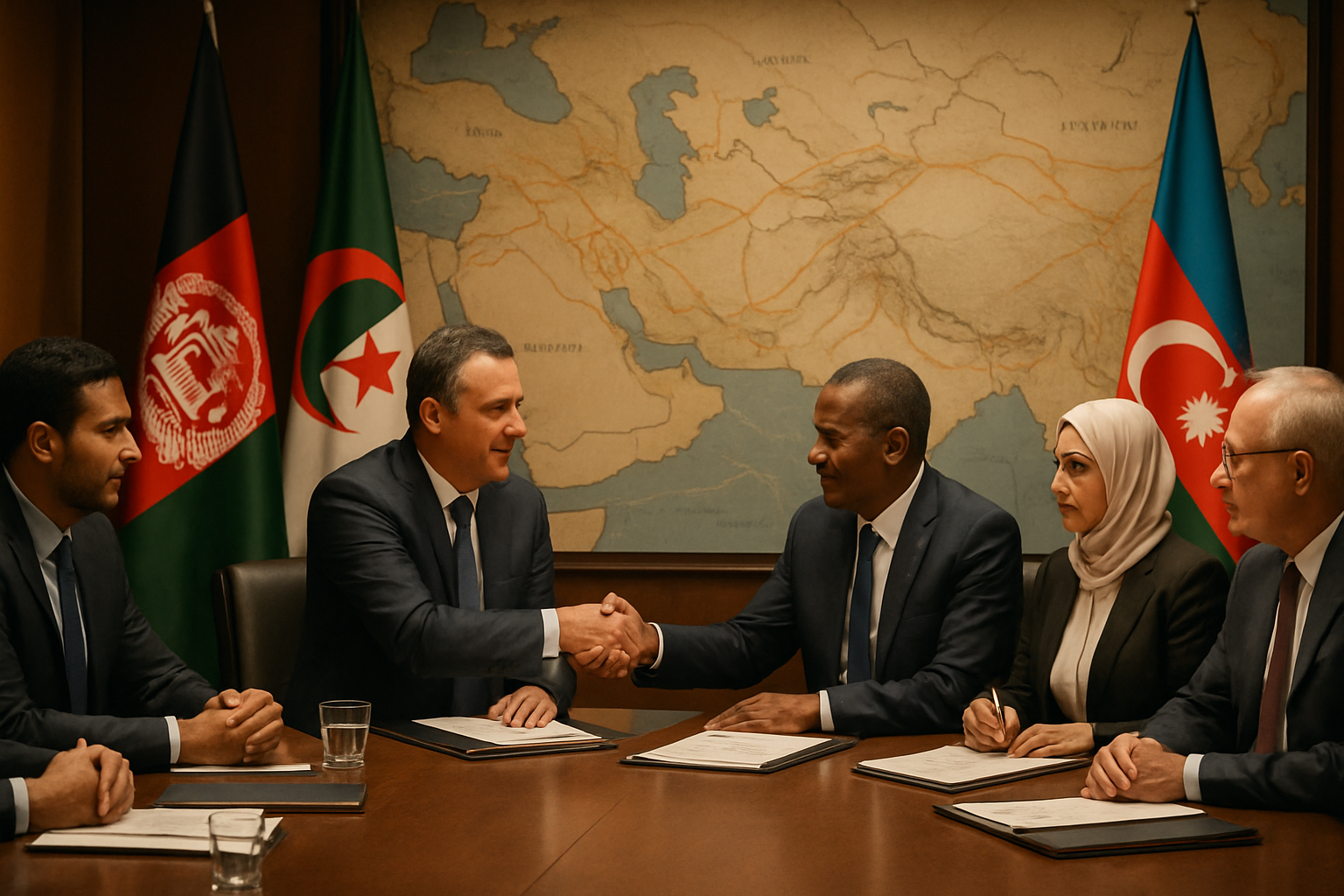
Regional economic partnerships are experiencing unprecedented momentum across multiple continents, as nations increasingly embrace bilateral cooperation frameworks over complex multilateral arrangements, with developments spanning from Central Asia to North Africa demonstrating a fundamental shift in global trade architecture.
Central Asian Trade Explosion
Afghanistan and Uzbekistan signed 20 commercial agreements worth more than $400 million during a high-level business meeting in Uzbekistan's Fergana Province, marking the latest expansion in what has become one of 2026's most dynamic regional partnerships. The deals span multiple sectors including textiles, raw materials, and pharmaceuticals, building upon February's foundation of 25 trade agreements worth $300 million.
The Afghan delegation, led by Zalgai Azimi, deputy for investment at the Afghan Chamber of Commerce, included senior business figures demonstrating the Taliban government's pragmatic approach to regional economic integration. This latest agreement brings total bilateral cooperation between the two nations to over $814 million from multiple 2026 frameworks alone.
"These agreements represent more than just commercial transactions—they demonstrate how economic cooperation can transcend political complexities."
— Regional Trade Expert
North African Cooperation Renaissance
Simultaneously, Algeria and Mauritania launched the 20th session of their Grand Joint Committee for Cooperation, co-chaired by Prime Ministers Nadir Larbaoui and Moctar Ould Ajay. This institutional framework, representing two decades of sustained diplomatic engagement, exemplifies how formal cooperation mechanisms can provide continuity beyond individual political cycles.
The meeting preceded extensive bilateral consultations between the two Prime Ministers at Algeria's government headquarters, highlighting the sophisticated diplomatic infrastructure that supports modern regional partnerships. Such institutional mechanisms have proven crucial in maintaining momentum across electoral changes and regional challenges.
Financial Integration Advances
In the South Caucasus, the Central Bank of Azerbaijan hosted a delegation from the National Bank of Georgia for a working visit focused on expertise exchange and institutional cooperation strengthening. This financial sector collaboration represents a critical component of regional integration, as central bank coordination enables more seamless trade relationships and monetary cooperation.
These financial partnerships are increasingly recognized as fundamental infrastructure for sustainable regional trade, providing the institutional framework necessary for larger economic integration projects.
Infrastructure as Regional Integration Catalyst
The success of current partnerships builds upon massive infrastructure investments that have created the physical foundation for enhanced regional trade. The Uzbekistan-Afghanistan-Pakistan railway project enables Central Asian access to Pakistani ports via the Gwadar/CPEC framework, positioning Afghanistan as a transit hub connecting Central Asia to global markets.
Afghanistan-Iran rail freight has increased 17-fold in the 1404 solar year, handling 650,000 tons of goods and 150,000 tons of transit cargo. This dramatic expansion demonstrates how infrastructure investment can rapidly transform trade relationships and regional economic dynamics.
Beyond Traditional Multilateralism
The current surge in bilateral partnerships reflects a broader trend toward more flexible, targeted cooperation arrangements. The Afghanistan-Central Asia Consultative Dialogue, launched in April 2026, set an ambitious $10 billion trade target within 3-4 years, up from current $2.7 billion levels, demonstrating how nations are creating new institutional frameworks tailored to their specific needs.
This approach contrasts with traditional multilateral frameworks that often require complex consensus-building among diverse stakeholders. Bilateral partnerships allow for more rapid implementation of targeted cooperation addressing specific national priorities with greater flexibility than traditional institutional arrangements.
Challenges and Implementation
Despite the momentum, significant challenges remain. Afghanistan faces humanitarian pressures with 88% of female-headed households unable to meet minimum requirements, while international sanctions complicate banking and financial transactions. Pakistan-Afghanistan border tensions periodically affect regional stability, demonstrating how political tensions can impact economic cooperation.
However, the sustained momentum behind regional economic integration demonstrates a pragmatic approach that emphasizes economic benefits while working around political complexities. Regular consultation mechanisms, working groups, and investment committees provide continuity beyond individual meetings or political changes.
Global Template Setting
These developments represent potential templates for 21st-century economic cooperation, offering alternatives to traditional North-South aid dependencies through South-South cooperation frameworks. The success of direct nation-to-nation agreements demonstrates pragmatic alternatives to institutional constraints, potentially influencing international approaches to trade facilitation and regional integration.
Modern partnerships emphasize technology transfer and institutional capability building rather than simple commodity exchanges. The integration of traditional knowledge with contemporary technology, transparent governance frameworks, and sustained political commitment across electoral cycles emerges as critical success factors.
Strategic Implications
The convergence of infrastructure development, institutional cooperation mechanisms, and flexible partnership frameworks suggests that regional economic integration is entering a new phase characterized by greater sophistication and pragmatism. Countries are developing bilateral partnerships that serve immediate economic needs while building strategic relationships for long-term cooperation.
Success depends on translating political agreements into practical cooperation that delivers tangible benefits to businesses and communities. The emphasis on regular consultations, technical working groups, and monitoring frameworks provides institutional memory and continuity essential for sustainable partnerships.
As global supply chains face continued pressures from geopolitical tensions and climate challenges, regional partnerships offer diversification alternatives while strengthening cooperation frameworks that can adapt to changing circumstances. The current wave of regional economic partnerships may prove decisive in reshaping international trade architecture for decades to come.