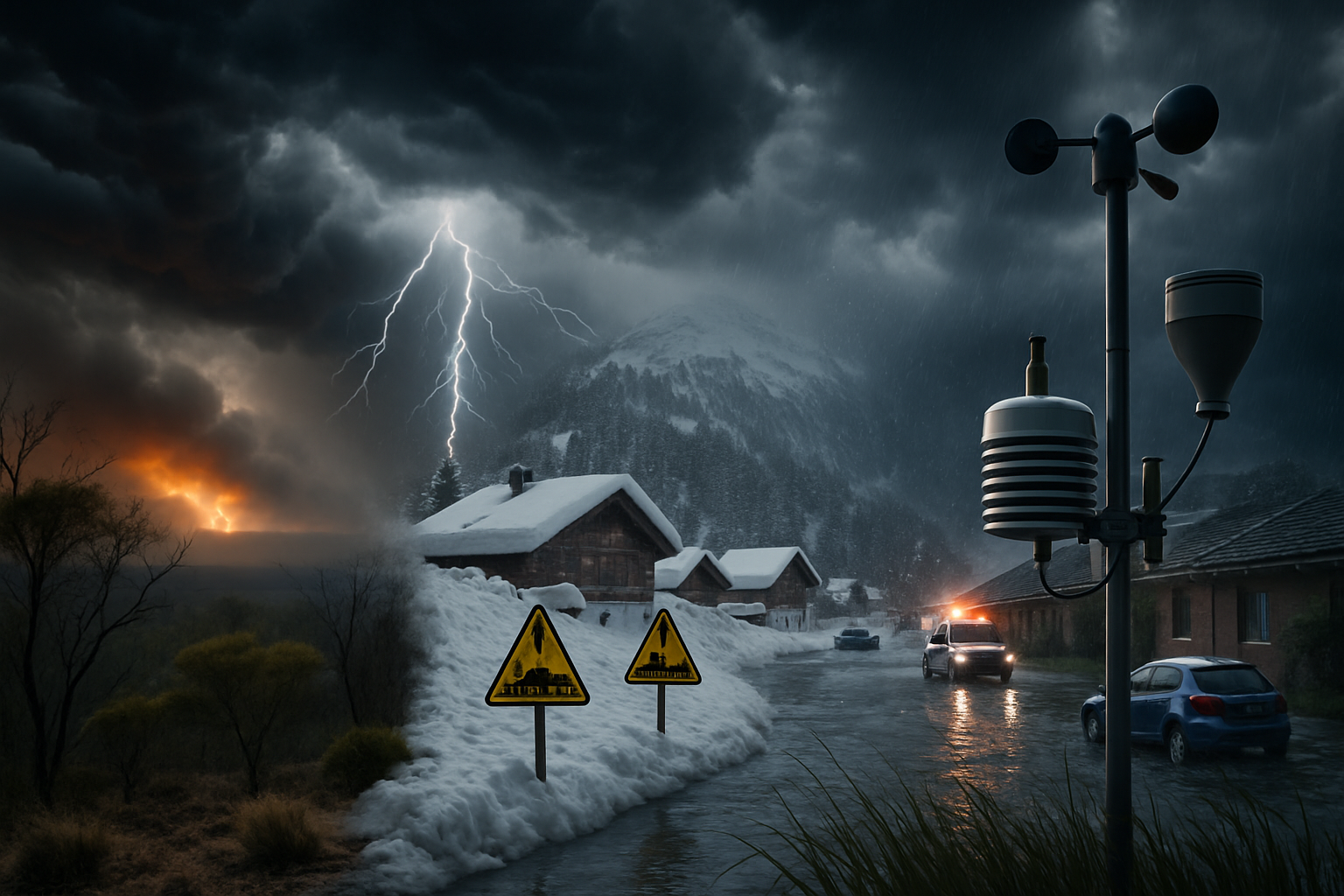
Emergency services across four continents are grappling with simultaneous extreme weather events as Australia faces heightened bushfire risks despite approaching winter, while Northern Europe endures severe winter conditions and flooding threatens multiple regions worldwide.
The latest crisis unfolds as the Australasian Fire and Emergency Services Council (AFAC) issued stark warnings about increased bushfire risks across vast areas of Australia, even as the country approaches its winter months. Large portions of Victoria, New South Wales, South Australia, and Western Australia face an "increased number of significant bushfires" compared to typical autumn conditions.
Australia Battles Unprecedented Autumn Fire Risk
The peak fire authority has identified bone-dry vegetation across Victoria as driving unprecedented bushfire risks in the lead-up to winter. Almost all of Victoria, along with regions in southern, central and eastern NSW, the south-eastern corner of South Australia, and parts of southern Western Australia, face elevated fire danger.
The parched conditions result from vegetation buildup over the past two years, creating a tinderbox effect that experts warn could trigger catastrophic fires despite the approaching cooler season. This represents a significant departure from typical seasonal fire patterns, where autumn traditionally marks a reduction in fire risks.
Emergency services have positioned additional resources across affected regions as the National Bushfire Outlook identifies these areas as facing heightened danger throughout the autumn period. The warnings come as Australia grapples with the long-term impacts of climate change on traditional seasonal fire cycles.
European Winter Crisis Intensifies
Simultaneously, Northern Europe continues to face one of its harshest winters in decades, with multiple countries reporting severe weather conditions that have overwhelmed emergency services. Finland's meteorological services have warned of dangerous driving conditions across wide areas, with Fintraffic and the Finnish Meteorological Institute issuing comprehensive warnings about hazardous road conditions.
The Finnish alerts come as the country faces significant snowfall accumulations of up to 15 centimeters, creating treacherous conditions for transportation networks already strained by weeks of extreme weather. The warnings span extensive regions, affecting both urban and rural areas as authorities struggle to maintain safe travel conditions.
Austria faces equally challenging conditions as polar vortex disruptions continue to drive extreme winter weather across Central Europe. The warnings represent part of a broader pattern of climate volatility that has characterized the 2026 winter season, with weather systems exceeding historical parameters.
Historical Context of Climate Volatility
These simultaneous weather emergencies occur against the backdrop of January 2026 being confirmed as the 18th consecutive month of global temperatures exceeding 1.5°C above pre-industrial levels. This unprecedented warming trend demonstrates how human-induced climate change is overriding natural cooling cycles, enabling extreme weather events to occur simultaneously across different hemispheres and seasons.
The current crisis builds upon months of devastating weather disasters that have overwhelmed emergency services worldwide. Earlier in February 2026, a succession of Atlantic storms - Kristin, Leonardo, Marta, Nils, and Pedro - claimed over 30 lives across Portugal, Spain, and France, requiring the deployment of 26,500 emergency personnel in what became Portugal's largest peacetime rescue operation.
"The scale and simultaneity of these extreme weather events represents a fundamental shift in global climate patterns that requires immediate adaptation of our emergency response systems."
— Climate Emergency Specialist, European Scientific Advisory Council
Infrastructure vulnerabilities have been exposed across multiple continents, with transportation networks, power grids, and communication systems operating beyond their historical design parameters. Emergency services report reaching capacity limits globally, while traditional mutual aid mechanisms become strained when multiple countries face simultaneous disasters.
Economic and Social Impacts
The economic consequences of these simultaneous weather emergencies are mounting rapidly across affected regions. Agricultural sectors face billions in losses from damaged crops and disrupted supply chains, while tourism industries grapple with cancellations and infrastructure damage during typically peak seasons.
In Australia, the bushfire risks threaten agricultural areas during critical growing periods, while European winter storms have paralyzed transportation networks and forced widespread business closures. The cascade effects ripple through global supply chains, affecting industries far beyond the immediate impact zones.
Recovery timelines have shifted from traditional weeks to months or years in many affected areas, representing a fundamental change in how societies must prepare for and respond to extreme weather events. The concept of "building back better" with climate-resilient infrastructure has become essential rather than optional.
Infrastructure Under Unprecedented Stress
Modern infrastructure systems, designed for historical climate patterns, are proving inadequate for current conditions. Power grids across Europe have experienced widespread failures from heavy snow and ice damage to transmission lines, while transportation networks struggle with conditions that exceed engineering specifications.
Communication networks face repeated disruptions, complicating emergency coordination efforts when clear information flows become critical. The interconnected nature of modern infrastructure means that failures in one system often cascade to others, amplifying the impacts of extreme weather events.
Emergency services emphasize that current response strategies, based on historical weather patterns and traditional mutual aid assumptions, must be fundamentally restructured for an era of permanent climate volatility. Enhanced emergency response capabilities, climate-resilient infrastructure, and new international cooperation frameworks are urgently needed.
International Cooperation and Response
The simultaneous nature of these weather emergencies has tested international cooperation frameworks to their limits. The European Union's Civil Protection Mechanism has been activated, with Sweden and Denmark providing a €246 million assistance package representing the largest coordinated European weather response on record.
However, the traditional model of regional mutual aid faces challenges when multiple countries experience emergencies simultaneously. This has forced a reconsideration of how international disaster response systems should be structured for an era where extreme weather events can affect vast geographic areas concurrently.
Scientists emphasize that current conditions provide a preview of routine circumstances expected in the 2030s without significant climate adaptation investment. The choice between reactive crisis management and transformative infrastructure adaptation approaches becomes increasingly urgent as extreme weather frequency and intensity continue to escalate.
Looking Forward: Adaptation Imperatives
The February 2026 weather crisis represents a potential watershed moment for global climate preparedness. Additional weather systems are developing across multiple regions, suggesting that current emergency conditions may persist for weeks, establishing what experts describe as a "new normal" of extreme weather frequency.
Climate adaptation strategies must shift from treating extreme weather as exceptional events to designing systems for permanent volatility. This requires unprecedented international coordination, enhanced infrastructure resilience, and comprehensive emergency response evolution capable of managing simultaneous global disasters.
The window for effective climate action continues to narrow while the costs of both adaptation and inaction escalate rapidly. The current crisis demonstrates that climate change is not a future threat but a present reality requiring immediate, transformative responses across all sectors of society.
As communities worldwide face these escalating challenges, the emphasis on building climate resilience, maintaining essential services during extreme weather, and protecting vulnerable populations becomes increasingly critical. The lessons learned from these simultaneous weather emergencies will prove essential for navigating the climate volatility that characterizes our rapidly changing planet.