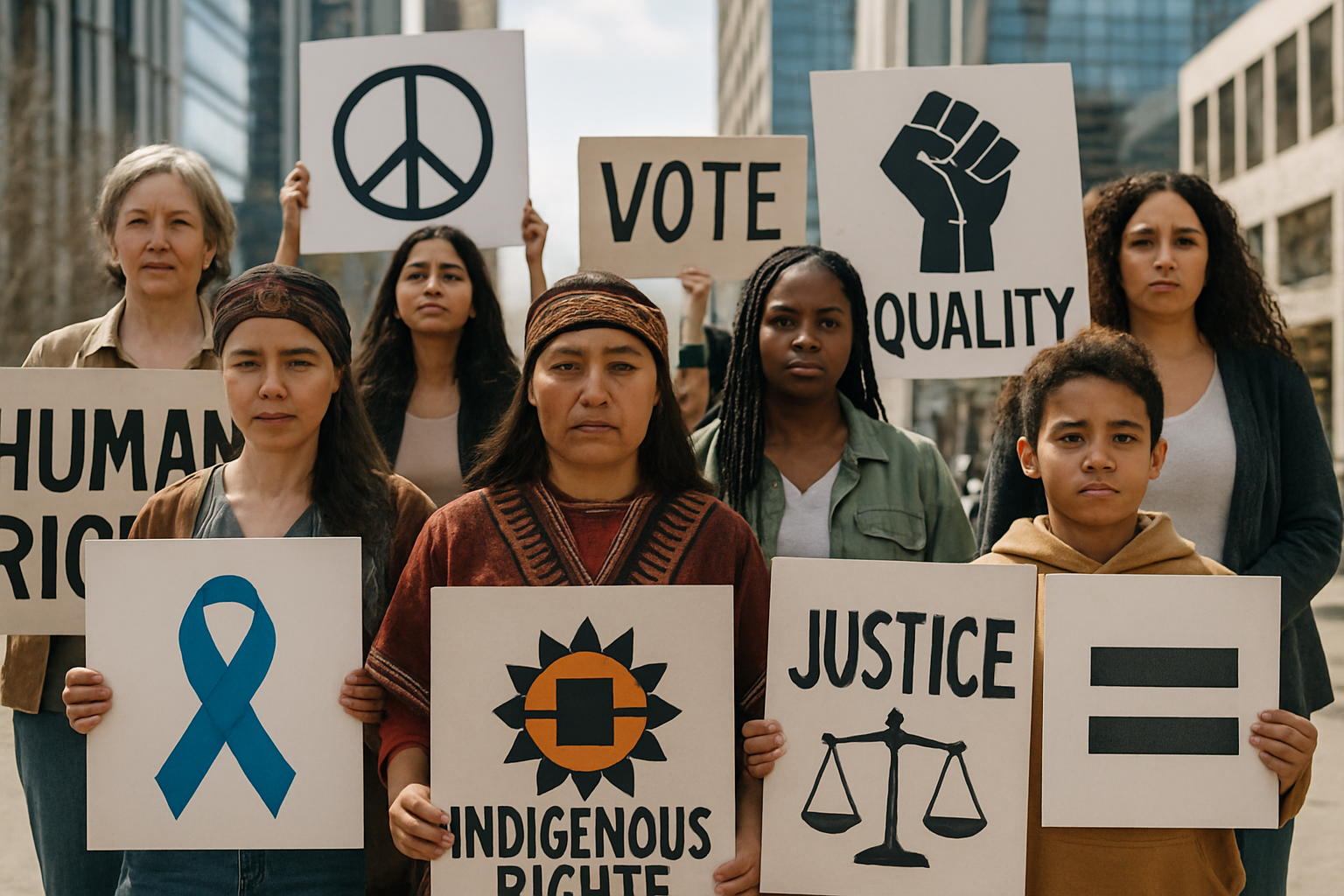
From the war-torn streets of Gaza where children with autism struggle to find safety, to the Pacific islands where indigenous women face exploitation, April 2026 has witnessed a complex tapestry of human rights challenges and advocacy efforts spanning multiple continents and diverse communities.
The convergence of World Autism Awareness Day observations with ongoing humanitarian crises, combined with emerging research on indigenous rights and troubling educational safety failures, paints a sobering picture of the persistent struggle for human dignity and basic rights worldwide.
Autism Awareness Under Fire: Gaza's Silent Crisis
As the world marked World Autism Awareness Day on April 2nd, the Palestinian Media Center revealed a devastating reality facing hundreds of autistic children in Gaza. The ongoing conflict has transformed autism from a manageable condition requiring specialized care into what advocates describe as "doubled suffering" in an environment where bombing never stops and homes collapse regularly.
In Gaza's besieged territory, children with autism experience a harsh reality that far exceeds their capacity to understand or adapt. The constant noise of warfare, the destruction of familiar environments, and the forced displacement of families create an environment fundamentally incompatible with the stability and routine that autistic children desperately need.
"Here, where the bombing doesn't stop and homes collapse, hundreds of children with autism live a harsh reality that exceeds their ability to understand or adapt."
— Palestinian Media Center Report
The contrast between Gaza's crisis and global autism awareness efforts elsewhere is stark. While Saint Lucia joined the international community in "lighting it up blue" for Autism Awareness Month 2026, working with the Helen Association to promote understanding and inclusion, Gaza's children face an environment where even basic therapeutic support has become impossible.
Indigenous Rights and Cultural Exploitation
Far from the conflict zones of the Middle East, new academic research has exposed another form of human rights crisis affecting Tongan women involved in traditional kava practices. Dr. Hilda Port's doctoral research, titled "How Do Evolving Kava-Related Practices Impact the Role of Women," has brought renewed attention to the experiences of Tongan women tou'a who face abuse, sexual objectification, and social disrepute as cultural traditions become commercialized.
The study reveals how cultural shifts and commercialization have placed women participating in kava-related practices at increased risk. Traditional roles that once held cultural significance have become vulnerable to exploitation as commercial interests intersect with cultural practices, creating new forms of gender-based discrimination within indigenous communities.
This research highlights a broader pattern affecting indigenous communities worldwide, where traditional practices become commodified in ways that particularly harm women and girls. The intersection of cultural preservation and women's rights presents complex challenges that require nuanced approaches respecting both cultural autonomy and human dignity.
Educational Safety Crises and Child Protection Failures
The period has also witnessed alarming failures in child protection across educational institutions in New Zealand. Three separate incidents have raised serious questions about safeguarding protocols and institutional accountability.
The conviction of former executive Greg Hornblow for receiving commercial sexual services from a 14-year-old in 2025 represents one case, while revelations about a teacher making highly inappropriate and sexualized comments to students has highlighted systemic problems in professional conduct oversight.
Perhaps most troubling was the incident in Auckland where a young child was inadvertently locked alone in an early childhood center van for 80 minutes, left screaming after teachers forgot to check all seats. This incident alone demonstrates how basic safety protocols can fail with devastating consequences for vulnerable children.
"The teacher told a student 'you only scream like that when you're being raped' after the girl was startled by a classmate and accidentally hit her finger with a hammer."
— New Zealand Teaching Council Censure Report
These incidents reflect broader challenges facing child protection systems worldwide, where institutional failures intersect with individual misconduct to create environments where vulnerable children face unnecessary risks.
Global Context: Technology and Human Rights
These localized crises occur against a backdrop of global challenges affecting human rights and social justice initiatives. The ongoing digital privacy crisis, with major platform accountability issues and AI-generated content threats, has particular implications for vulnerable populations including children with disabilities and indigenous communities.
Memory research reveals how social justice advocacy has evolved significantly since March 2026, with coordinated approaches combining institutional engagement, prevention-first strategies, and international cooperation. However, persistent challenges remain in addressing systematic discrimination and protecting vulnerable populations from both traditional and emerging forms of exploitation.
Prevention-First Approaches and International Cooperation
Despite these challenges, there are encouraging developments in advocacy strategies worldwide. The evolution from crisis response to prevention-first approaches has shown promise in multiple contexts. Countries implementing comprehensive prevention programs report superior outcomes through reduced crisis interventions while achieving better community resilience.
The success of Malta's "Women's Day Every Day" approach, emphasizing sustained attention rather than annual symbolic recognition, provides a template for how advocacy can evolve beyond episodic responses to systematic change.
International cooperation has also adapted to contemporary challenges, with bilateral partnerships and peer-to-peer knowledge sharing networks supplementing traditional multilateral frameworks. This distributed cooperation model allows for culturally responsive approaches while maintaining universal human rights commitments.
Economic Dimensions of Human Rights
Research consistently demonstrates that comprehensive human rights protections generate economic returns through reduced healthcare costs, enhanced community stability, and decreased social service demands. Countries investing in human rights infrastructure show stronger economic growth, increased innovation capacity, and more resilient communities.
The economic arguments provide additional leverage beyond moral justifications for human rights work. Business community engagement increasingly recognizes that discrimination reduces productivity, limits innovation, and undermines social stability essential for economic development.
Looking Forward: Institutional Engagement and Systematic Change
The diverse challenges highlighted in April 2026 demonstrate that lasting social change requires sustained commitment working within existing governmental frameworks while maintaining pressure for systematic reform. Understanding that institutional change requires sustained policy implementation and adequate resources, rather than confrontational approaches alone.
Success requires coordinated approaches addressing multiple challenges simultaneously: ensuring safety for vulnerable populations like autistic children in conflict zones, protecting indigenous women from exploitation, maintaining robust child protection systems, and adapting to emerging technological threats to human dignity.
The template emerging from these varied struggles emphasizes the importance of combining governmental recognition with grassroots activism, economic empowerment initiatives, and cultural transformation efforts. Most significantly, it highlights the need for sustained daily commitment to human rights rather than periodic symbolic gestures.
Conclusion
The human rights landscape of April 2026 reveals both remarkable resilience in the face of systematic challenges and urgent needs for coordinated international action. From Gaza's autism crisis to Tongan women's rights, from New Zealand's educational failures to global digital privacy concerns, the month has demonstrated how human rights challenges intersect across geographic and cultural boundaries.
The path forward requires sustained political commitment, adequate resources, comprehensive stakeholder engagement, and international cooperation that respects cultural contexts while advancing universal rights principles. As advocates worldwide have learned, true progress demands transforming annual observances into sustained institutional change, creating genuinely equitable societies through daily commitment to human dignity and social justice.
The stakes extend beyond immediate crises to fundamental questions about how societies organize around human flourishing versus crisis management, determining whether coming decades will witness systematic advancement of human rights or continued regression in the face of complex global challenges.