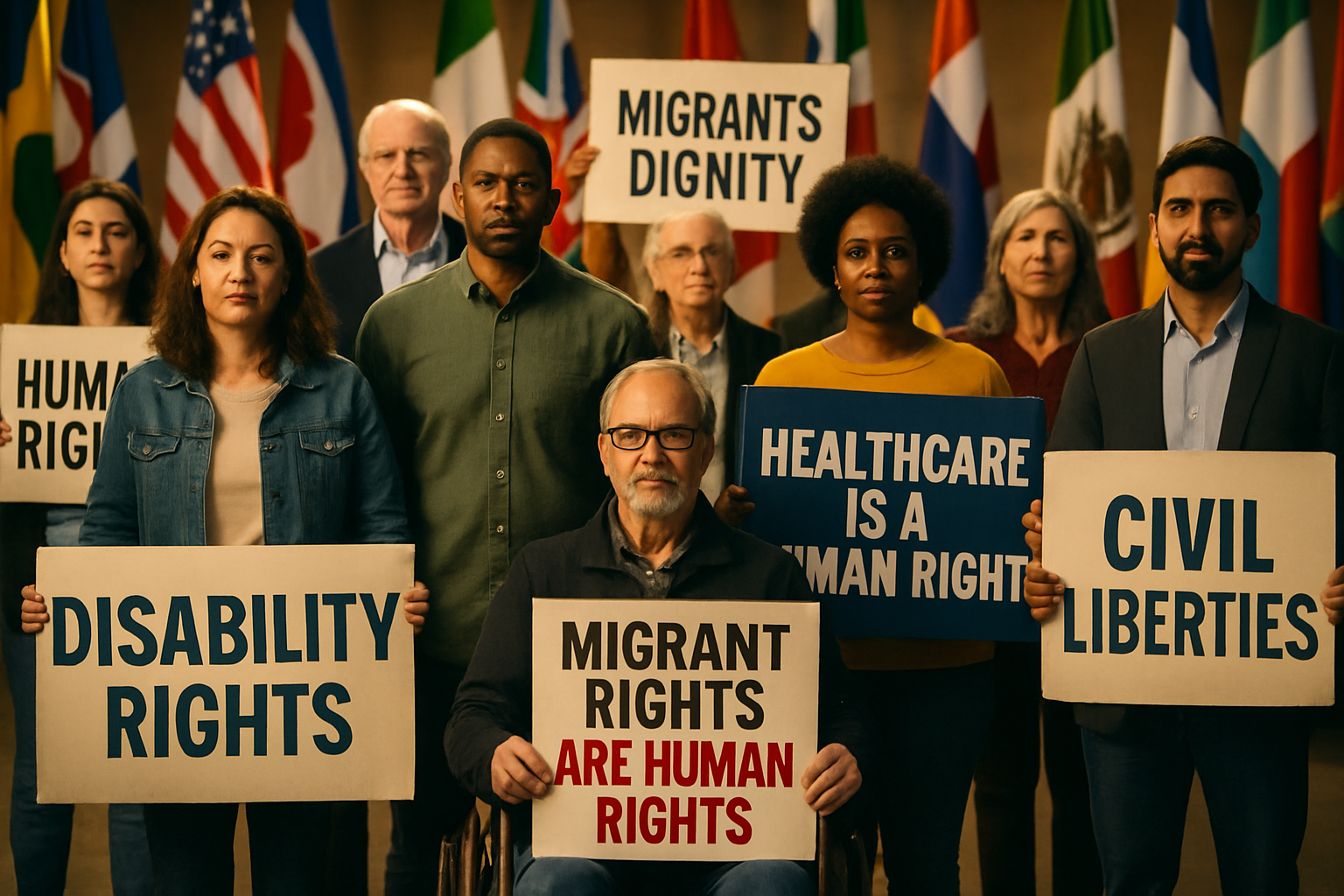
Social justice movements worldwide are confronting their most complex challenges in decades, as new data reveals deepening healthcare inequality, migration crises, and civil rights setbacks alongside unprecedented community organizing and policy advances across seven nations.
From Australia's revelations that vulnerable citizens must choose between food and medicine to Papua New Guinea's groundbreaking disability inclusion workshops, the global landscape of social justice activism in April 2026 demonstrates both the persistent urgency of human rights advocacy and the evolving sophistication of grassroots organizing strategies.
Healthcare Access as a Human Right Under Threat
Australia's healthcare crisis has emerged as a stark symbol of systemic inequality affecting vulnerable populations. A comprehensive survey has exposed the financial barriers faced by Australians prescribed medicines not covered by the Pharmaceutical Benefits Scheme (PBS), forcing many into impossible choices between essential medication and basic needs like food.
The findings reveal a healthcare system that, despite its universal coverage reputation, leaves significant gaps in care accessibility for the most vulnerable citizens. This mirrors patterns documented in Planet News investigations throughout 2026, where healthcare access has become a defining social justice issue globally.
The Australian crisis occurs within the broader context of the "Therapeutic Revolution of 2026," a global shift toward prevention-first healthcare strategies. However, the revolution's benefits remain unevenly distributed, creating new forms of medical inequality that social justice advocates are increasingly organizing to address.
Civil Society Resistance in Democratic Republic of Congo
In Kinshasa, civil society organizations are demonstrating remarkable resilience and strategic sophistication in their opposition to controversial government migration policies. The Société civile Forces vives de la RDC has taken a firm stance against proposed plans to accept migrants expelled from the United States, representing a significant assertion of civil society autonomy in policy discussions.
"Civil society's opposition reflects deeper concerns about national sovereignty and resource allocation during a period of significant domestic challenges."
— Civil Rights Analysis
This opposition movement highlights the evolution of civil society engagement in the Democratic Republic of Congo, where community organizations are increasingly asserting their role in national policy discussions that affect vulnerable populations. The stance demonstrates how local civil society groups are connecting international migration policies with domestic social justice concerns.
Racial Division and Political Accountability in Guyana
Guyana's ongoing struggles with racial division have taken center stage in recent political discourse, with critics arguing that established political parties continue to deploy divisive strategies that undermine social cohesion. The debate around what some describe as an "expired playbook of racial division" reflects broader global concerns about how political institutions either advance or hinder social justice progress.
The Guyanese situation exemplifies the complex relationship between electoral politics and social justice advocacy, where community organizers must navigate political systems that may actively work against inclusive policies and social harmony.
Breakthrough Disability Rights Initiatives in Papua New Guinea
Papua New Guinea is implementing groundbreaking disability inclusion initiatives that are being studied internationally as models for community-centered advocacy. The Organizations of Persons with Disabilities (OPD) recently conducted innovative workshops in Kiunga that brought together community partners to address inclusion challenges systematically.
These workshops represent a shift from charity-based approaches to rights-based disability advocacy, emphasizing community partnership and sustained institutional change. The initiatives demonstrate how effective social justice organizing requires authentic community engagement and collaborative problem-solving approaches.
The Papua New Guinea model has attracted attention from international disability rights organizations seeking to understand how grassroots organizing can achieve meaningful policy changes in resource-constrained environments.
Romanian Universities Pioneer Gender Equity Measures
Romanian educational institutions are implementing pioneering approaches to gender equity and safety in educational environments. Recent initiatives at universities in southern Romania have focused on creating inclusive spaces for women and non-binary students, addressing long-standing concerns about safety and accessibility in higher education.
These developments reflect a broader European trend toward comprehensive approaches to gender equality in educational institutions, moving beyond symbolic gestures to implement practical measures that address real-world barriers faced by marginalized students.
UK Confronts Historical Injustice and Current Threats
The United Kingdom faces a critical examination of its approach to preventing violence and protecting vulnerable populations, particularly in the aftermath of the Southport attack. Lawyers representing victims have issued stark warnings that governmental institutions are "failing to learn the lessons" from the tragic July 2024 incident that claimed eight lives.
The criticism centers on systemic failures in intervention programs, including the controversial Prevent counter-terrorism initiative, which victims' representatives argue continues to allow "violence-obsessed teenagers" to remain "catastrophic" threats to public safety.
"Ministers are failing to learn the lessons from the Southport attack and allowing violence-obsessed teenagers to remain a catastrophic threat to society."
— Victims' Legal Representatives
An upcoming official inquiry report by Sir Adrian Fulford is expected to deliver severe criticism of multiple agencies, highlighting the intersection between historical injustices and contemporary threats to community safety.
International Context and Global Patterns
These national developments occur within a broader global context of social justice activism that has evolved significantly throughout 2026. Previous Planet News investigations have documented how advocacy strategies have shifted from reactive protest to proactive policy engagement, emphasizing sustained institutional change over episodic mobilization.
The "daily commitment" model, adapted from International Women's Day organizing, has influenced social justice movements worldwide to focus on sustained policy implementation rather than symbolic recognition. This approach has proven particularly effective in addressing complex, interconnected challenges that require long-term institutional reform.
Technological Integration and Community Organizing
Social justice movements are increasingly sophisticated in their use of technology for organizing while maintaining focus on authentic human connections. The balance between digital organizing tools and community-centered approaches has become a defining characteristic of contemporary advocacy.
Organizations worldwide report that technology enhances rather than replaces face-to-face organizing, enabling broader participation while preserving the personal relationships essential for sustained social change.
Economic Dimensions of Social Justice
The economic implications of social justice policies have become increasingly central to advocacy strategies. Research consistently demonstrates that comprehensive human rights protections generate economic returns through reduced healthcare costs, enhanced community stability, and decreased social service demands.
Countries implementing strong social justice frameworks report improved economic outcomes, providing advocates with evidence-based arguments that complement moral justifications for policy reforms.
Prevention-First Approaches to Social Justice
The global shift toward prevention-first strategies, documented throughout 2026's "Therapeutic Revolution," has influenced social justice organizing beyond healthcare. Advocates increasingly emphasize early intervention and systemic reform over crisis response, requiring new approaches to community organizing and policy engagement.
This prevention-first model has proven particularly effective in addressing issues like healthcare access, disability rights, and community safety, where proactive approaches yield superior outcomes compared to reactive interventions.
International Cooperation and Knowledge Sharing
Despite challenges facing traditional multilateral institutions, social justice movements have developed innovative cooperation models through bilateral partnerships and peer-to-peer networks. These distributed cooperation frameworks allow culturally responsive approaches while maintaining evidence-based standards for advocacy effectiveness.
The Papua New Guinea disability rights model, for instance, incorporates international best practices while remaining deeply rooted in local community structures and cultural contexts.
Looking Forward: Critical Juncture for Social Justice
April 2026 represents a critical juncture for global social justice movements, as the convergence of healthcare crises, migration pressures, and political backlash tests the resilience and adaptability of advocacy organizations worldwide.
Success in this environment requires movements that can maintain long-term vision while responding to immediate crises, balance technological tools with authentic community relationships, and coordinate internationally while respecting local autonomy and cultural contexts.
The developments across Australia, Congo, Guyana, Papua New Guinea, Romania, and the United Kingdom demonstrate both the persistent challenges facing social justice advocates and the remarkable innovation and resilience of contemporary organizing strategies.
Implementation Requirements
Effective social justice advocacy in 2026 requires sustained political commitment beyond electoral cycles, comprehensive stakeholder engagement, authentic community leadership, and respect for cultural diversity while maintaining universal human rights principles.
The most successful initiatives combine evidence-based policy advocacy with grassroots organizing, international cooperation with local relevance, and technological innovation with human-centered values.
As social justice movements continue to evolve, their ability to address interconnected challenges while maintaining focus on human dignity and community empowerment will determine their effectiveness in creating lasting positive change for vulnerable populations worldwide.